

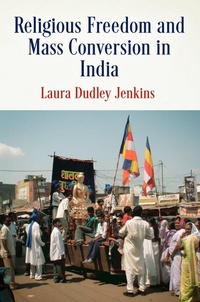
Religious Freedom and Mass Conversion in India
Published on 31. May 2019
Book
Hardback
320 pages
978-0-8122-5092-3 (ISBN)
Description
Hinduism is the largest religion in India, encompassing roughly 80 percent of the population, while 14 percent of the population practices Islam and the remaining 6 percent adheres to other religions. The right to "freely profess, practice, and propagate religion" in India's constitution is one of the most comprehensive articulations of the right to religious freedom. Yet from the late colonial era to the present, mass conversions to minority religions have inflamed majority-minority relations in India and complicated the exercise of this right.
In Religious Freedom and Mass Conversion in India, Laura Dudley Jenkins examines three mass conversion movements in India: among Christians in the 1930s, Dalit Buddhists in the 1950s, and Mizo Jews in the 2000s. Critics of these movements claimed mass converts were victims of overzealous proselytizers promising material benefits, but defenders insisted the converts were individuals choosing to convert for spiritual reasons. Jenkins traces the origins of these opposing arguments to the 1930s and 1940s, when emerging human rights frameworks and early social scientific studies of religion posited an ideal convert: an individual making a purely spiritual choice. However, she observes that India's mass conversions did not adhere to this model and therefore sparked scrutiny of mass converts' individual agency and spiritual sincerity.
Jenkins demonstrates that the preoccupation with converts' agency and sincerity has resulted in significant challenges to religious freedom. One is the proliferation of legislation limiting induced conversions. Another is the restriction of affirmative action rights of low caste people who choose to practice Islam or Christianity. Last, incendiary rumors are intentionally spread of women being converted to Islam via seduction. Religious Freedom and Mass Conversion in India illuminates the ways in which these tactics immobilize potential converts, reinforce damaging assumptions about women, lower castes, and religious minorities, and continue to restrict religious freedom in India today.
In Religious Freedom and Mass Conversion in India, Laura Dudley Jenkins examines three mass conversion movements in India: among Christians in the 1930s, Dalit Buddhists in the 1950s, and Mizo Jews in the 2000s. Critics of these movements claimed mass converts were victims of overzealous proselytizers promising material benefits, but defenders insisted the converts were individuals choosing to convert for spiritual reasons. Jenkins traces the origins of these opposing arguments to the 1930s and 1940s, when emerging human rights frameworks and early social scientific studies of religion posited an ideal convert: an individual making a purely spiritual choice. However, she observes that India's mass conversions did not adhere to this model and therefore sparked scrutiny of mass converts' individual agency and spiritual sincerity.
Jenkins demonstrates that the preoccupation with converts' agency and sincerity has resulted in significant challenges to religious freedom. One is the proliferation of legislation limiting induced conversions. Another is the restriction of affirmative action rights of low caste people who choose to practice Islam or Christianity. Last, incendiary rumors are intentionally spread of women being converted to Islam via seduction. Religious Freedom and Mass Conversion in India illuminates the ways in which these tactics immobilize potential converts, reinforce damaging assumptions about women, lower castes, and religious minorities, and continue to restrict religious freedom in India today.
Reviews / Votes
"The book is analytically insightful and methodologically innovative and provides a vital contribution to understanding the relationship between religion, the state, and citizenship rights in India." (Asian Ethnology) "The primary argument of Religious Freedom and Mass Conversion in India is absolutely clear: The prototypical and normative convert constructed in international human rights discourse from the 1930s onward-one characterized primarily by agency and sincerity-is inadequate both theoretically and politically . . . Jenkins approaches the topic innovatively, intentionally juxtaposing to the normative narrative of the ideal agential and sincere convert counternarratives that call this normative narrative into question." (Journal of Church and State) "Religious Freedom and Mass Conversion in India is unparalleled in its reach. It explores mass conversion over time-from the late colonial period to the modern era; across communities-among the lower castes, Hindus, Buddhists, Jews, and women; and in several different regions of India. It is a much needed contribution to scholarship on India and to comparative studies of religion, politics, and constitutional law." (Amrita Basu, Amherst College)More details
Series
Language
English
Place of publication
Pennsylvania
United States
Target group
College/higher education
Product notice
Paper over boards
Illustrations
1 illus.
Dimensions
Height: 231 mm
Width: 155 mm
Thickness: 33 mm
Weight
567 gr
ISBN-13
978-0-8122-5092-3 (9780812250923)
Copyright in bibliographic data and cover images is held by Nielsen Book Services Limited or by the publishers or by their respective licensors: all rights reserved.
Schweitzer Classification
Other editions
Additional editions
Laura Dudley Jenkins
Religious Freedom and Mass Conversion in India
E-Book
04/2019
1st Edition
University of Pennsylvania Press
€92.99
Available for download
Person
Laura Dudley Jenkins is Professor of Political Science and a faculty affiliate of the Women's, Gender, and Sexuality Studies Department and Asian Studies Program at the University of Cincinnati.
Content
Introduction: Religious Freedom and the Right to Convert
PART I. MOBILITY
Chapter 1. Mass Movement Christians: Religious and Social Mobility
Chapter 2. Ambedkarite Buddhists: Religious and Political Mobility
Chapter 3. Mizo Jews: Religious and Spatial Mobility
PART II. IMMOBILITY
Chapter 4. Prosecution: Anticonversion Legislation
Chapter 5. Prevention: Losing Affirmative Action
Chapter 6. Persecution: The Love Jihad Rumor
Conclusion. A More Equal Freedom
Notes
Bibliography
Index
Acknowledgments
PART I. MOBILITY
Chapter 1. Mass Movement Christians: Religious and Social Mobility
Chapter 2. Ambedkarite Buddhists: Religious and Political Mobility
Chapter 3. Mizo Jews: Religious and Spatial Mobility
PART II. IMMOBILITY
Chapter 4. Prosecution: Anticonversion Legislation
Chapter 5. Prevention: Losing Affirmative Action
Chapter 6. Persecution: The Love Jihad Rumor
Conclusion. A More Equal Freedom
Notes
Bibliography
Index
Acknowledgments