

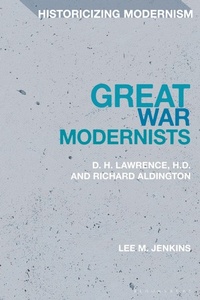
Great War Modernists
D.H. Lawrence, H.D. and Richard Aldington
Published on 19. February 2026
Book
Paperback/Softback
200 pages
978-1-350-28537-8 (ISBN)
Description
Taking 44 Mecklenburgh Square as the focal point and springboard for a critical group study of D.H. Lawrence, H.D. and Richard Aldington, this book offers a fresh perspective on the relationship of modernist biofiction and poetry to the literature of the First World War.
A group that Perdita Schaffner described as 'another Bloomsbury set', the Mecklenburgh Square writers, like the Bloomsbury Group proper, 'lived in squares' and 'loved in triangles', in Dorothy Parker's famous formulation. Geographically adjacent, these sets intersected socially and, at points, in their aesthetics: both practiced innovative forms of what may broadly be defined as 'life writing'. But, demarcating the Mecklenburgh Square writers from the Bloomsbury Set, the former had its origins in the transatlantic avant-garde: Lawrence. H.D., Aldington (and John Cournos) were all associated with Imagism, the poetic movement which instantiated Anglo-American modernism.
Considered as a pro-tem collective, these four poets, all of whom were also novelists and translators, contest the binaries that still obtain between modernist and First World War writing. This group study of Lawrence, H.D., Aldington and Cournos tracks the transition of Imagism from a pre-war mode to a war poetics which includes but is not confined to the trench lyric and it traces, in the transtextual relations between the Mecklenburgh Square novels, the traumatic imprint of the war on modernist life writing.
A group that Perdita Schaffner described as 'another Bloomsbury set', the Mecklenburgh Square writers, like the Bloomsbury Group proper, 'lived in squares' and 'loved in triangles', in Dorothy Parker's famous formulation. Geographically adjacent, these sets intersected socially and, at points, in their aesthetics: both practiced innovative forms of what may broadly be defined as 'life writing'. But, demarcating the Mecklenburgh Square writers from the Bloomsbury Set, the former had its origins in the transatlantic avant-garde: Lawrence. H.D., Aldington (and John Cournos) were all associated with Imagism, the poetic movement which instantiated Anglo-American modernism.
Considered as a pro-tem collective, these four poets, all of whom were also novelists and translators, contest the binaries that still obtain between modernist and First World War writing. This group study of Lawrence, H.D., Aldington and Cournos tracks the transition of Imagism from a pre-war mode to a war poetics which includes but is not confined to the trench lyric and it traces, in the transtextual relations between the Mecklenburgh Square novels, the traumatic imprint of the war on modernist life writing.
Reviews / Votes
Jenkins successfully 'squares the circle' (139) of the book's central argument, showing that Great War modernism, particularly in its autobiographical and intertextual dimensions, continues to shape literary discourse ... This book offers a valuable reassessment of Great War modernism from the doorsteps of 44 Mecklenburgh Square. * Journal of Wyndham Lewis Studies * The impact of the Great War on literary Modernism was catastrophic and enduring. This remarkable study of D.H. Lawrence, H.D. and Richard Aldington testifies, at the home-front as in the trenches, to lives and writing shaped indelibly by war-time contingencies * Chris Ackerley, Emeritus Professor of English and Linguistics, University of Otago, New Zealand * Great War Modernists unites the Mecklenburgh Square novels into a monolithic type of collective artistic activity, presents a new awareness of the Great War shaping modernist aesthetics and life writing, reframes the view of Imagism as a wartime poetic mode, elaborates on biofiction, and explores the interdisciplinary connections to avant-garde art, thereby helping to revisit the cultural memory of the war. * First World War Studies *More details
Series
Language
English
Place of publication
London
United Kingdom
Publishing group
Bloomsbury Publishing PLC
Target group
Professional and scholarly
Illustrations
4 bw illus
Dimensions
Height: 234 mm
Width: 156 mm
Thickness: 11 mm
Weight
307 gr
ISBN-13
978-1-350-28537-8 (9781350285378)
Copyright in bibliographic data and cover images is held by Nielsen Book Services Limited or by the publishers or by their respective licensors: all rights reserved.
Schweitzer Classification
Other editions
Additional editions
E-Book
07/2024
1st Edition
Bloomsbury Academic
€31.99
Available for download
E-Book
07/2024
1st Edition
Bloomsbury Academic
€31.99
Available for download
Person
Lee M. Jenkins is Professor of English at University College Cork, Ireland. She is the author of Wallace Stevens: Rage for Order (1999), The Language of Caribbean Poetry (2005), and The American Lawrence (2015, paperback edn. 2020). She is the co-editor of three collections, Locations of Literary Modernism (2000), The Cambridge Companion to Modernist Poetry (2007), and A History of Modernist Poetry (2015), and the author of many journal articles and book chapters, including a chapter in Bloomsbury's forthcoming Handbook to D.H. Lawrence.
Content
Introduction: Circling the Square
Chapter One. Life Studies: Biofiction, Bloomsbury, and 'the bitterness of the war'
Chapter Two: The House of Fiction: 44 Mecklenburgh Square
Chapter Three: Images of War
Chapter Four: Transnational and Translational Modernisms
Conclusion: Squaring the Circle: H.D., Lawrence, 'War One' and 'War Two'
Bibliography
Index
Chapter One. Life Studies: Biofiction, Bloomsbury, and 'the bitterness of the war'
Chapter Two: The House of Fiction: 44 Mecklenburgh Square
Chapter Three: Images of War
Chapter Four: Transnational and Translational Modernisms
Conclusion: Squaring the Circle: H.D., Lawrence, 'War One' and 'War Two'
Bibliography
Index