

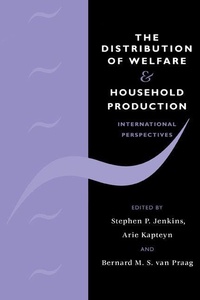
The Distribution of Welfare and Household Production
International Perspectives
Published on 9. December 2010
Book
Paperback/Softback
446 pages
978-0-521-16842-7 (ISBN)
Description
When the overall economic pie is not growing, then how it is shared out becomes more important. This book is a collection of empirical and theoretical papers by a distinguished set of international authors about the personal distribution of welfare and household production. Comparisons of poverty, income inequality and income capacity across countries in Europe and North America are the basis of Part I. Three chapters introduce subjective (non-monetary) approaches to the assessment of personal economic welfare. In Part III new results about the measurement of inequality and poverty are derived. Part V explores topics examining interactions between personal welfare and the resources derived from one's household, the labor market, and from the government through the tax and benefit system. The book reflects the interests of, and is a memorial to, the late Aldi Hagenaars.
More details
Language
English
Place of publication
Cambridge
United Kingdom
Target group
College/higher education
Product notice
Paperback (trade)
Illustrations
Worked examples or Exercises
Dimensions
Height: 229 mm
Width: 152 mm
Thickness: 26 mm
Weight
719 gr
ISBN-13
978-0-521-16842-7 (9780521168427)
Copyright in bibliographic data and cover images is held by Nielsen Book Services Limited or by the publishers or by their respective licensors: all rights reserved.
Schweitzer Classification
Other editions
Additional editions
Stephen P. Jenkins | Arie Kapteyn | Bernard M. S. van Praag
The Distribution of Welfare and Household Production
International Perspectives
Book
04/1998
Cambridge University Press
€111.70
Shipment within 15-20 days
Persons
Content
1. Introduction S. Jenkins, A. Kapteyn, and B. van Praag; 2. Escape from citadella neoclassica: reflections of the work of Aldi Hagenaars J. Hartog; Part I. Cross-National Comparisons of the Distribution of Welfare: 3. Patterns of poverty in Europe A. J. M. Hagenaars, K. de Vos, and M. A. Zaidi; 4. Comparing poverty rates across countries: a case study of France and the United Kingdom A. B. Atkinson, K. Gardiner, V. Lechene, and H. Sutherland; 5. The distribution of welfare: inequality, earnings capacity, and household production in a comparative perspective P. Saunders, I. O'Connor, and T. Smeeding; 6. Mobility and inequality in the 1980s: a cross-national comparison of the United States and Germany R. V. Burkhauser, D. Holtz-Eakin, and S. E. Rhody; Part II. Subjective Approaches to Welfare Measurement: 7. Poverty perceptions and the poverty line Y. Amiel and F. Cowell; 8. Using subjective information in macroeconomic modeling: an application to vacation behavior P. Kooreman; 9. Well-being and labor market status I. Woittiez and J. J. M. Theeuwes; Part III. Summarizing Welfare: 10. Do inequality measures measure inequality? G. S. Fields; 11. Deprivation profiles and deprivation indices A. F. Shorrocks; 12. Poverty orderings for the Dalton utility-gap measures J. E. Foster and Y. Jin; 13. Changing welfare in a changing world? Income and expenditure inequalities in the Czech and Slovak Republics T. I. Garner; Part IV. The Household, Income, and Welfare: 14. The distribution of income, wealth, and economic security: the impact of unemployment insurance reforms in Canada L. Osberg, S. Erksoy, and S. Phipps; 15. A structural model of the determinants of educational success R. Haveman, K. Wilson, and B. Wolfe; 16. Equivalence scales and the distribution of well-being across and within households D. S. Johnson; 17. The incomes of UK women: limited progress towards equality with men? S. P. Jenkins and N. C. O'Leary; 18. Equivalence scales and household welfare: what can be learned from household budget data? R. Blundell; Index.