

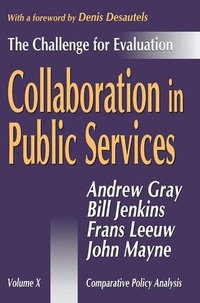
Collaboration in Public Services
The Challenge for Evaluation
1st Edition
Published on 31. July 2003
Book
Hardback
264 pages
978-0-7658-0183-8 (ISBN)
Description
The International Group for Policy and Program Evaluation (INTEVAL) serves as a forum for scholars and practitioners of public policy to discuss ideas and developments as a community dedicated to enhancing the contribution of evaluation to government. From the group's studies has emerged a concern with the impact of public management reforms. Collaboration in Public Services examines collaboration in the delivery of public policies and identifies the challenges for policy and program evaluation.
Written by a mix of academics, program managers, evaluators, and auditors, this volume explores the forms and challenges of collaboration in different national contexts. Chapter 1 introduces the notion and manifestations of collaboration and discusses emerging issues. Chapter 2 examines partnerships and networks of public service delivery. Chapter 3, drawing on Dutch and British data, reveals the QUANGO as both a collaborative end and means. Chapter 4 analyzes Israel's push to enhance collaboration with voluntary organizations. Chapter 5 examines the Canadian and Danish experiences.
Chapter 6 suggests that the creation of markets to improve quality has not been totally successful at least in Nordic countries. Chapter 7 suggests that traditional service values such as trust and parliamentary accountability are challenged by the complexity of collaboration, but, using illustrations from Canada and other OECD countries, argues that results-based governance can increase trust, flexibility, and empowerment. Chapter 8 demonstrates from Dutch and Canadian experiences that auditor responses to collaborative delivery tend to overlook traditional roles as guardians of accountability on behalf of parliaments. Chapter 9 deliberates the efficacy of programs involving multiple partners. Chapter 10 discusses the lessons and challenges of evaluation and collaborative government.
Written by a mix of academics, program managers, evaluators, and auditors, this volume explores the forms and challenges of collaboration in different national contexts. Chapter 1 introduces the notion and manifestations of collaboration and discusses emerging issues. Chapter 2 examines partnerships and networks of public service delivery. Chapter 3, drawing on Dutch and British data, reveals the QUANGO as both a collaborative end and means. Chapter 4 analyzes Israel's push to enhance collaboration with voluntary organizations. Chapter 5 examines the Canadian and Danish experiences.
Chapter 6 suggests that the creation of markets to improve quality has not been totally successful at least in Nordic countries. Chapter 7 suggests that traditional service values such as trust and parliamentary accountability are challenged by the complexity of collaboration, but, using illustrations from Canada and other OECD countries, argues that results-based governance can increase trust, flexibility, and empowerment. Chapter 8 demonstrates from Dutch and Canadian experiences that auditor responses to collaborative delivery tend to overlook traditional roles as guardians of accountability on behalf of parliaments. Chapter 9 deliberates the efficacy of programs involving multiple partners. Chapter 10 discusses the lessons and challenges of evaluation and collaborative government.
More details
Series
Language
English
Place of publication
Somerset
United Kingdom
Publishing group
Taylor & Francis Inc
Target group
College/higher education
Professional and scholarly
Dimensions
Height: 229 mm
Width: 152 mm
Weight
536 gr
ISBN-13
978-0-7658-0183-8 (9780765801838)
Copyright in bibliographic data and cover images is held by Nielsen Book Services Limited or by the publishers or by their respective licensors: all rights reserved.
Schweitzer Classification
Other editions
Additional editions
Book
11/2017
1st Edition
Routledge
€77.03
Shipment within 10-20 days
E-Book
10/2017
Routledge
€64.49
Available for download
E-Book
10/2017
Routledge
€64.49
Available for download
Person
Andrew Gray is emeritus professor of public sector management, University of Durham and deputy editor of Public Money and Management. Bill Jenkins is professor of public policy and management at The University of Kent and deputy editor of Public Administration, Frans Leeuw is chief review officer, the Netherlands' Inspectorate for Education and professor of sociology at Utrecht University. John Mayne is a principal with the Office of the Auditor General of Canada.
Content
1: Collaborative Government and Evaluation: The Implications of a New Policy Instrument; 2: Networks and Partnering Arrangements: New Challenges for Evaluation and Auditing; 3: Quangos, Evaluation, and Accountability in Collaborative Government; 4: The Politics of Evaluating Government Collaboration with the Third Sector; 5: Collaborating for Public Service Quality: The Implications for Evaluation; 6: Collaboration by Contract and Pooling Resources: The Implications for Evaluation; 7: Results-Based Governance: Collaborating for Outcomes; 8: Auditing and Evaluating Collaborative Government: The Role of Supreme Audit Institutions; 9: Evaluation, Accountability, and Collaboration; 10: Evaluation and Collaborative Government: Lessons and Challenges