

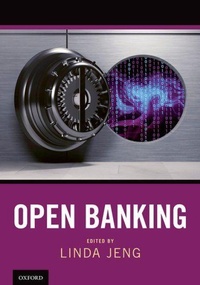
Open Banking
Published on 29. April 2022
Book
Hardback
344 pages
978-0-19-758287-9 (ISBN)
Description
Open banking is a silent revolution transforming the banking industry. It is the manifestation of the revolution of consumer technology in banking and will dramatically change not only how we bank, but also the world of finance and how we interact with it. Since the United Kingdom along with the rest of the European Union adopted rules requiring banks to share customer data to improve competition in the banking sector, a wave of countries from Asia to Africa to the Americas have adopted various forms of their own open banking regimes. Among Basel Committee jurisdictions, at least fifteen jurisdictions have some form of open banking, and this number does not even include the many jurisdictions outside the Basel Committee membership with open banking activities. Although U.S. banks and market participants have been sharing customer-permissioned data for the past twenty years and there have been recent policy discussions, such as the Obama administration's failed Consumer Data Privacy Bill and the Data Aggregation Principles of the Consumer Financial Protection Bureau, open banking is still a little-known concept among consumers and policymakers in the States. This book defines the concept of 'open banking' and explores key legal, policy, and economic questions raised by open banking.
Reviews / Votes
Over the past three years we have built a world-leading open banking infrastructure in the UK. With morethan four million consumers and businesses actively using open banking enabled products, over 300regulated companies operating in this space and another 450 looking to enter the market, momentum ison our side and it's a very exciting time to join our thriving open banking ecosystem. * Charlotte Crosswell, Chair and Trustee, United Kingdom's Open BankingImplementation Entity * The rapidly developing world of open banking needs the combination of academic, technological and practical thought which is so clearly the focus of this leading work. I am very much looking forward to reading this book, and the discussion and further work which it will certainly inspire. * Scott Farrell, chair of the Australian Government's review into Open Banking in Australia * Linda Jeng is a first-rate mind, and someone who has been a key architect of current analysis of the global financial system. 'Open Banking' is a timely addition to the current deliberations in both the public and private sector. As we look to building the next generations of finance using Artificial Intelligence, Digital Assets and other new technologies, this work is a welcome addition to critical thinking on the subject. * Sultan Meghji, Co-founder and former Chief Executive Officer of Neocova * This book assembles an all-star cast of experts on financial technology who bring you to the front lines of policy debate. The project delivers insights into a complex web of questions that all arise from a simple one: Who owns your financial data? * Victoria Guida, POLITICO * In the short period of time since the Basel Committee published its 2019 report on Open Banking -- an effort led by Linda Jeng, open banking has continued to rapidly evolve and expand, taking on even greater importance on a global scale. From data privacy, data protection, and data portability to fraud, economics, antitrust/competition and AI/ML, open banking is a complex, multifaceted topic. It is also an international subject with different jurisdictional perspectives. This volume compiles contributions on all of these topics from experts in their respective fields. It is an invaluable resource and guide for practitioners, regulators, market participants and the many other stakeholders having an interest in open banking. * Bill Coen, Former Secretary General, Basel Committee on Banking Supervision * Open Banking takes the reader on a journey through the complex policy, economic, legal, regulatory, and ethical questions that open banking raises. Drawing on the world's leading experts, the book is a first of its kind in describing and reviewing how countries around the world are answering the questions that open banking raises. It is an indispensable guide for all those that want to understand and study open banking, that are called on to develop policy and regulation on open banking questions and for professionals and companies that engage in open banking and finance, be it as a data source or as a data user. * Peter Kerstens, European Commission *More details
Language
English
Place of publication
New York
United States
Target group
Professional and scholarly
Product notice
sewn/stitched
Cloth over boards
Dimensions
Height: 264 mm
Width: 191 mm
Thickness: 33 mm
Weight
794 gr
ISBN-13
978-0-19-758287-9 (9780197582879)
Copyright in bibliographic data and cover images is held by Nielsen Book Services Limited or by the publishers or by their respective licensors: all rights reserved.
Schweitzer Classification
Other editions
Additional editions
Person
Linda Jeng is a Visiting Scholar on Financial Technology and Adjunct Professor of Law at Georgetown University Law Center's Institute of International Economic Law. Her research interests include open banking, data rights, digital currencies and blockchain. She is also leading policy, regulatory and product strategy at the fintech startup Transparent Systems. Previously, she was with the Fed and had chaired the Basel Committee's working group on open banking and APIs. She has spent most of her career working on financial stability and Too-Big-To-Fail regulatory reform, including at the Financial Stability Board in Basel, Switzerland, the U.S. Senate during the passage of the Dodd-Frank Act, and the U.S. Treasury Department during the international implementation of G20-led reforms. Prof. Jeng has worked at the Securities & Exchange Commission, the Office of the Comptroller of the Currency, and a global bank in Paris. She has a J.D. from Columbia Law School, a Master of Advanced Studies from
Universite de Toulouse, France, and a B.A. from Duke University.
Universite de Toulouse, France, and a B.A. from Duke University.
Content
Foreword by Chris Brummer
Introduction by Linda Jeng
Chapter 1: Open Banking Ecosystem and Infrastructure: Banking on Openness by Andres Wolberg-Stok
Chapter 2: Defining Data Rights and the Role of the Individual by Kaitlin Asrow
Chapter 3: Customer Protection and the Liability Conundrum in an Open Finance Ecosystem by Steven Boms and Sam Taussig
Chapter 4: Artificial Intelligence and Machine Learning: The Opportunities and Challenges of Using Big Data by Matthew Adam Bruckner
Chapter 5: Data Access Technology Standards: A History of Open Banking Data Access by Don Cardinal and Nick Thomas
Chapter 6: Taking Your Data with You: Singapore's Approach to Data Portability by Zee Kin Yeong and David Roi Hardoon
Chapter 7: Open Banking and the Economics of Data by Yan Carriere-Swallow and Vikram Haksar
Chapter 8: Open Banking, Open Data, and Open Finance: Lessons from the European Union by Douglas W. Arner, Ross P. Buckley and Dirk A. Zetzsche
Chapter 9: United Kingdom: The Butterfly Effect by Gavin Littlejohn, Ghela Boskovich and Richard Prior
Chapter 10: The Australian Consumer Data Right: The Promise of Open Data by Julie McKay and Jamie Leach
Chapter 11: India's Approach to Open Banking: Some Implications for Financial Inclusion by Yan Carriere-Swallow, Vikram Haksar and Manasa Patnam
Chapter 12: Digital Identity: Exploring a Consumer-centric Identity for Open Banking by Greg Kidd
Chapter 13: Decentralized Finance: The Future of Crypto and Open Finance? By Nic Carter
Chapter 14: From Open Banking to Open Data and Beyond: Competition and the Future of Banking by Brad Carr
Introduction by Linda Jeng
Chapter 1: Open Banking Ecosystem and Infrastructure: Banking on Openness by Andres Wolberg-Stok
Chapter 2: Defining Data Rights and the Role of the Individual by Kaitlin Asrow
Chapter 3: Customer Protection and the Liability Conundrum in an Open Finance Ecosystem by Steven Boms and Sam Taussig
Chapter 4: Artificial Intelligence and Machine Learning: The Opportunities and Challenges of Using Big Data by Matthew Adam Bruckner
Chapter 5: Data Access Technology Standards: A History of Open Banking Data Access by Don Cardinal and Nick Thomas
Chapter 6: Taking Your Data with You: Singapore's Approach to Data Portability by Zee Kin Yeong and David Roi Hardoon
Chapter 7: Open Banking and the Economics of Data by Yan Carriere-Swallow and Vikram Haksar
Chapter 8: Open Banking, Open Data, and Open Finance: Lessons from the European Union by Douglas W. Arner, Ross P. Buckley and Dirk A. Zetzsche
Chapter 9: United Kingdom: The Butterfly Effect by Gavin Littlejohn, Ghela Boskovich and Richard Prior
Chapter 10: The Australian Consumer Data Right: The Promise of Open Data by Julie McKay and Jamie Leach
Chapter 11: India's Approach to Open Banking: Some Implications for Financial Inclusion by Yan Carriere-Swallow, Vikram Haksar and Manasa Patnam
Chapter 12: Digital Identity: Exploring a Consumer-centric Identity for Open Banking by Greg Kidd
Chapter 13: Decentralized Finance: The Future of Crypto and Open Finance? By Nic Carter
Chapter 14: From Open Banking to Open Data and Beyond: Competition and the Future of Banking by Brad Carr