

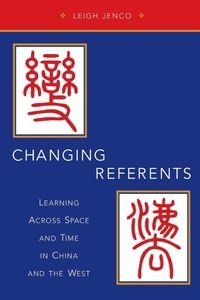
Changing Referents
Learning Across Space and Time in China and the West
Published on 29. October 2015
Book
Paperback/Softback
304 pages
978-0-19-026382-9 (ISBN)
Description
Globalization has brought together otherwise disparate communities with distinctive and often conflicting ways of viewing the world. Yet even as these phenomena have exposed the culturally specific character of the academic theories used to understand them, most responses to this ethnocentricity fall back on the same parochial vocabulary they critique. Against those who insist our thinking must return always to the dominant terms of Euro-American modernity, Leigh Jenco argues - and more importantly, demonstrates - that methods for understanding cultural others can take theoretical guidance from those very bodies of thought typically excluded by political and social theory.
Jenco examines a decades-long Chinese conversation over "Western Learning," starting in the mid-nineteenth century, which subjected methods of learning from difference to unprecedented scrutiny and development. Just as Chinese elites argued for the possibility of their producing knowledge along "Western" lines rather than "Chinese" ones, so too, Jenco argues, might we come to see foreign knowledge as a theoretical resource - that is, as a body of knowledge which formulates methods of argument, goals of inquiry, and criteria of evidence that may be generalizable to other places and times. The call of reformers such as Liang Qichao and Yan Fu to bianfa - literally "change the institutions" of Chinese society and politics in order to produce new kinds of Western knowledge-was simultaneously a call to "change the referents" those institutions sought to emulate, and from which participants might draw their self-understanding. Their arguments show that the institutional and cultural contexts which support the production of knowledge are not prefigured givens that constrain cross-cultural understanding, but dynamic platforms for learning that are tractable to concerted efforts over time to transform them. In doing so, these thinkers point us beyond the mere acknowledgement of cultural difference toward reform of the social, institutional and disciplinary spaces in which the production of knowledge takes place.
Jenco examines a decades-long Chinese conversation over "Western Learning," starting in the mid-nineteenth century, which subjected methods of learning from difference to unprecedented scrutiny and development. Just as Chinese elites argued for the possibility of their producing knowledge along "Western" lines rather than "Chinese" ones, so too, Jenco argues, might we come to see foreign knowledge as a theoretical resource - that is, as a body of knowledge which formulates methods of argument, goals of inquiry, and criteria of evidence that may be generalizable to other places and times. The call of reformers such as Liang Qichao and Yan Fu to bianfa - literally "change the institutions" of Chinese society and politics in order to produce new kinds of Western knowledge-was simultaneously a call to "change the referents" those institutions sought to emulate, and from which participants might draw their self-understanding. Their arguments show that the institutional and cultural contexts which support the production of knowledge are not prefigured givens that constrain cross-cultural understanding, but dynamic platforms for learning that are tractable to concerted efforts over time to transform them. In doing so, these thinkers point us beyond the mere acknowledgement of cultural difference toward reform of the social, institutional and disciplinary spaces in which the production of knowledge takes place.
Reviews / Votes
"Jenco analyzes China's early intellectual debates regarding the utility of Western learning and China's desperate attempts at political reform following two disastrous Opium Wars with Great Britain, defeat in the first Sino-Japanese War in 1895, and the country's descent into national collapse in the 1920s and 1930s. This provides a springboard to examine the relevance of non-Western, cross-cultural discourse on contemporary comparative political theory." --S. C. Hart, College of William and Mary, CHOICE
"In Changing Referents, Leigh Jenco quite brilliantly and fundamentally recasts our view of the ways Chinese thinkers responded to the crises that immersed them from the late nineteenth-century on. She shows that the ideas generated in China during these times represented original and quite viable solutions to unprecedented problems, with the ideas themselves and the process by which they were derived still offering lessons to those who would pay close
attention to them. This is a thoroughly liberating study, in all senses of the word."
-Ted Huters, author of Bringing the World Home: Appropriating the West in Late Qing and Early Republican China
"Drawing on illuminating interpretations of Chinese debates over 'Western Learning' one century ago, Jenco makes provocative arguments for a mode of cross-cultural learning that moves beyond conventional inclusion or assimilation. Remarkably, her critical sensitivity in combination with constructive creativity is well informed by not only cutting-edge Western theories but also formidable knowledge of Chinese intellectual history, rarely seen in a political
theorist. This book opens a new and promising alternative for the rethinking and remaking of contemporary political theory in both the West and China."
-Liu Qing, Professor of Political Science, East China Normal University
"By studying Chinese debates over the 'Western Knowledge,' Jenco brilliantly throws light on some of the most intricate questions of our time: the relationship between society and knowledge, self and other. The book breaks new ground in comparative theorizing that moves beyond the safe pieties of globalization and multiculturalism. It uses Chinese intellectual history to demonstrate that the project of deparochialization of ideas will be genuine only if it
recognizes the deep ways in which knowledge and society constitute each other. A major contribution to comparative theory and intellectual history."
-Pratap Bhanu Mehta, President, Centre for Policy Research Delhi
"Must all thinking in the modern age necessarily take place on Euro-American terms? Answering in the negative, Leigh Jenco argues-and more importantly, demonstrates-that China's nineteenth- and twentieth-century "Western Learning" debates can offer theoretically credible alternatives to current methods for engaging otherness and confronting ethnocentrism."
Leigh Jenco is Associate Professor of Political Theory at the London School of Economics and Political Science.
More details
Language
English
Place of publication
New York
United States
Target group
College/higher education
Dimensions
Height: 234 mm
Width: 156 mm
Thickness: 16 mm
Weight
450 gr
ISBN-13
978-0-19-026382-9 (9780190263829)
Copyright in bibliographic data and cover images is held by Nielsen Book Services Limited or by the publishers or by their respective licensors: all rights reserved.
Schweitzer Classification
Other editions
Additional editions
Book
10/2015
Oxford University Press Inc
€205.70
Shipment within 15-20 days
E-Book
10/2015
1st Edition
OUP eBook
€25.49
Available for download
E-Book
09/2015
1st Edition
OUP eBook
€25.49
Available for download
Person
Leigh Jenco is Associate Professor of Political Theory at the London School of Economics and Political Science.
Content
Acknowledgments ; 1. Toward the Creative Engagement of Chinese Thought ; 2. Westernization as Barbarization: Culturalism, Universalism and Particularism ; 3. Can Cultural Others be Historical Others? The Curious Thesis of "Chinese origins for Western knowledge" (Xi xue Zhong yuan) ; 4. Why Learning from Others is Political, not (only) Epistemological: Arguments for "Changing Referents" (Bianfa) ; 5. How Meaning Moves: Tan Sitong's Metaphysics of Culture ; 6. Where Knowledge Creates its Own Object: Yan Fu and Liang Qichao on "The Study of Groups" (Qunxue) ; 7. Culture as History: Envisioning Change in the May Fourth Era ; 8. The Culturally Unprecedented: "Old," "New," and the Political Tractability of Background Conditions ; 9. Here and Now: Modern Chinese Thought as a Source of Innovation ; Appendix ; Bibliography ; Index