

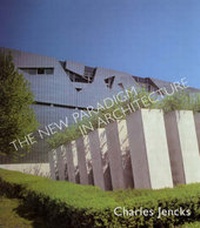
The New Paradigm in Architecture
Published on 11. August 2002
Book
Hardback
288 pages
978-0-300-09512-8 (ISBN)
Description
The New Paradigm in Architecture tells the story of a movement that has changed the face of architecture over the last forty years.
The book begins by surveying the counter culture of the 1960s, when Jane Jacobs and Robert Venturi called for a more complex urbanism and architecture. It concludes by showing how such demands began to be realized by the 1990s in a new architecture that is aided by computer design-more convivial, sensuous, and articulate than the Modern architecture it challenges. Promoted by such architects as Frank Gehry, Daniel Libeskind, and Peter Eisenman, it has also been adopted by many schools and offices around the world. Charles Jencks traces the history of computer design which is, at its heart, built on the desire for an architecture that communicates with its users, one based on the heterogeneity of cities and global culture.
This book, the first to explore the broad issue of Postmodernism, has fostered its growth in other fields such as philosophy and the arts. First written at the start of an architectural movement in the mid-1970s, it has been translated into eleven languages and has gone through six editions. Now completely rewritten and with two new chapters, this edition brings the history up to date with the latest twists in the narrative and the turn to a new complexity in architecture.
The book begins by surveying the counter culture of the 1960s, when Jane Jacobs and Robert Venturi called for a more complex urbanism and architecture. It concludes by showing how such demands began to be realized by the 1990s in a new architecture that is aided by computer design-more convivial, sensuous, and articulate than the Modern architecture it challenges. Promoted by such architects as Frank Gehry, Daniel Libeskind, and Peter Eisenman, it has also been adopted by many schools and offices around the world. Charles Jencks traces the history of computer design which is, at its heart, built on the desire for an architecture that communicates with its users, one based on the heterogeneity of cities and global culture.
This book, the first to explore the broad issue of Postmodernism, has fostered its growth in other fields such as philosophy and the arts. First written at the start of an architectural movement in the mid-1970s, it has been translated into eleven languages and has gone through six editions. Now completely rewritten and with two new chapters, this edition brings the history up to date with the latest twists in the narrative and the turn to a new complexity in architecture.
More details
Language
English
Place of publication
United States
Target group
College/higher education
Professional and scholarly
Product notice
Cloth over boards
Illustrations
60 b-w + 310 color illus.
Dimensions
Height: 286 mm
Width: 248 mm
Weight
1678 gr
ISBN-13
978-0-300-09512-8 (9780300095128)
Copyright in bibliographic data and cover images is held by Nielsen Book Services Limited or by the publishers or by their respective licensors: all rights reserved.
Schweitzer Classification
Person
Charles Jencks is a designer and the author of numerous books on the theory and history of architecture. He was formerly visiting professor at the University of California, Los Angeles.