

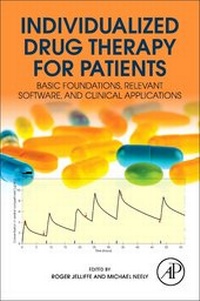
Individualized Drug Therapy for Patients
Basic Foundations, Relevant Software and Clinical Applications
Published on 8. November 2016
Book
Paperback/Softback
434 pages
978-0-12-803348-7 (ISBN)
Description
Individualized Drug Therapy for Patients: Basic Foundations, Relevant Software and Clinical Applications focuses on quantitative approaches that maximize the precision with which dosage regimens of potentially toxic drugs can hit a desired therapeutic goal. This book highlights the best methods that enable individualized drug therapy and provides specific examples on how to incorporate these approaches using software that has been developed for this purpose.
The book discusses where individualized therapy is currently and offers insights to the future. Edited by Roger Jelliffe, MD and Michael Neely, MD, renowned authorities in individualized drug therapy, and with chapters written by international experts, this book provides clinical pharmacologists, pharmacists, and physicians with a valuable and practical resource that takes drug therapy away from a memorized ritual to a thoughtful quantitative process aimed at optimizing therapy for each individual patient.
The book discusses where individualized therapy is currently and offers insights to the future. Edited by Roger Jelliffe, MD and Michael Neely, MD, renowned authorities in individualized drug therapy, and with chapters written by international experts, this book provides clinical pharmacologists, pharmacists, and physicians with a valuable and practical resource that takes drug therapy away from a memorized ritual to a thoughtful quantitative process aimed at optimizing therapy for each individual patient.
More details
Language
English
Place of publication
San Diego
United States
Publishing group
Elsevier Science Publishing Co Inc
Target group
Professional and scholarly
Clinical pharmacologists, pharmacists and physicians
Dimensions
Height: 235 mm
Width: 191 mm
Weight
660 gr
ISBN-13
978-0-12-803348-7 (9780128033487)
Copyright in bibliographic data and cover images is held by Nielsen Book Services Limited or by the publishers or by their respective licensors: all rights reserved.
Schweitzer Classification
Other editions
Additional editions
Roger W. Jelliffe | Michael Neely
Individualized Drug Therapy for Patients
Basic Foundations, Relevant Software and Clinical Applications
E-Book
11/2016
Academic Press
€71.95
Available for download
Persons
Roger Jelliffe MD, FCP, FAAPS, an adult cardiologist, developed the first software, for individualizing digitalis dosage, in 1967. He founded the USC Laboratory of Applied Pharmacokinetics and directed it until he retired and had recruited Dr. Michael Neely, who became director in 2013. The laboratory has developed what is now the USC Pmetrics software for population modeling and the Bestdose clinical software for individualizing drug dosage regimens specifically with maximum precision, including several different Bayesian methods for managing individual patients in various clinical situations. The laboratory has contributed significantly to optimize therapy for cardiovascular, bacterial and fungal diseases, transplants, and for acutely ill and unstable patients in the ICU. Dr. Neely is an Associate Professor of Pediatrics and a Clinical Scholar at the University of Southern California (USC) in Los Angeles, CA. He is a board-certified pediatric infectious diseases physician with an active clinical practice at the Children's Hospital of Los Angeles (CHLA). His research interests are in pediatric clinical pharmacometrics, including population pharmacokinetic and pharmacodynamic modeling, pharmacogenomics, simulation, and most importantly, use of models to optimize therapy for individual patients. He is currently the Director of the Laboratory of Applied Pharmacokinetics and Bioinformatics at the CHLA Saban Research Institute. LAPKB is a multidisciplinary team of physicians, mathematicians, statisticians, engineers, and information technologists, who are leading experts in non-parametric population modeling and multiple-model Bayesian adaptive control of therapeutic drug regimens in individual patients. LAPKB maintains the freely available Pmetrics pharmacometric package for R, and the BestDose software for individualized dosing. LAPKB has numerous local, national and international collaborators. Dr. Neely has a Master's of Science Degree in Clinical and Biomedical Investigations at USC, is a Fellow and Regent in the American College of Clinical Pharmacology, a member of the Society for Pediatric Research, and he consults on the United States Food and Drug Administration Anti-infective Drug Advisory Committee. He is currently the principle investigator on two NIH-sponsored clinical projects involving the developmental aspects of voriconazole pharmacokinetics, as well as creating software tools to optimally dose voriconazole, vancomycin, and other therapeutic drugs. He mentors numerous trainees and visiting scholars, is an invited speaker worldwide, and is the author of over 80 peer-reviewed papers.
Content
Section I: Basic Techniques for Individualized Therapy
1. Basic Pharmacokinetics and Dynamics for Clinicians
2. Describing Drug Behavior in Groups of Patients
3. Developing Maximally Precise Dosage Regimens for Patients - Multiple Model (MM) Dosage Design
4. Optimizing Laboratory Assay Methods for Individualized Therapy
5. Evaluation of Renal Function
Section II: The Clinical Software
6. Using the BestDose Clinical Software - Examples With Aminoglycosides
7. Monitoring the Patient: Four Different Bayesian Methods to Make Individual Patient Drug Models
8. Monitoring Each Patient Optimally: When to Obtain the Best Samples for Therapeutic Drug Monitoring
9. Optimizing Individualized Drug Therapy in the ICU
10. Quantitative Modeling of Diffusion Into Endocardial Vegetations, the Postantibiotic Effect, and Bacterial Growth and Kill
11. Individualizing Digoxin Therapy
Section III: Clinical Applications of Individualized Therapy
12. Optimizing Single-Drug Antibacterial and Antifungal Therapy
13. Combination Chemotherapy With Anti-Infective Agents
14. Controlling Antiretroviral Therapy in Children and Adolescents with HIV Infection
15. Individualizing Tuberculosis Therapy
16. Individualizing Transplant Therapy
17. Individualizing Dosage Regimens of Antineoplastic Agents
18. Controlling Busulfan Therapy in Children
19. Individualizing Antiepileptic Therapy for Patients
20. Individualizing Drug Therapy in the Elderly
21. The Present and Future State of Individualized Therapy
1. Basic Pharmacokinetics and Dynamics for Clinicians
2. Describing Drug Behavior in Groups of Patients
3. Developing Maximally Precise Dosage Regimens for Patients - Multiple Model (MM) Dosage Design
4. Optimizing Laboratory Assay Methods for Individualized Therapy
5. Evaluation of Renal Function
Section II: The Clinical Software
6. Using the BestDose Clinical Software - Examples With Aminoglycosides
7. Monitoring the Patient: Four Different Bayesian Methods to Make Individual Patient Drug Models
8. Monitoring Each Patient Optimally: When to Obtain the Best Samples for Therapeutic Drug Monitoring
9. Optimizing Individualized Drug Therapy in the ICU
10. Quantitative Modeling of Diffusion Into Endocardial Vegetations, the Postantibiotic Effect, and Bacterial Growth and Kill
11. Individualizing Digoxin Therapy
Section III: Clinical Applications of Individualized Therapy
12. Optimizing Single-Drug Antibacterial and Antifungal Therapy
13. Combination Chemotherapy With Anti-Infective Agents
14. Controlling Antiretroviral Therapy in Children and Adolescents with HIV Infection
15. Individualizing Tuberculosis Therapy
16. Individualizing Transplant Therapy
17. Individualizing Dosage Regimens of Antineoplastic Agents
18. Controlling Busulfan Therapy in Children
19. Individualizing Antiepileptic Therapy for Patients
20. Individualizing Drug Therapy in the Elderly
21. The Present and Future State of Individualized Therapy