

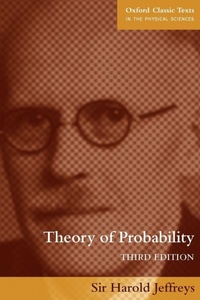
The Theory of Probability
3rd Edition
Published on 6. August 1998
Book
Paperback/Softback
470 pages
978-0-19-850368-2 (ISBN)
Description
Another title in the reissued Oxford Classic Texts in the Physical Sciences series, Jeffrey's Theory of Probability, first published in 1939, was the first to develop a fundamental theory of scientific inference based on the ideas of Bayesian statistics. His ideas were way ahead of their time and it is only in the past ten years that the subject of Bayes' factors has been significantly developed and extended. Until recently the two schools of statistics (Bayesian and Frequentist) were distinctly different and set apart. Recent work (aided by increased computer power and availability) has changed all that and today's graduate students and researchers all require an understanding of Bayesian ideas. This book is their starting point.
Reviews / Votes
Though mathematically very demanding, the principles and examples are clear enough, and Jeffreys' trenchant references to critics of Bayesian methods often made me laugh out loud - an unusual experience with an advanced statistics text. Its selection as an Oxford Classic Text is unusual but well judged. * Robert Matthews, New Scientist *More details
Series
Edition
3rd Revised edition
Language
English
Place of publication
Oxford
United Kingdom
Target group
Professional and scholarly
Edition type
Revised edition
Illustrations
tables
Dimensions
Height: 234 mm
Width: 156 mm
Thickness: 26 mm
Weight
711 gr
ISBN-13
978-0-19-850368-2 (9780198503682)
Copyright in bibliographic data and cover images is held by Nielsen Book Services Limited or by the publishers or by their respective licensors: all rights reserved.
Schweitzer Classification
Person
Content
1. Fundamental notions ; 2. Direct probabilities ; 3. Estimation problems ; 4. Approximate methods and simplifications ; 5. Significance tests: one new parameter ; 6. Significance tests: various complications ; 7. Frequency definitions and direct methods ; 8. General questions