

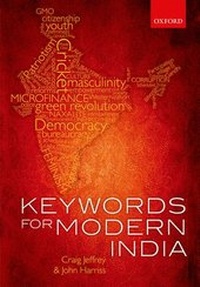
Keywords for Modern India
Published on 28. August 2014
Book
Paperback/Softback
214 pages
978-0-19-966564-8 (ISBN)
Description
What have English terms such as 'civil society', 'democracy', 'development' or 'nationalism' come to mean in an Indian context and how have their meanings and uses changed over time? Why are they the subjects of so much debate - in their everyday uses as well as amongst scholars? How did a concept such as 'Hinduism' come to be framed, and what does it mean now? What is 'caste'? Does it have quite the same meaning now as in the past? Why is the idea of 'faction' so significant in modern India? Why has the idea of 'empowerment' come to be used so extensively? These are the sorts of questions that are addressed in this book.
Keywords for Modern India is modelled after the classic exploration of English culture and society through the study of keywords - words that are 'strong, important and persuasive' - by Raymond Williams. The book, like Williams' Keywords, is not a dictionary or an encyclopaedia. Williams said that his was 'an inquiry into a vocabulary', and Keywords for Modern India presents just such an inquiry into the vocabulary deployed in writing in and about India in the English language - which has long been and is becoming ever more a critically important language in India's culture and society. Exploring the changing uses and contested meanings of common but significant words is a powerful and illuminating way of understanding contemporary India, for scholars and for students, and for general readers.
Keywords for Modern India is modelled after the classic exploration of English culture and society through the study of keywords - words that are 'strong, important and persuasive' - by Raymond Williams. The book, like Williams' Keywords, is not a dictionary or an encyclopaedia. Williams said that his was 'an inquiry into a vocabulary', and Keywords for Modern India presents just such an inquiry into the vocabulary deployed in writing in and about India in the English language - which has long been and is becoming ever more a critically important language in India's culture and society. Exploring the changing uses and contested meanings of common but significant words is a powerful and illuminating way of understanding contemporary India, for scholars and for students, and for general readers.
Reviews / Votes
This book is not a dictionary or a glossary per se, but a cultural studies enterprise that examines words, their meanings, histories, and how they have changed in different contexts ... The volume's combined "References and Further Reading" section, organized by keyword but separate from the entries, points to resources in a lengthy, scholarly bibliography. * R. N. Sharma, emeritus, Monmouth University, CHOICE *More details
Language
English
Place of publication
Oxford
United Kingdom
Target group
College/higher education
Professional and scholarly
Dimensions
Height: 247 mm
Width: 178 mm
Thickness: 12 mm
Weight
388 gr
ISBN-13
978-0-19-966564-8 (9780199665648)
Copyright in bibliographic data and cover images is held by Nielsen Book Services Limited or by the publishers or by their respective licensors: all rights reserved.
Schweitzer Classification
Other editions
Additional editions
Craig Jeffrey | John Harriss
Keywords for Modern India
Book
08/2014
Oxford University Press
€129.40
Shipment within 15-20 days
Craig Jeffrey | John Harriss
Keywords for Modern India
E-Book
08/2014
1st Edition
OUP eBook
€29.99
Available for download
Persons
Craig Jeffrey is Director of the International Graduate School at the University of Oxford. He has conducted academic research on youth, politics, and education in India. His recent books include Timepass: Youth, Class, and the Politics of Waiting in India (2010) and India Today: Economy, Society, Politics (2012 with Stuart Corbridge and John Harriss). He is Professor of Development Geography at the University of Oxford and Fellow and Tutor of Geography at St. John's College.
John Harriss was previously Professor and Director of the Development Studies Institute, London School of Economics; and sometime Dean of the School of Development Studies at the University of East Anglia. He is a social anthropologist with long standing interests in the politics and political economy of India, where he has lived and conducted research on many occasions. He is Professor, and founding Director of the School for International Studies, Simon Fraser University; Visiting Research Professor, National University of Singapore.
John Harriss was previously Professor and Director of the Development Studies Institute, London School of Economics; and sometime Dean of the School of Development Studies at the University of East Anglia. He is a social anthropologist with long standing interests in the politics and political economy of India, where he has lived and conducted research on many occasions. He is Professor, and founding Director of the School for International Studies, Simon Fraser University; Visiting Research Professor, National University of Singapore.
Author
Professor of Development Geography and Fellow of St. John's CollegeProfessor of Development Geography and Fellow of St. John's College, University of Oxford
Professor of International Studies, Simon Fraser University; and Visiting Research ProfessorProfessor of International Studies, Simon Fraser University; and Visiting Research Professor, National University of Singapore
Content
1. Introduction ; 2. Keywords for Modern India ; 3. References and Further Reading ; Bibliography