

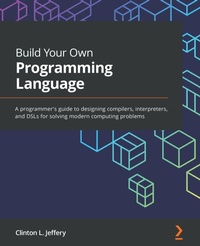
Build Your Own Programming Language
A programmer's guide to designing compilers, interpreters, and DSLs for solving modern computing problems
Published on 31. December 2021
Book
Paperback/Softback
494 pages
978-1-80020-480-5 (ISBN)
Description
Written by the creator of the Unicon programming language, this book will show you how to implement programming languages to reduce the time and cost of creating applications for new or specialized areas of computing
Key Features
Reduce development time and solve pain points in your application domain by building a custom programming language
Learn how to create parsers, code generators, file readers, analyzers, and interpreters
Create an alternative to frameworks and libraries to solve domain-specific problems
Book DescriptionThe need for different types of computer languages is growing rapidly and developers prefer creating domain-specific languages for solving specific application domain problems. Building your own programming language has its advantages. It can be your antidote to the ever-increasing size and complexity of software.
In this book, you'll start with implementing the frontend of a compiler for your language, including a lexical analyzer and parser. The book covers a series of traversals of syntax trees, culminating with code generation for a bytecode virtual machine. Moving ahead, you'll learn how domain-specific language features are often best represented by operators and functions that are built into the language, rather than library functions. We'll conclude with how to implement garbage collection, including reference counting and mark-and-sweep garbage collection. Throughout the book, Dr. Jeffery weaves in his experience of building the Unicon programming language to give better context to the concepts where relevant examples are provided in both Unicon and Java so that you can follow the code of your choice of either a very high-level language with advanced features, or a mainstream language.
By the end of this book, you'll be able to build and deploy your own domain-specific languages, capable of compiling and running programs.What you will learn
Perform requirements analysis for the new language and design language syntax and semantics
Write lexical and context-free grammar rules for common expressions and control structures
Develop a scanner that reads source code and generate a parser that checks syntax
Build key data structures in a compiler and use your compiler to build a syntax-coloring code editor
Implement a bytecode interpreter and run bytecode generated by your compiler
Write tree traversals that insert information into the syntax tree
Implement garbage collection in your language
Who this book is forThis book is for software developers interested in the idea of inventing their own language or developing a domain-specific language. Computer science students taking compiler construction courses will also find this book highly useful as a practical guide to language implementation to supplement more theoretical textbooks. Intermediate-level knowledge and experience working with a high-level language such as Java or the C++ language are expected to help you get the most out of this book.
Key Features
Reduce development time and solve pain points in your application domain by building a custom programming language
Learn how to create parsers, code generators, file readers, analyzers, and interpreters
Create an alternative to frameworks and libraries to solve domain-specific problems
Book DescriptionThe need for different types of computer languages is growing rapidly and developers prefer creating domain-specific languages for solving specific application domain problems. Building your own programming language has its advantages. It can be your antidote to the ever-increasing size and complexity of software.
In this book, you'll start with implementing the frontend of a compiler for your language, including a lexical analyzer and parser. The book covers a series of traversals of syntax trees, culminating with code generation for a bytecode virtual machine. Moving ahead, you'll learn how domain-specific language features are often best represented by operators and functions that are built into the language, rather than library functions. We'll conclude with how to implement garbage collection, including reference counting and mark-and-sweep garbage collection. Throughout the book, Dr. Jeffery weaves in his experience of building the Unicon programming language to give better context to the concepts where relevant examples are provided in both Unicon and Java so that you can follow the code of your choice of either a very high-level language with advanced features, or a mainstream language.
By the end of this book, you'll be able to build and deploy your own domain-specific languages, capable of compiling and running programs.What you will learn
Perform requirements analysis for the new language and design language syntax and semantics
Write lexical and context-free grammar rules for common expressions and control structures
Develop a scanner that reads source code and generate a parser that checks syntax
Build key data structures in a compiler and use your compiler to build a syntax-coloring code editor
Implement a bytecode interpreter and run bytecode generated by your compiler
Write tree traversals that insert information into the syntax tree
Implement garbage collection in your language
Who this book is forThis book is for software developers interested in the idea of inventing their own language or developing a domain-specific language. Computer science students taking compiler construction courses will also find this book highly useful as a practical guide to language implementation to supplement more theoretical textbooks. Intermediate-level knowledge and experience working with a high-level language such as Java or the C++ language are expected to help you get the most out of this book.
More details
Language
English
Place of publication
Birmingham
United Kingdom
Dimensions
Height: 235 mm
Width: 191 mm
Thickness: 27 mm
Weight
913 gr
ISBN-13
978-1-80020-480-5 (9781800204805)
Copyright in bibliographic data and cover images is held by Nielsen Book Services Limited or by the publishers or by their respective licensors: all rights reserved.
Schweitzer Classification
Other editions
Additional editions
Clinton L. Jeffery
Build Your Own Programming Language
A programmer's guide to designing compilers, interpreters, and DSLs for solving modern computing problems
E-Book
06/2024
1st Edition
Packt Publishing Limited
from
€59.99
Available for download
Person
Clinton L. Jeffery is Professor and Chair of the Department of Computer Science and Engineering at New Mexico Institute of Mining and Technology. He received his B.S. from the University of Washington, and M.S. and Ph.D. degrees from the University of Arizona, all in computer science. He has conducted research and written many books and papers on programming languages, program monitoring, debugging, graphics, virtual environments, and visualization. With colleagues, he invented the Unicon programming language, hosted on the Unicon website.
Content
Table of Contents
Why Build Another Programming Language
Programming Language Design
Scanning Source Code
Parsing
Syntax Trees
Symbol Tables
Checking Base Types
Checking Types on Arrays, Method Calls, and Structure Accesses
Intermediate Code Generation
Syntax Cloning in an IDE
Bytecode Interpreters
Generating Bytecode
Native Code Generation
Implementing Operators and Built-In Functions
Domain Control Structures
Garbage Collection
Final Thoughts
Appendix A - Unicon Essentials
Why Build Another Programming Language
Programming Language Design
Scanning Source Code
Parsing
Syntax Trees
Symbol Tables
Checking Base Types
Checking Types on Arrays, Method Calls, and Structure Accesses
Intermediate Code Generation
Syntax Cloning in an IDE
Bytecode Interpreters
Generating Bytecode
Native Code Generation
Implementing Operators and Built-In Functions
Domain Control Structures
Garbage Collection
Final Thoughts
Appendix A - Unicon Essentials