

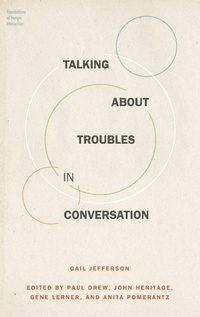
Talking About Troubles in Conversation
Published on 21. May 2015
Book
Hardback
254 pages
978-0-19-993732-5 (ISBN)
Description
Few conversational topics can be as significant as our troubles in life, whether everyday and commonplace, or more exceptional and disturbing. In groundbreaking research conducted with John Lee at the University of Manchester UK, Gail Jefferson turned the microscope on how people talk about their troubles, not in any professional or therapeutic setting, but in their ordinary conversations with family and friends. Through recordings of interactions in which people talk about problems they're having with their children, concerns about their health, financial problems, marital and relationship difficulties (their own or other people's), examination failures, dramatic events such as burglaries or a house fire and other such troubles, Jefferson explores the interactional dynamics and complexities of introducing such topics, of how speakers sustain and elaborate their descriptions and accounts of their troubles, how participants align and affiliate with one another, and finally manage to move away from such topics.
The studies Jefferson published out of that remarkable period of research have been collected together in this volume. They are as insightful and informative about how we talk about our troubles, as they are innovative in the development and application of Conversation Analysis.
Gail Jefferson (1938-2008) was one of the co-founders of Conversation Analysis (CA); through her early collaboration with Harvey Sacks and in her subsequent research, she laid the foundations for what has become an immensely important interdisciplinary paradigm. She co-authored, with Harvey Sacks and Emanuel Schegloff, two of the most highly cited articles ever published in Language, on turn-taking and repair. These papers were foundational, as was the transcription system that she developed and that is used by conversation analysts world-wide. Her research papers were a distinctive and original voice in the emerging micro-analysis of interaction in everyday life.
The studies Jefferson published out of that remarkable period of research have been collected together in this volume. They are as insightful and informative about how we talk about our troubles, as they are innovative in the development and application of Conversation Analysis.
Gail Jefferson (1938-2008) was one of the co-founders of Conversation Analysis (CA); through her early collaboration with Harvey Sacks and in her subsequent research, she laid the foundations for what has become an immensely important interdisciplinary paradigm. She co-authored, with Harvey Sacks and Emanuel Schegloff, two of the most highly cited articles ever published in Language, on turn-taking and repair. These papers were foundational, as was the transcription system that she developed and that is used by conversation analysts world-wide. Her research papers were a distinctive and original voice in the emerging micro-analysis of interaction in everyday life.
Reviews / Votes
"This classic, timeless work is a must read for those interested in linguistics, relational communication, sociology, and group dynamics... Highly recommended." --CHOICEMore details
Other editions
Additional editions
Gail Jefferson | Paul Drew | John Heritage
Talking About Troubles in Conversation
Book
05/2015
Oxford University Press Inc
€77.10
Shipment within 15-20 days
Gail Jefferson | Paul Drew | John Heritage
Talking About Troubles in Conversation
E-Book
05/2015
1st Edition
OUP eBook
€34.99
Available for download
Persons
Gail Jefferson (1938-2008) was, with Harvey Sacks and Emanuel Schegloff, one of the co-founders of Conversation Analysis. Through her early collaborative with Sacks, she developed the transcription system that underpins our paradigm. Her research into the basic mechanisms and patterns of conversation, and into the contingencies of interaction, is of enduring importance in our understanding of how people interact with one another.
About the editors: Paul Drew, John Heritage, Gene Lerner and Anita Pomerantz are among the world's leading conversation analysts. Their research spans ordinary social interaction as well as interactions in legal, medical, social welfare and other such institutionally specialized interactions - their publications are amongst the most cited in the field. They each worked closely with Gail Jefferson, and have worked on this project closely, in order to bring her work to the attention of new generations of CA researchers and teachers.
About the editors: Paul Drew, John Heritage, Gene Lerner and Anita Pomerantz are among the world's leading conversation analysts. Their research spans ordinary social interaction as well as interactions in legal, medical, social welfare and other such institutionally specialized interactions - their publications are amongst the most cited in the field. They each worked closely with Gail Jefferson, and have worked on this project closely, in order to bring her work to the attention of new generations of CA researchers and teachers.
Content
Introduction Talking About Troubles; an Introduction. Paul Drew, John Heritage, Gene Lerner & Anita Pomerantz ; Chapter 1 On the Sequential Organization of Troubles-Talk in Ordinary Conversation. ; Chapter 2 On 'Trouble-Premonitory' Response to Inquiry. ; Chapter 3 The Rejection of Advice: Managing the Problematic Convergence of a 'Troubles-Telling' and a 'Service Encounter'. ; Chapter 4 On The Interactional Unpackaging of a 'gloss'. ; Chapter 5 On the Organization of Laughter in Talk About Troubles. ; Chapter 6 On Stepwise Transition From Talk About a Trouble to Inappropriately Next-Positioned Matters.