

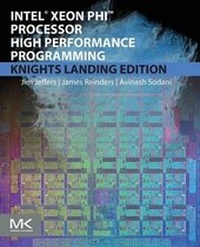
Intel Xeon Phi Processor High Performance Programming
Knights Landing Edition
2nd Edition
Published on 20. June 2016
Book
Paperback/Softback
662 pages
978-0-12-809194-4 (ISBN)
Description
Intel Xeon Phi Processor High Performance Programming is an all-in-one source of information for programming the Second-Generation Intel Xeon Phi product family also called Knights Landing. The authors provide detailed and timely Knights Landingspecific details, programming advice, and real-world examples. The authors distill their years of Xeon Phi programming experience coupled with insights from many expert customers - Intel Field Engineers, Application Engineers, and Technical Consulting Engineers - to create this authoritative book on theessentials of programming for Intel Xeon Phi products.
Intel (R) Xeon Phi (TM) Processor High-Performance Programming is useful even before you ever program a system with an Intel Xeon Phi processor. To help ensure that your applications run at maximum efficiency, the authors emphasize key techniques for programming any modern parallel computing system whether based on Intel Xeon processors, Intel Xeon Phi processors, or other high-performance microprocessors. Applying these techniques will generally increase your program performance on any system and prepareyou better for Intel Xeon Phi processors.
Intel (R) Xeon Phi (TM) Processor High-Performance Programming is useful even before you ever program a system with an Intel Xeon Phi processor. To help ensure that your applications run at maximum efficiency, the authors emphasize key techniques for programming any modern parallel computing system whether based on Intel Xeon processors, Intel Xeon Phi processors, or other high-performance microprocessors. Applying these techniques will generally increase your program performance on any system and prepareyou better for Intel Xeon Phi processors.
Reviews / Votes
"I believe you will find this book is an invaluable reference to help develop your own Unfair Advantage." - James A. Ang, Ph.D., Manager, Exascale Computing Program, Sandia National Laboratories, New Mexico, USAMore details
Edition
2nd edition
Language
English
Place of publication
San Francisco
United States
Publishing group
Elsevier Science & Technology
Target group
Professional and scholarly
Dimensions
Height: 235 mm
Width: 191 mm
Weight
1290 gr
ISBN-13
978-0-12-809194-4 (9780128091944)
Copyright in bibliographic data and cover images is held by Nielsen Book Services Limited or by the publishers or by their respective licensors: all rights reserved.
Schweitzer Classification
Other editions
Additional editions
James Jeffers | James Reinders | Avinash Sodani
Intel Xeon Phi Processor High Performance Programming
Knights Landing Edition
E-Book
05/2016
2nd Edition
Morgan Kaufmann
€42.95
Available for download
Previous edition
James Jeffers | James Reinders
Intel Xeon Phi Coprocessor High Performance Programming
Book
03/2013
Morgan Kaufmann
€51.38
Article exhausted; check for reprint
Persons
Jim Jeffers was the primary strategic planner and one of the first full-time employees on the program that became Intel (R) MIC. He served as lead SW Engineering Manager on the program and formed and launched the SW development team. As the program evolved, he became the workloads (applications) and SW performance team manager. He has some of the deepest insight into the market, architecture and programming usages of the MIC product line. He has been a developer and development manager for embedded and high performance systems for close to 30 years. James Reinders is a senior engineer who joined Intel Corporation in 1989 and has contributed to projects including the world's first TeraFLOP supercomputer (ASCI Red), as well as compilers and architecture work for a number of Intel processors and parallel systems. James has been a driver behind the development of Intel as a major provider of software development products, and serves as their chief software evangelist. James has published numerous articles, contributed to several books and is widely interviewed on parallelism. James has managed software development groups, customer service and consulting teams, business development and marketing teams. James is sought after to keynote on parallel programming, and is the author/co-author of three books currently in print including Structured Parallel Programming, published by Morgan Kaufmann in 2012. Avinash Sodani is the chief architect of the Knights Landing Xeon Phi Processor. He has many years of experience architecting high end processors and previously was one of the architects for the first Core(tm) processor codenamed Nehalem.
Content
Section I: Knights Landing1. Introduction2. Knights Landing overview3. Programming MCDRAM and Cluster modes4. Knights Landing architecture5. Intel Omni-Path Fabric6. ?arch optimization advice
Section II: Parallel Programming7. Programming overview for Knights Landing8. Tasks and threads9. Vectorization10. Vectorization advisor11. Vectorization with SDLT12. Vectorization with AVX-512 intrinsics13. Performance libraries14. Profiling and timing15. MPI16. PGAS programming models17. Software-defined visualization18. Offload to Knights Landing19. Power analysis
Section III: Pearls20. Optimizing classical molecular dynamics in LAMMPS21. High performance seismic simulations22. Weather research and forecasting (WRF)23. N-Body simulation24. Machine learning25. Trinity workloads26. Quantum chromodynamics
Section II: Parallel Programming7. Programming overview for Knights Landing8. Tasks and threads9. Vectorization10. Vectorization advisor11. Vectorization with SDLT12. Vectorization with AVX-512 intrinsics13. Performance libraries14. Profiling and timing15. MPI16. PGAS programming models17. Software-defined visualization18. Offload to Knights Landing19. Power analysis
Section III: Pearls20. Optimizing classical molecular dynamics in LAMMPS21. High performance seismic simulations22. Weather research and forecasting (WRF)23. N-Body simulation24. Machine learning25. Trinity workloads26. Quantum chromodynamics