

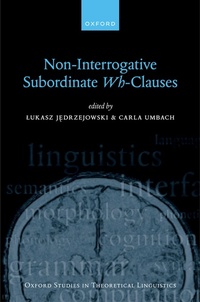
Non-Interrogative Subordinate Wh-Clauses
Published on 17. July 2023
Book
Hardback
560 pages
978-0-19-284462-0 (ISBN)
Description
This volume examines subordinate wh-clauses that lack an interrogative interpretation, particularly those in which the wh-word seems to deviate from its literal meaning. These include subordinate manner wh-clauses that have a declarative-like meaning, locative wh-clauses expressing kinds, and headed relatives that serve as recognitional cues, among many others. While regular interrogative embedding has been widely studied in recent years, little is known about the circumstances under which non-interrogative (subordinate) wh-clauses are licensed, nor why some, but not all, wh-phrases can be polyfunctional.
The chapters in the book combine the study of cross-linguistic variation in patterns of subordination with formal semantic and syntactic analyses, with data drawn from a wide range of languages including Basque, Czech, English, Mandarin, Romanian, and Taiwan Southern Min. They provide novel insights into the ways in which wh-phrases can be used to introduce complements, relative clauses, and adverbial clauses, and show how the meanings associated with wh-words are exploited beyond their standard distribution. The findings have implications for our understanding of both the phenomenon of subordination as a whole and the relationship between form and meaning in wh-clauses.
The chapters in the book combine the study of cross-linguistic variation in patterns of subordination with formal semantic and syntactic analyses, with data drawn from a wide range of languages including Basque, Czech, English, Mandarin, Romanian, and Taiwan Southern Min. They provide novel insights into the ways in which wh-phrases can be used to introduce complements, relative clauses, and adverbial clauses, and show how the meanings associated with wh-words are exploited beyond their standard distribution. The findings have implications for our understanding of both the phenomenon of subordination as a whole and the relationship between form and meaning in wh-clauses.
More details
Series
Language
English
Place of publication
Oxford
United Kingdom
Target group
College/higher education
Product notice
sewn/stitched
Cloth over boards
Dimensions
Height: 191 mm
Width: 160 mm
Thickness: 58 mm
Weight
975 gr
ISBN-13
978-0-19-284462-0 (9780192844620)
Copyright in bibliographic data and cover images is held by Nielsen Book Services Limited or by the publishers or by their respective licensors: all rights reserved.
Schweitzer Classification
Other editions
Additional editions
Lukasz Jedrzejowski | Carla Umbach
Non-Interrogative Subordinate Wh-Clauses
E-Book
07/2023
1st Edition
OUP eBook
€119.99
Available for download
Persons
Lukasz Jedrzejowski is a Postdoctoral Researcher in the Department of German Language and Literature I at the University of Cologne. His research interests include comparative syntax, formal diachronic semantics, and the syntax-semantics interface, and he has recently worked specifically on the diachrony of subordinate clauses and habituality.
Carla Umbach is a Senior Researcher in the Department of German Language and Literature I at the University of Cologne. Her main research interests are in semantics and cognitive science, with a particular focus on the expression of similarity in natural language, equative comparison, metalinguistic comparison, evaluative predicates, and exclamative utterances.
Carla Umbach is a Senior Researcher in the Department of German Language and Literature I at the University of Cologne. Her main research interests are in semantics and cognitive science, with a particular focus on the expression of similarity in natural language, equative comparison, metalinguistic comparison, evaluative predicates, and exclamative utterances.
Content
1: /Lukasz Jredrzejowski and Carla Umbach: Varieties of non-interrogative wh-clauses
2: Kristina Liefke: Two kinds of English non-manner how-clauses
3: Atle Gronn: Tense in how- and that-clauses under visual perception: A view from Russian
4: Aritz Irurtzun: Basque non-interrogative nola as a (de dicto) factive complementizer
5: Carla Umbach, Stefan Hinterwimmer, and Cornelia Ebert: Depictive manner complements
6: Norbert Corver: Decomposing adverbs and complementizers: A case study of Dutch hoe, 'how'
7: Roland Hinterhoelzl: Perceptive evidential wie-clauses in German: A situation-based approach
8: Radek %Simik and Jakub Slama: Czech evidential relatives introduced by jak, 'how': Recognitional cues for the hearer
9: Andreas Pankau: Comparative relatives in German
10: Karin Pittner and Werner Frey: German wie-comment and reporting clauses: A comparison with so-parentheticals
11: Wei-Tien Dylan Tsai: Embedding force and attitude: Evidence from Chinese and Vietnamese non-canonical wh-expressions
12: Lucia M. Tovena: Asking about the reason for an effect, and some consequences for the analysis of wh-interrogatives
13: Ivano Caponigro and Anamaria F&al&auls: 'Why' without asking in Romanian
14: Marisa Brook and Keir Moulton: Locating the locative in English pseudo-locative where-relatives
15: Wataru Uegaki: The doubt-whether puzzle
2: Kristina Liefke: Two kinds of English non-manner how-clauses
3: Atle Gronn: Tense in how- and that-clauses under visual perception: A view from Russian
4: Aritz Irurtzun: Basque non-interrogative nola as a (de dicto) factive complementizer
5: Carla Umbach, Stefan Hinterwimmer, and Cornelia Ebert: Depictive manner complements
6: Norbert Corver: Decomposing adverbs and complementizers: A case study of Dutch hoe, 'how'
7: Roland Hinterhoelzl: Perceptive evidential wie-clauses in German: A situation-based approach
8: Radek %Simik and Jakub Slama: Czech evidential relatives introduced by jak, 'how': Recognitional cues for the hearer
9: Andreas Pankau: Comparative relatives in German
10: Karin Pittner and Werner Frey: German wie-comment and reporting clauses: A comparison with so-parentheticals
11: Wei-Tien Dylan Tsai: Embedding force and attitude: Evidence from Chinese and Vietnamese non-canonical wh-expressions
12: Lucia M. Tovena: Asking about the reason for an effect, and some consequences for the analysis of wh-interrogatives
13: Ivano Caponigro and Anamaria F&al&auls: 'Why' without asking in Romanian
14: Marisa Brook and Keir Moulton: Locating the locative in English pseudo-locative where-relatives
15: Wataru Uegaki: The doubt-whether puzzle