

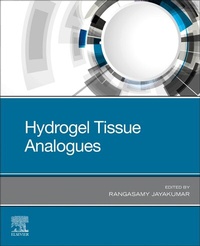
Hydrogel Tissue Analogues
Published on 1. December 2019
Book
Paperback/Softback
300 pages
978-0-12-816697-0 (ISBN)
Description
Hydrogel Tissue Analogues explores the diverse range of preparations of hydrogels as a tissue analogue, with a focus on processing methods and rheological characterization. Applications of hydrogels for various tissues are described, along with regulatory aspects and clinically used products. Chapters focus on state-of-the-art research in the processing of hydrogels, with a spotlight on biomimetic approaches and bioprinting, rheological characterization and implications in the biomedical field, the applications of hydrogels in tissue regeneration, including bone, adipose, cartilage, cardiac, intervertebral disc and skin regeneration, as well as hydrogels for hemostasis, enhancing vascularization and treatment of infectious diseases, the bioadhesive nature of hydrogels, and regulatory aspects.
More details
Language
English
Place of publication
United States
Target group
Professional and scholarly
Researchers, scientists and graduate students in polymer chemistry and biomedical research
Dimensions
Height: 235 mm
Width: 191 mm
ISBN-13
978-0-12-816697-0 (9780128166970)
Copyright in bibliographic data and cover images is held by Nielsen Book Services Limited or by the publishers or by their respective licensors: all rights reserved.
Schweitzer Classification
Persons
Rangasamy Jayakumar is a Professor at the Centre for Nanosciences and Molecular Medicine, Amrita Vishwa Vidyapeetham (Deemed University), Kerala, India. He received his PhD degree in polymer chemistry from Anna University, Chennai, India (2002) and MSc degree from Bharathidasan University.
Dr. Arun Kumar Rajendran is a Senior Researcher at the School of Chemical and Biological Engineering, Institute of Chemical Processes, Seoul National University, Seoul, South Korea. His current research focuses on materials for tissue engineering and regenerative medicine, especially biopolymers and bioceramics. He was awarded his bachelors in dental surgery (B.D.S.) from Bharath University, Chennai, India (2010) and Master of technology (Nanosciene and Technology) from Amrita Vishwavidhyapeetham University, Kochi, India. He obtained his Doctoral degree (Ph.D.) from Tokyo Medical and Dental University, Tokyo, Japan (2019), along with the prestigious MEXT scholarship. His current role is supported by the prestigious KRF-Brain Pool fellowship awarded by the National Research Foundation of Korea (NRF) (2020-present). He has around 20 international publications with more than 850 citations. He has also authored 3 book chapters and presented his works in various international conferences. He has won several best presentation awards for his works in the conferences. He also volunteers as a peer-reviewer in some of the international journals.
Dr. Arun Kumar Rajendran is a Senior Researcher at the School of Chemical and Biological Engineering, Institute of Chemical Processes, Seoul National University, Seoul, South Korea. His current research focuses on materials for tissue engineering and regenerative medicine, especially biopolymers and bioceramics. He was awarded his bachelors in dental surgery (B.D.S.) from Bharath University, Chennai, India (2010) and Master of technology (Nanosciene and Technology) from Amrita Vishwavidhyapeetham University, Kochi, India. He obtained his Doctoral degree (Ph.D.) from Tokyo Medical and Dental University, Tokyo, Japan (2019), along with the prestigious MEXT scholarship. His current role is supported by the prestigious KRF-Brain Pool fellowship awarded by the National Research Foundation of Korea (NRF) (2020-present). He has around 20 international publications with more than 850 citations. He has also authored 3 book chapters and presented his works in various international conferences. He has won several best presentation awards for his works in the conferences. He also volunteers as a peer-reviewer in some of the international journals.
Content
Part 1 Introduction, Preparation and Characterization of Hydrogels
1. Introduction to Hydrogels
2. Preparation of Hydrogels for Biomedical applications: Biomimetic Approach
3. Bioprinting of Hydrogels
4. Rheological Characterization of Hydrogel and implications towards biomedical applications
Part 2 Application of Hydrogels
5. Bioadhesive Hydrogel
6. Tissue Sealants and hemostatic Hydrogels
7. Hydrogels for improving angiogenesis
8. Hydrogels for Bone Regeneration
9. Hydrogels for Cartilage Regeneration
10. Hydrogels for Cardiac tissue regeneration
11. Intervertebral disc regeneration using Hydrogel implants
12. Hydrogels for Adipose Tissue Engineering
13. Hydrogels for Skin regeneration
14. Hydrogels for Infectious Diseases
15. Hydrogels in Dentistry
Part 3 Regulation and clinical application of Hydrogels
16. Regulation of hydrogels based products for Biomedical application
17. Clinically used hydrogels for Biomedical application
1. Introduction to Hydrogels
2. Preparation of Hydrogels for Biomedical applications: Biomimetic Approach
3. Bioprinting of Hydrogels
4. Rheological Characterization of Hydrogel and implications towards biomedical applications
Part 2 Application of Hydrogels
5. Bioadhesive Hydrogel
6. Tissue Sealants and hemostatic Hydrogels
7. Hydrogels for improving angiogenesis
8. Hydrogels for Bone Regeneration
9. Hydrogels for Cartilage Regeneration
10. Hydrogels for Cardiac tissue regeneration
11. Intervertebral disc regeneration using Hydrogel implants
12. Hydrogels for Adipose Tissue Engineering
13. Hydrogels for Skin regeneration
14. Hydrogels for Infectious Diseases
15. Hydrogels in Dentistry
Part 3 Regulation and clinical application of Hydrogels
16. Regulation of hydrogels based products for Biomedical application
17. Clinically used hydrogels for Biomedical application