

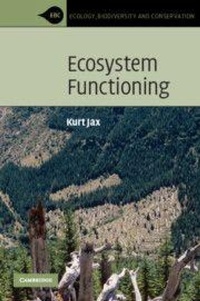
Ecosystem Functioning
Published on 16. September 2010
Book
Paperback/Softback
286 pages
978-0-521-70523-3 (ISBN)
Description
In the face of decreasing biodiversity and ongoing global changes, maintaining ecosystem functioning is seen both as a means to preserve biological diversity as well as for safeguarding human well-being by securing the services ecosystems provide. The concept today is prominent in many fields of ecology and conservation biology, such as biodiversity research, ecosystem management, or restoration ecology. Although the idea of ecosystem functioning is important, the concept itself remains rather vague and elusive. This book provides a novel analysis and integrated synthesis of different approaches to conceptualising and assessing ecosystem functioning. It links the natural sciences with methodologies from philosophy and the social sciences, and introduces a new methodology for a clearer and more efficient application of ecosystem functioning concepts in practice. Special emphasis is laid on the social dimensions of the concept and the ways it influences research practice. Several case studies relate theoretical analyses to practical application.
Reviews / Votes
"The text is filed with many intriguing questions, offering constant stimulation to readers. A valuable resource for readers interested in ecological theory as well as ecosystem science and management. Highly recommended."J. Chen, University of Toledo for Choice Magazine
More details
Series
Language
English
Place of publication
Cambridge
United Kingdom
Target group
Professional and scholarly
Product notice
Paperback (trade)
Illustrations
Worked examples or Exercises; 1 Tables, black and white; 2 Maps; 8 Halftones, black and white; 30 Line drawings, black and white
Dimensions
Height: 228 mm
Width: 154 mm
Thickness: 17 mm
Weight
467 gr
ISBN-13
978-0-521-70523-3 (9780521705233)
Copyright in bibliographic data and cover images is held by Nielsen Book Services Limited or by the publishers or by their respective licensors: all rights reserved.
Schweitzer Classification
Other editions
Additional editions
Kurt Jax
Ecosystem Functioning
E-Book
09/2012
1st Edition
Cambridge University Press
€54.49
Available for download
Kurt Jax
Ecosystem Functioning
Book
09/2010
Cambridge University Press
€147.50
No shipping information available
Person
Kurt Jax is a senior scientist at the Helmholtz-Centre for Environmental Research - UFZ, in Leipzig, Germany, and Professor of Ecology at the Department of Ecology and Ecosystem Management of the Technische Universitaet Muenchen, Munich. He was educated as a freshwater ecologist. Having gained experience in research and conservation projects in freshwater, terrestrial and marine environments, he now focuses on the conceptual foundations of ecology and conservation biology, a field in which he has done research for two decades. His special emphasis is on the application of ecological concepts as tools for conservation biology and on the adaptation of methods from the humanities (especially philosophy) for interdisciplinary research in the environmental sciences. He pursues both theoretical and empirical research in this field. His activities include the development of the new research and edition project Handbook of Ecological Concepts and empirical conservation research in the Cape Horn region. Major publications of the last years have dealt with the concepts referring to ecological units (such as population, community, or ecosystem), and the relations between peoples' perceptions of nature and conservation strategies. Between 1999 and 2008 Kurt Jax was also a member of the Editorial Advisory Board of the journal Environmental Ethics.
Content
1. Introduction; 2. Setting the scene. The context of investigating ecosystem functioning; 3. What do we need for a functioning ecosystem? The debate on biodiversity and ecosystem functioning; 4. Becoming general: What is ecosystem functioning?; 5. Ecosystem functioning: science meets society; 6. Assessing ecosystem functioning: existing approaches; 7. Putting ecosystem functioning concepts into practice: a classification and some guidelines.