

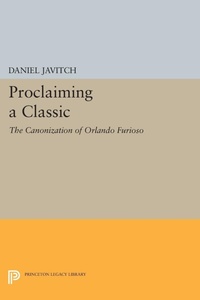
Proclaiming a Classic
The Canonization of Orlando Furioso
Will be published approx. on 14. July 2014
Book
Paperback/Softback
216 pages
978-0-691-60601-9 (ISBN)
Description
Despite its immediate popularity and its acclaim as a modern equal of the ancient epics, Ariosto's Orlando Furioso (published in its final version in 1532) was for learned readers a perplexing work: it mixed romance, epic, and lyric poetry, poked fun at its marvelous and outmoded chivalric matter, contained many interrupted narrative threads, and included base and lowborn characters. In exploring the literary debates involved in elevating the Furioso to the rank of a classic, Daniel Javitch maintains that this was the first work of modern poetry to provoke widespread critical controversy, and that the contestation played an inaugural role in the formation of the European poetic canon. The Furioso was seen by its early publishers to embody the formal, thematic, and functional characteristics of the highly esteemed epics of antiquity. Some critics, however, found in this poem new forms and functions that seemed better suited to modern times; still others denied the work any form of legitimacy.
Showing how the Furioso became a locus upon which various and conflicting ideologies could be projected, Javitch argues that such a development offers the best indication of a poem's having achieved canonicity. Originally published in 1991. The Princeton Legacy Library uses the latest print-on-demand technology to again make available previously out-of-print books from the distinguished backlist of Princeton University Press. These editions preserve the original texts of these important books while presenting them in durable paperback and hardcover editions. The goal of the Princeton Legacy Library is to vastly increase access to the rich scholarly heritage found in the thousands of books published by Princeton University Press since its founding in 1905.
Showing how the Furioso became a locus upon which various and conflicting ideologies could be projected, Javitch argues that such a development offers the best indication of a poem's having achieved canonicity. Originally published in 1991. The Princeton Legacy Library uses the latest print-on-demand technology to again make available previously out-of-print books from the distinguished backlist of Princeton University Press. These editions preserve the original texts of these important books while presenting them in durable paperback and hardcover editions. The goal of the Princeton Legacy Library is to vastly increase access to the rich scholarly heritage found in the thousands of books published by Princeton University Press since its founding in 1905.
More details
Series
Language
English
Place of publication
New Jersey
United States
Target group
College/higher education
Professional and scholarly
Product notice
Paperback (trade)
Dimensions
Height: 234 mm
Width: 156 mm
Thickness: 12 mm
Weight
336 gr
ISBN-13
978-0-691-60601-9 (9780691606019)
Copyright in bibliographic data and cover images is held by Nielsen Book Services Limited or by the publishers or by their respective licensors: all rights reserved.
Schweitzer Classification
Other editions
Additional editions
E-Book
07/2014
1st Edition
Princeton University Press
€37.99
Available for download
Person
Daniel Javitch
Content
*FrontMatter, pg. i*CONTENTS, pg. vii*ACKNOWLEDGMENTS, pg. ix*INTRODUCTION, pg. 3*Chapter One. THE SUCCESS OF ORLANDO FURIOSO IN THE SIXTEENTH CENTURY, pg. 10*Chapter Two. THE LEGITIMATION OF ORLANDO FURIOSO, pg. 21*Chapter Three. COMMENTARIES ON IMITATIONS IN ORLANDO FURIOSO, pg. 48*Chapter Four. AFFILIATIONS WITH OVID'S METAMORPHOSES, pg. 71*Chapter Five. CRITICAL RESPONSES TO NARRATIVE DISCONTINUITY IN ORLANDO FURIOSO, pg. 86*Chapter Six. LIONARDO SALVIATI'S DEFENSE OF ORLANDO FURIOSO, pg. 106*Chapter Seven. OTHER DEFENSES OF ORLANDO FURIOSO IN THE 1580s, pg. 123*Chapter Eight. HARINGTON'S ENGLISH REFRACTIONS OF ORLANDO FURIOSO, pg. 134*CONCLUSION, pg. 158*NOTES, pg. 167*PRIMARY WORKS CONSULTED, pg. 199*INDEX, pg. 203