

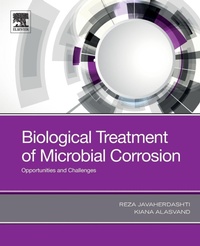
Biological Treatment of Microbial Corrosion
Opportunities and Challenges
Published on 26. February 2019
Book
Paperback/Softback
162 pages
978-0-12-816108-1 (ISBN)
Description
Biological Treatment of Microbial Corrosion: Opportunities and Challenges explores the latest biological approaches to microbial corrosion and its inhibition. The book provides comprehensive information on the current knowledge of microbes involved in corrosion and their mechanisms of action on corrosion induction and inhibition. This information is helpful for a wide range of audiences, from university researchers, to industry specialists. The book discusses foundational information about corrosion and microbiologically influenced corrosion and its importance. Other chapters provide an in-depth review of corrosion causing microorganisms, their properties and their mechanism of involvement in MIC.
Updated findings on the biological treatment of corrosion are addressed, as are future opportunities and challenges that could lead to prosperous, sustainable and secure industrial application of these techniques.
Updated findings on the biological treatment of corrosion are addressed, as are future opportunities and challenges that could lead to prosperous, sustainable and secure industrial application of these techniques.
More details
Language
English
Place of publication
United States
Target group
Professional and scholarly
Product notice
Paperback (trade)
Dimensions
Height: 235 mm
Width: 191 mm
Thickness: 9 mm
Weight
291 gr
ISBN-13
978-0-12-816108-1 (9780128161081)
Copyright in bibliographic data and cover images is held by Nielsen Book Services Limited or by the publishers or by their respective licensors: all rights reserved.
Schweitzer Classification
Other editions
Additional editions
Reza Javaherdashti | Kiana Alasvand
Biological Treatment of Microbial Corrosion
Opportunities and Challenges
E-Book
02/2019
Elsevier
€131.00
Available for download
Persons
Dr. Javaherdashti holds a double degree in materials science and metallurgical engineering. He has more than 20 years of industrial and academic experience. In addition to various research papers and root cause analysis reports, Dr. Javaherdashti has authored several reference books on corrosion. He is an American Society of Mechanical Engineers (ASME)-approved trainer and has designed and executed many international industrial workshops. Furthermore, he has been involved in many consulting and problem-solving activities around the globe and is also a corrosion advisor to internationally renowned companies. Dr. Javherdashti is a veteran member of various well-reputed international corrosion societies such as the National Association of Corrosion Engineers (NACE). Dr. Kiana Alasvand is a Research Fellow with the Department of Studies in Microbiology, University of Mysore, India. Dr. Alasvand's topics of research include: the study of corrosion of metal exposed to bacterial culture by mass loss, bacterial biosynthesis of nanoparticles and its characterization, screening of antimicrobial producing bacteria against SRB, and isolation and identification of sulfate reducing bacteria from ship hull by biochemical and molecular methods.
Content
1. Introduction: Why corrosion and particularly microbial corrosion are important2. A Brief introduction to Corrosion Engineering3. An Introduction to Microbial corrosion4. An Introduction to Microbiology for Non-Microbiologists5. Biological Treatment of MIC6. Conclusion