

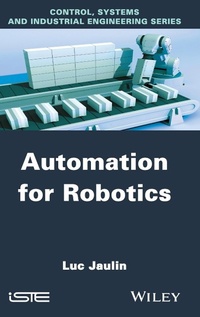
Automation for Robotics
1st Edition
Will be published approx. on 3. March 2015
Book
Hardback
256 pages
978-1-84821-798-0 (ISBN)
Description
In order to enable a better understanding of the key concepts of automation, this book develops the fundamental aspects of the field while also proposing numerous concrete exercises and their solutions. The theoretical approach that it presents fundamentally uses the state space and makes it possible to process general and complex systems in a simple way, involving several switches and sensors of different types. This approach requires the use of developed theoretical tools such as linear algebra, analysis and physics, generally taught in preparatory classes for specialist engineering courses.
More details
Language
English
Place of publication
London
United Kingdom
Target group
Professional and scholarly
Product notice
sewn/stitched
Cloth over boards
Dimensions
Height: 240 mm
Width: 161 mm
Thickness: 19 mm
Weight
557 gr
ISBN-13
978-1-84821-798-0 (9781848217980)
Copyright in bibliographic data and cover images is held by Nielsen Book Services Limited or by the publishers or by their respective licensors: all rights reserved.
Schweitzer Classification
Other editions
Additional editions
Person
Luc Jaulin is Professor in Robotics at ENSTA-Bretagne in France. He conducts research at the Lab-STICC in the field of submarine robotics and sailing robots using set methods.
Content
INTRODUCTION vii
CHAPTER 1. MODELING 1
1.1. Linear systems 1
1.2. Mechanical systems 2
1.3. Servomotors 4
1.4. Exercises 4
1.5. Solutions 21
CHAPTER 2. SIMULATION 47
2.1. Concept of vector field 47
2.2. Graphical representation 49
2.2.1. Patterns 50
2.2.2. Rotation matrix 50
2.2.3. Homogeneous coordinates 52
2.3. Simulation 54
2.3.1. Euler's method 54
2.3.2. Runge-Kutta method 55
2.3.3. Taylor's method 56
2.4. Exercises 56
2.5. Solutions 67
CHAPTER 3. LINEAR SYSTEMS 85
3.1. Stability 85
3.2. Laplace transform 87
3.2.1. Laplace variable 87
3.2.2. Transfer function 88
3.2.3. Laplace transform 88
3.2.4. Input-output relation 90
3.3. Relationship between state and transfer representations 90
3.4. Exercises 92
3.5. Solutions 103
CHAPTER 4. LINEAR CONTROL 127
4.1. Controllability and observability 128
4.2. State feedback control 129
4.3. Output feedback control 130
4.4. Summary 133
4.5. Exercises 134
4.6. Solutions 150
CHAPTER 5. LINEARIZED CONTROL 185
5.1. Linearization 185
5.1.1. Linearization of a function 185
5.1.2. Linearization of a dynamic system 187
5.1.3. Linearization around an operating point 187
5.2. Stabilization of a nonlinear system 188
5.3. Exercises 191
5.4. Solutions 207
BIBLIOGRAPHY 235
INDEX 237
CHAPTER 1. MODELING 1
1.1. Linear systems 1
1.2. Mechanical systems 2
1.3. Servomotors 4
1.4. Exercises 4
1.5. Solutions 21
CHAPTER 2. SIMULATION 47
2.1. Concept of vector field 47
2.2. Graphical representation 49
2.2.1. Patterns 50
2.2.2. Rotation matrix 50
2.2.3. Homogeneous coordinates 52
2.3. Simulation 54
2.3.1. Euler's method 54
2.3.2. Runge-Kutta method 55
2.3.3. Taylor's method 56
2.4. Exercises 56
2.5. Solutions 67
CHAPTER 3. LINEAR SYSTEMS 85
3.1. Stability 85
3.2. Laplace transform 87
3.2.1. Laplace variable 87
3.2.2. Transfer function 88
3.2.3. Laplace transform 88
3.2.4. Input-output relation 90
3.3. Relationship between state and transfer representations 90
3.4. Exercises 92
3.5. Solutions 103
CHAPTER 4. LINEAR CONTROL 127
4.1. Controllability and observability 128
4.2. State feedback control 129
4.3. Output feedback control 130
4.4. Summary 133
4.5. Exercises 134
4.6. Solutions 150
CHAPTER 5. LINEARIZED CONTROL 185
5.1. Linearization 185
5.1.1. Linearization of a function 185
5.1.2. Linearization of a dynamic system 187
5.1.3. Linearization around an operating point 187
5.2. Stabilization of a nonlinear system 188
5.3. Exercises 191
5.4. Solutions 207
BIBLIOGRAPHY 235
INDEX 237