

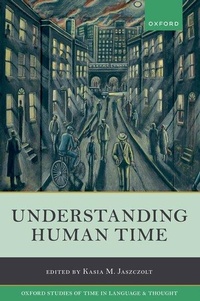
Understanding Human Time
Published on 25. May 2023
Book
Hardback
378 pages
978-0-19-289644-5 (ISBN)
Description
This book explores the time that we (think we) experience and the concept of time in our beliefs, our knowledge, and our fears. We believe that time passes, we know that death is inevitable, we fear that we are going to be late. How do these human feelings and sensations of time relate to metaphysical time of tenseless reality? What do different languages tell us about the nature of human time? And what exactly is the flow of time? The chapters in this volume bring together insights from linguists and philosophers to examine questions about time on the micro-level of physical reality, as well as time in language and discourse on the macro-level of social reality. The unifying theme is that in order to understand human time we have to discover not only how we think and speak about time, but also what it is that makes us think and speak about it in a certain way.
More details
Series
Language
English
Place of publication
Oxford
United Kingdom
Target group
Professional and scholarly
Product notice
sewn/stitched
Cloth over boards
Dimensions
Height: 241 mm
Width: 162 mm
Thickness: 27 mm
Weight
703 gr
ISBN-13
978-0-19-289644-5 (9780192896445)
Copyright in bibliographic data and cover images is held by Nielsen Book Services Limited or by the publishers or by their respective licensors: all rights reserved.
Schweitzer Classification
Other editions
Additional editions

Kasia M. Jaszczolt
Understanding Human Time
E-Book
05/2023
1st Edition
OUP eBook
€98.99
Available for download

Kasia M. Jaszczolt
Understanding Human Time
E-Book
05/2023
1st Edition
OUP eBook
€98.99
Available for download
Person
Kasia M. Jaszczolt is Professor of Linguistics and Philosophy of Language at the University of Cambridge and Professorial Fellow of Newnham College, Cambridge. Her research interests include (i) the compositionality and dynamicity of discourse meaning, and (ii) the human concept of time in the context of the concept of the self and how the two are expressed in different languages. She is the author of the OUP volumes Default Semantics (2005), Representing Time (2009), and Meaning in Linguistic Interaction (2016), and co-editor of Time: Language, Cognition, and Reality (with Louis de Saussure; OUP 2013) and Expressing the Self: Cultural Diversity and Cognitive Universals (with Minyao Huang; OUP 2018).
Content
1: Kasia M. Jaszczolt: Introduction: Metaphysical time, human time, and time in language
2: Simon Prosser: Tense and emotion
3: Anna Piata: An exploration into construals of subjective time in poetry
4: Graeme A. Forbes: The 2D past
5: Louis de Saussure: Counterfactuality as pragmatic inference in perspectival readings of Past Conditional utterances with modal verbs: Evidence from French
6: Patrick Caudal: Avertive/frustrative markers in Australian languages: Blurring the boundaries between aspectuo-temporal and modal meanings
7: M. Joshua Mozersky: On modelling the future
8: Matt Farr: Perceiving direction in directionless time
9: Giuliano Torrengo: Temporal transparency and the flow of time
10: Kasia M. Jaszczolt: Does human time really flow? Metaindexicality, metarepresentation, and basic concepts
11: Daniel L. Everett: Underspecified temporal semantics in Piraha: Compositional transparency and semiotic inference
References
Index
2: Simon Prosser: Tense and emotion
3: Anna Piata: An exploration into construals of subjective time in poetry
4: Graeme A. Forbes: The 2D past
5: Louis de Saussure: Counterfactuality as pragmatic inference in perspectival readings of Past Conditional utterances with modal verbs: Evidence from French
6: Patrick Caudal: Avertive/frustrative markers in Australian languages: Blurring the boundaries between aspectuo-temporal and modal meanings
7: M. Joshua Mozersky: On modelling the future
8: Matt Farr: Perceiving direction in directionless time
9: Giuliano Torrengo: Temporal transparency and the flow of time
10: Kasia M. Jaszczolt: Does human time really flow? Metaindexicality, metarepresentation, and basic concepts
11: Daniel L. Everett: Underspecified temporal semantics in Piraha: Compositional transparency and semiotic inference
References
Index