

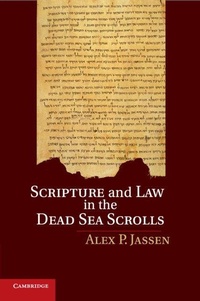
Scripture and Law in the Dead Sea Scrolls
Published on 2. August 2018
Book
Paperback/Softback
322 pages
978-1-108-46903-6 (ISBN)
Description
This book is the first work of its kind to examine legal exegesis in the Dead Sea Scrolls from the perspective of both the history of Jewish law and early Jewish scriptural interpretation. It shows how the Dead Sea Scrolls transform the meaning and application of biblical law to meet the needs of new historical and cultural settings. The Dead Sea Scrolls legal texts are examined through the comparative lens of law and legal interpretation in Second Temple Judaism and rabbinic Judaism. The creative interpretation of scriptural texts in the Dead Sea Scrolls responds to the tension between seemingly rigid authoritative scripture and the need for law and scripture to be perpetually evolving entities. The ongoing legal interpretation of scriptural texts frames the development of Jewish law at the same time as it shapes the nature of the biblical canon.
Reviews / Votes
'In this book, Alex P. Jassen joins two lines of inquiry that are commonly pursued independently of one another: the scriptural hermeneutics of the Dead Sea Scrolls and their legal contents. Previous studies of scriptural interpretation in the Dead Sea Scrolls have tended to focus on the nonlegal, narrative, hortatory, liturgical, and eschatalogical texts, while those on the legal contents of the scrolls have sought to uncover the sect's practices, polemics against other groups, or the larger history of ancient Jewish law. While there have been several important recent studies that combine interests in Qumran (the site of the discovery of the Dead Sea Scrolls) law and scriptural exegesis, none has been as comprehensive and as systematic as is Jassen's. This book offers high-quality scholarship on an important and timely topic.' Steven D. Fraade, Mark Taper Professor of the History of Judaism, Yale University, Connecticut 'There is no doubt that the legal texts from Qumran have become a real focus of scrolls research in the relatively short time that all of them have been available. The contemporary emphasis on these texts reflects well their importance to the ancient community that owned them. Despite all the research that has been devoted to these works, Jassen approaches them in an original way. He knows the texts well, deals with issues of reading and reconstruction, interacts with the secondary literature adeptly, and explains the issues lucidly. Jassen works at a very high level.' James C. VanderKam, John A. O'Brien Professor of Hebrew Scriptures, University of Notre Dame, Indiana 'This volume fleshes out an important new research agenda which Jassen forcefully promoted in a 30-page article on 'The Presentation of the Ancient Prophets as Lawgivers at Qumran' that appeared in the Journal of Biblical Studies in 2008 ... The present volume consolidates this approach further by offering detailed case studies exploring legal hermeneutics of prophetic texts in the Scrolls and reflecting on the significance of those findings for the history of Jewish law and legal exegesis from the Second Temple period to the rabbis.' Charlotte Hempe, Journal of Jewish StudiesMore details
Language
English
Place of publication
Cambridge
United Kingdom
Target group
College/higher education
Professional and scholarly
Product notice
Paperback (trade)
Illustrations
Worked examples or Exercises; 15 Tables, unspecified
Dimensions
Height: 229 mm
Width: 152 mm
Thickness: 20 mm
Weight
525 gr
ISBN-13
978-1-108-46903-6 (9781108469036)
Copyright in bibliographic data and cover images is held by Nielsen Book Services Limited or by the publishers or by their respective licensors: all rights reserved.
Schweitzer Classification
Other editions
Additional editions
Alex P. Jassen
Scripture and Law in the Dead Sea Scrolls
Book
04/2014
Cambridge University Press
€72.10
Shipment within 15-20 days
Person
Alex P. Jassen is Associate Professor of Hebrew and Judaic Studies in the Skirball Department of Hebrew and Judaic Studies at New York University. He previously taught at the University of Minnesota, where he was the recipient of the university's prestigious McKnight Land-Grant Fellowship. Dr Jassen holds a B.A. in Jewish Studies and Near Eastern Languages and Civilizations from the University of Washington (2001) and a Ph.D. in Hebrew and Judaic Studies from New York University (2006). He has published widely on the Dead Sea Scrolls and ancient Judaism and is a member of the international editorial team responsible for publication of the Dead Sea Scrolls. He is the author of Mediating the Divine: Prophecy and Revelation in the Dead Sea Scrolls and Second Temple Judaism (2012), winner of the 2009 John Templeton Award for Theological Promise, as well as many articles in leading journals such as the Association for Jewish Studies Review, Biblical Interpretation, Dead Sea Discoveries, the Journal of Biblical Literature, the Journal of Jewish Studies, and Revue de Qumran. He is the co-editor of Scripture, Violence, and Textual Practice in Early Judaism and Christianity (with Ra'anan S Boustan and Calvin J. Roetzel, 2010), and co-editor-in-chief of the Journal of Ancient Judaism. He served as academic advisor for the 'Dead Sea Scrolls: Words that Changed the World' exhibit at the Science Museum of Minnesota. His work on religious violence has been recognized with a fellowship from the National Endowment for the Humanities.
Content
1. Introduction; 2. The Dead Sea Scrolls and the history of Jewish law and legal exegesis; 3. Jewish legal exegesis and the origins and development of the canon; 4. Isaiah 58:13 and the Sabbath prohibition on speech in the Dead Sea Scrolls, Part 1: the Damascus Document; 5. Isaiah 58:13 and the Sabbath prohibition on speech in the Dead Sea Scrolls, Part 2: 4QHalakha B; 6. Isaiah 58:13 and the Sabbath prohibition on speech in the Book of Jubilees and Rabbinic literature; 7. Isaiah 58:13 and the restriction on thoughts of labor on the Sabbath in the Dead Sea Scrolls; 8. Isaiah 58:13 and the restriction on thoughts of labor on the Sabbath in Philo and Rabbinic literature; 9. Jeremiah 17:21-22 and the Sabbath carrying prohibition in the Dead Sea Scrolls; 10. Jeremiah 17:21-22 and the Sabbath carrying prohibition in Nehemiah, Jubilees, and Rabbinic literature; 11. Non-pentateuchal passages as prooftexts; 12. Conclusions.