

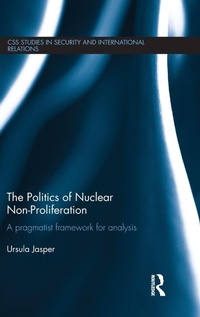
The Politics of Nuclear Non-Proliferation
A pragmatist framework for analysis
1st Edition
Published on 9. October 2013
Book
Hardback
240 pages
978-0-415-82139-1 (ISBN)
Description
This book examines the puzzle of why some states acquire nuclear weapons, whereas others refrain from trying to do so - or even renounce them.
Based on the predominant theoretical thinking in International Relations it is often assumed that nuclear proliferation is inevitable, given the anarchic nature of the international system. Proliferation is thus often explained by vague references to states' insecurity in an anarchic environment. Yet, elusive generalisations and grand, abstract theories inhibit a more profound and detailed knowledge of the very political processes that lead towards nuclearisation or its reversal.
Drawing upon the philosophical and social-theoretical insights of American pragmatism, The Politics of Nuclear Non-Proliferation provides a theoretically innovative and practically useful framework for the analysis of states' nuclear proliferation policies. Rather than reccounting a parsimonious, lean account of proliferation, the framework allows for the incorporation of multiple paradigms in order to depict the complex political contestation underlying states' proliferation decisions. This pragmatist framework of analysis offers ways of overcoming long-standing metatheoretical gridlocks in the IR discipline and encourages scholars to reorient their efforts towards imminent "real-world" challenges.
This book will be of much interest to students of nuclear proliferation, international security and IR theory.
Based on the predominant theoretical thinking in International Relations it is often assumed that nuclear proliferation is inevitable, given the anarchic nature of the international system. Proliferation is thus often explained by vague references to states' insecurity in an anarchic environment. Yet, elusive generalisations and grand, abstract theories inhibit a more profound and detailed knowledge of the very political processes that lead towards nuclearisation or its reversal.
Drawing upon the philosophical and social-theoretical insights of American pragmatism, The Politics of Nuclear Non-Proliferation provides a theoretically innovative and practically useful framework for the analysis of states' nuclear proliferation policies. Rather than reccounting a parsimonious, lean account of proliferation, the framework allows for the incorporation of multiple paradigms in order to depict the complex political contestation underlying states' proliferation decisions. This pragmatist framework of analysis offers ways of overcoming long-standing metatheoretical gridlocks in the IR discipline and encourages scholars to reorient their efforts towards imminent "real-world" challenges.
This book will be of much interest to students of nuclear proliferation, international security and IR theory.
More details
Series
Language
English
Place of publication
London
United Kingdom
Publishing group
Taylor & Francis Ltd
Target group
College/higher education
Professional and scholarly
Illustrations
1 s/w Zeichnung, 1 s/w Tabelle
1 Tables, black and white; 1 Line drawings, black and white
Dimensions
Height: 240 mm
Width: 161 mm
Thickness: 18 mm
Weight
529 gr
ISBN-13
978-0-415-82139-1 (9780415821391)
Copyright in bibliographic data and cover images is held by Nielsen Book Services Limited or by the publishers or by their respective licensors: all rights reserved.
Schweitzer Classification
Other editions
Additional editions
Book
08/2015
1st Edition
Routledge
€48.10
Shipment within 10-20 days
E-Book
10/2013
1st Edition
Routledge
€41.99
Available for download
E-Book
10/2013
1st Edition
Routledge
€41.99
Available for download
Person
Ursula Jasper is a Senior Researcher at the Center for Security Studies (CSS), Swiss Institute of Technology (ETH), Zurich. She holds a PhD in Political Science from the University of St Gallen, Switzerland.
Content
1. Introduction 2. Debating (non-)Proliferation 3. A Pragmatist Framework of Analysis 4. Switzerland - The Ambivalent Neutral 5. Libya - The Stateless State 6. Conclusion