

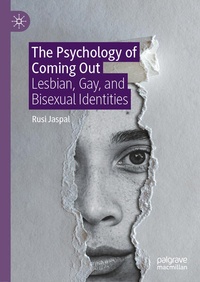
The Psychology of Coming Out
Description
Until now, dominant models of sexual identity development have overlooked the interpersonal process of coming out to somebody significant. None interrogate the implications of coming out for the total identity of the individual. In this elegant and original book, Rusi Jaspal proposes an integrative theoretical framework within which the psychological antecedents, consequences, and experiences of coming out can be collectively examined.
Drawing on case studies and the first-hand accounts of over 500 lesbian, gay, and bisexual people regarding their coming out experiences, this book forces us to re-think the notion that we now live a "post-gay era" in which coming out no longer matters. It explores themes, such as identity authenticity, interpersonal relationships, identity invalidation, rejection, microaggressions, gaslighting, and ghosting.
The Psychology of Coming Out: Lesbian, Gay, and Bisexual Identities is an invaluable resource for students, academics, and practitioners interested in the psychology of coming out.
Reviews / Votes
"An extraordinary 'deep dive' from a leading expert on the psychology of sexuality, this book provides a vital window into a critical process of sexual identity development. It represents as an invaluable resource for researchers, practitioners, sexual minority people, and all those who support sexual diversity." (Phillip L. Hammack, Ph.D., Professor of Psychology and Director of the Sexual and Gender Diversity Laboratory, University of California, Santa Cruz, USA)
"In
The Psychology of Coming Out
, Professor Rusi Jaspal, a leading figure in LGBTQ+ scholarship, has produced what I have no doubt is a landmark contribution and an essential read for anyone seeking to understand the deeply personal, yet profoundly social, journey of coming out. Through compelling case studies and thematic analyses, Professor Jaspal gives voice to a diverse range of LGB coming out experiences across varied contexts, all illuminated with care, dignity, and scholarly depth. This book is not only an important scholarly investigation into identity processes associated with coming out, it is also a compassionately written window into the wider psychological journey of LGB individuals and as such will be of great relevance to clinicians, educators, EDI professionals, family members and policymakers and is a call to action for society to create environments where LGB individuals can thrive and be supported. A true milestone in LGBTQ+ Psychology." (Professor Marco Cinnirella, Professor of Applied Social Psychology, Royal Holloway, University of London, UK)
"Rusi Jaspal's
The Psychology of Coming Out: Lesbian, Gay, and Bisexual Identities
offers a thought-provoking and nuanced exploration of the psychological dimensions of coming out, with a particular emphasis on global and cross-cultural contexts. Drawing on extensive research, Jaspal delves into the lived experiences of disclosing one's sexual identity, examining how this pivotal act influences personal cognition, interpersonal relationships, and the broader construction and defense of identity. He carefully considers both the benefits and challenges associated with coming out, providing a comprehensive analysis that bridges individual experience with sociocultural frameworks. This book is a valuable resource for university students at all levels-undergraduate and graduate alike-as well as for researchers interested in the theoretical and methodological underpinnings of coming out processes." (Professor Christian Grov, Distinguished Professor of Public Health, CUNY Graduate School of Public Health and Health Policy, New York, USA)
"This book presents a comprehensive and very clearly expressed account of theory, process, and lived experience of 'coming out' for lesbian, gay, and bisexual (LGB) people. It incorporates a detailed critique of the vast research on the topic, as well as presenting a new and integrated way to think about coming out as both an event and as a continued life-long process. Especially interesting is the inclusion of new data on the lived experience of coming out and how these data may help us to understand individuals' experiences from the words of the individuals themselves. These data also highlight the many complexities associated with coming out for LGB people within heteronormative societies. This book is an important read for all, and especially for anyone working in the educational, health, and helping professions." (Dr Claire Bloxsom, UKCP Registered Integrative Psychotherapist, BPS Chartered Psychologist, Nottingham, UK)
"The 'Psychology of Coming Out' is a landmark contribution to our understanding of lesbian, gay, and bisexual identities. Rusi Jaspal offers a compelling, theory-informed analysis of the psychological processes involved in coming out, drawing on rich empirical data and global perspectives. This book challenges assumptions about coming out, highlights the complexity of the process and experience of coming out, and culminates in a novel framework that will no doubt prove invaluable for further research and interventions aimed at supporting LGB individuals in diverse contexts. It is essential reading for scholars, practitioners, and students alike." (Professor David M. Frost, Professor of Social Psychology, University College London, London, UK)
More details
Other editions
Additional editions
Person
Rusi Jaspal is Professor of Psychology and Pro Vice-Chancellor (Research and Knowledge Exchange) at the University of Brighton in the UK. He is a Chartered Psychologist and a Fellow of the British Psychological Society, a Fellow of the Royal Society of Public Health, and a Fellow of the Academy of Social Sciences. He was educated at the University of Cambridge, University of Surrey and Royal Holloway, University of London, where he received his PhD. He has held professorships at De Montfort University Leicester, Abo Akademi University in Finland, and Nottingham Trent University. Rusi Jaspal is the author or editor of six books, including The Social Psychology of Gay Men published by Palgrave in 2019, and over 200 journal articles and book chapters focusing mainly on aspects of identity in LGBT people.
Content
Chapter 1. The Psychology of Coming Out: An Introduction.- Chapter 2. Theoretical Approaches to Coming Out.- Chapter 3. Identity: Construction, Development, and Defence.- Chapter 4. Methodological Aspects of Researching Coming Out.- Chapter 5. Deriving Identity Authenticity.- Chapter 6. Enhancing Interpersonal Relationships.- Chapter 7. Rejection, Emotional Distance, and Ambiguous Loss.- Chapter 8. Non-acknowledgement, Invalidation, and Silencing.- Chapter 9. Psychological Violence: Microaggressions, Ghosting, and Gaslighting.- Chapter 10. Coming Out in the Future.