

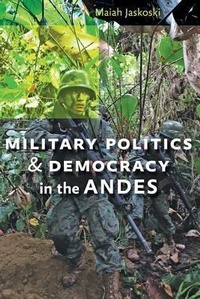
Military Politics and Democracy in the Andes
Will be published approx. on 10. October 2013
Book
Hardback
322 pages
978-1-4214-0907-8 (ISBN)
Description
"Military Politics and Democracy in the Andes" challenges conventional theories regarding military behavior in post-transition democracies. Through a deeply researched comparative analysis of the Ecuadorian and Peruvian armies, Maiah Jaskoski argues that militaries are concerned more with the predictability of their missions than with sovereignty objectives set by democratically elected leaders. Jaskoski gathers data from interviews with public officials, private sector representatives, journalists, and more than 160 Peruvian and Ecuadorian officers from all branches of the military. The results are surprising. Ecuador's army, for example, fearing the uncertainty of border defense against insurgent encroachment in the north, neglected this duty, thereby sacrificing the state's security goals, acting against government orders, and challenging democratic consolidation. Instead of defending the border, the army has opted to carry out policing functions within Ecuador, such as combating the drug trade.
Additionally, by ignoring its duty to defend sovereignty, the army is available to contract out its policing services to paying, private companies that, relative to the public, benefit disproportionately from army security. Jaskoski also looks briefly at this theory's implications for military responsiveness to government orders in democratic Bolivia, Colombia, and Venezuela, and in newly formed democracies more broadly.
Additionally, by ignoring its duty to defend sovereignty, the army is available to contract out its policing services to paying, private companies that, relative to the public, benefit disproportionately from army security. Jaskoski also looks briefly at this theory's implications for military responsiveness to government orders in democratic Bolivia, Colombia, and Venezuela, and in newly formed democracies more broadly.
Reviews / Votes
Academically rigorous... the specialized work belongs in college and university libraries with significant holdings in comparative politics and Latin American studies. ChoiceMore details
Language
English
Place of publication
Baltimore, MD
United States
Target group
Professional and scholarly
Product notice
Unsewn / adhesive bound
Paper over boards
Illustrations
6 s/w Abbildungen, 2 Karten
2 Maps; 6 Illustrations, black and white
Dimensions
Height: 229 mm
Width: 155 mm
Thickness: 25 mm
Weight
544 gr
ISBN-13
978-1-4214-0907-8 (9781421409078)
DOI
10.1353/book.23540
Copyright in bibliographic data and cover images is held by Nielsen Book Services Limited or by the publishers or by their respective licensors: all rights reserved.
Schweitzer Classification
Other editions
Additional editions
Maiah Jaskoski
Military Politics and Democracy in the Andes
E-Book
10/2013
Johns Hopkins University Press
€43.99
Available for download
Person
Maiah Jaskoski is an assistant professor of national security affairs at the Naval Postgraduate School in Monterey, California.
Content
Acknowledgments
Acronyms and Abbreviations
1. Military Mission Performance in Latin America
Challenges to Security and Democratic Civil-Military Relations in the Andes
Explaining Military Mission Performance in Democratic Latin America
Case Selection: A Focus on the Army in Peru and Ecuador
The Data
Overview of the Analysis
2. Civil-Military Relations in Democratic Peru and Ecuador
High Constraints on Peru's Military
Low Constraints on Ecuador's Military
3. Army Mission Performance in Post-Transition Peru and Ecuador, 1980s-1990s
Sovereignty before Policing
Deviations: Contradictions in Missions and Sovereignty Neglect
Alternative Explanations
4. Mission Constraint and Neglect of Counterinsurgency: Peru since 2000
Staying in the Barracks
Insecurity in Sendero Zones
Predictions of the Legitimacy, Professionalism, and Resource Maximization Hypotheses
Army Inaction
Restrictions on Army Autonomy
Contradiction through Mission Constraint
The Source of the Senior Cohort's "Need" for Autonomy
Neglect of Counterinsurgency as a Way to Maintain Predictability for Patrols
Return to Assertive Counterinsurgency
Narrow Mission Beliefs and Minimal Police Work
5. Mission Overload and Neglect of Border Defense: Ecuador since 2000
Neglecting a Porous Border while Policing the Interior
Insecurity in Northern Ecuador
Predictions of the Legitimacy, Professionalism, and Resource Maximization Hypotheses
Assertive Policing
Overwhelming Security Responsibilities
Policing to Avoid Obsolescence
Contradiction through Mission Overload
Managing the Contradiction
The Contradiction Escalates
Alternative Explanations: Revisiting Legitimacy
6. Battalions for Hire: Private Army Contracts in Peru and Ecuador
Resource-Hungry Army Units
Local Client Influence
Limits to Client Influence
7. Comparative Perspectives on Military Mission Performance
Colombia: Tolerance of Policing amid Ongoing Insurgency
Venezuela: Mission Loss, Organizational Trauma, and Rejection of Police Work
Bolivia: Policing despite Organizational Trauma
Extreme Executive Control: Trends in Venezuela and Bolivia
Reflections on Assigning Militaries to Conduct Police Work
Appendix: Field Research Methodology
Notes
References
Index
Acronyms and Abbreviations
1. Military Mission Performance in Latin America
Challenges to Security and Democratic Civil-Military Relations in the Andes
Explaining Military Mission Performance in Democratic Latin America
Case Selection: A Focus on the Army in Peru and Ecuador
The Data
Overview of the Analysis
2. Civil-Military Relations in Democratic Peru and Ecuador
High Constraints on Peru's Military
Low Constraints on Ecuador's Military
3. Army Mission Performance in Post-Transition Peru and Ecuador, 1980s-1990s
Sovereignty before Policing
Deviations: Contradictions in Missions and Sovereignty Neglect
Alternative Explanations
4. Mission Constraint and Neglect of Counterinsurgency: Peru since 2000
Staying in the Barracks
Insecurity in Sendero Zones
Predictions of the Legitimacy, Professionalism, and Resource Maximization Hypotheses
Army Inaction
Restrictions on Army Autonomy
Contradiction through Mission Constraint
The Source of the Senior Cohort's "Need" for Autonomy
Neglect of Counterinsurgency as a Way to Maintain Predictability for Patrols
Return to Assertive Counterinsurgency
Narrow Mission Beliefs and Minimal Police Work
5. Mission Overload and Neglect of Border Defense: Ecuador since 2000
Neglecting a Porous Border while Policing the Interior
Insecurity in Northern Ecuador
Predictions of the Legitimacy, Professionalism, and Resource Maximization Hypotheses
Assertive Policing
Overwhelming Security Responsibilities
Policing to Avoid Obsolescence
Contradiction through Mission Overload
Managing the Contradiction
The Contradiction Escalates
Alternative Explanations: Revisiting Legitimacy
6. Battalions for Hire: Private Army Contracts in Peru and Ecuador
Resource-Hungry Army Units
Local Client Influence
Limits to Client Influence
7. Comparative Perspectives on Military Mission Performance
Colombia: Tolerance of Policing amid Ongoing Insurgency
Venezuela: Mission Loss, Organizational Trauma, and Rejection of Police Work
Bolivia: Policing despite Organizational Trauma
Extreme Executive Control: Trends in Venezuela and Bolivia
Reflections on Assigning Militaries to Conduct Police Work
Appendix: Field Research Methodology
Notes
References
Index