

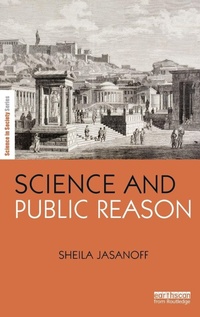
Science and Public Reason
1st Edition
Published on 26. June 2012
Book
Hardback
290 pages
978-0-415-52486-5 (ISBN)
Description
This collection of essays by Sheila Jasanoff explores how democratic governments construct public reason, that is, the forms of evidence and argument used in making state decisions accountable to citizens. The term public reason as used here is not simply a matter of deploying principled arguments that respect the norms of democratic deliberation. Jasanoff investigates what states do in practice when they claim to be reasoning in the public interest. Reason, from this perspective, comprises the institutional practices, discourses, techniques and instruments through which governments claim legitimacy in an era of potentially unbounded risks-physical, political, and moral. Those legitimating efforts, in turn, depend on citizens' acceptance of the forms of reasoning that governments offer. Included here therefore is an inquiry into the conditions that lead citizens of democratic societies to accept policy justification as being reasonable. These modes of public knowing, or "civic epistemologies," are integral to the constitution of contemporary political cultures.
Methodologically, the book is grounded in the field of Science and Technology Studies (STS). It uses in-depth qualitative studies of legal and political practices to shed light on divergent cross-cultural constructions of public reason and the reasoning political subject. The collection as a whole contributes to democratic theory, legal studies, comparative politics, geography, and ethnographies of modernity, as well as STS.
Methodologically, the book is grounded in the field of Science and Technology Studies (STS). It uses in-depth qualitative studies of legal and political practices to shed light on divergent cross-cultural constructions of public reason and the reasoning political subject. The collection as a whole contributes to democratic theory, legal studies, comparative politics, geography, and ethnographies of modernity, as well as STS.
Reviews / Votes
'This collection brings together a quarter century of writing by Sheila Jasanoff on the sources and impacts of science and technology. In showing how they permeate public life, she demonstrates also that the field of Science and Technology Studies is no arcane speciality, but a research field of sweeping significance for law, history, administration, and the social sciences. At stake in the interactions of science with democratic institutions is public reason itself.' - Theodore M. Porter, Department of History, UCLA, USA'This book fascinatingly asks: What begins where all that seems solid, all that modernity has created, melts into air, leaving no shared ground to stand on? Sheila Jasanoff's exciting answer: a new age and style of public reason that can shed surprisingly clear light on a world in turmoil.' - Ulrich Beck, University of Munich, Germany & L.S.E, U.K
'No one has contributed as much as Sheila Jasanoff to furthering our understanding of the importance of law in the complex relationships that develop between politics and technoscience. Science and Public Reason is more than a collection of her most significant articles on the subject; this seminal book opens entirely original perspectives on what, in a globalized world, a new alliance between science, techniques and democracy could and should be.' - Michel Callon, Ecole des mines de Paris, France
'Sheila Jasanoff's latest book demonstrates, once again, why she is at the very forefront of her field.' - Bruce Ackerman, Yale University, USA
"Professor Sheila Jasanoff's superb treatise Science and Public Reason, part of Earthscan's Science in Society Series, is a wonderful book describing, through a collection of her essays and articles from the past 25- years, the rise of the field of Science and Technology Studies. The book could not have arrived soon enough, as we now globally face the triple threat of 1)massive biodiversity loss, 2) nutrient cycling disruption (greenhouse gases, Montreal Protocolgases, nitrogen fertiliz er caused eutrophication, etc.), and 3) water quality degradation (saltwater intrusion, depleted aquifers, lack of clean drinking water, etc.).' - Gabriel Thoumi, CFA, Mongabay.com
'Without doubt, the essays put together in the volume are work in immense scholarship. Picking on scientific controversies from Germany, England, the US and India, ranging from mad cow scare to silicone gel breast transplant, Jasanoff creates a mosaic of scientific controversies wherein interplay between science and public reasoning had led to influencing state policies to some extent.' - Sudhirendar Sharma, d-sector.org
More details
Series
Language
English
Place of publication
London
United Kingdom
Publishing group
Taylor & Francis Ltd
Target group
College/higher education
Postgraduate
Product notice
Leather / fine binding (stationery)
Illustrations
1 s/w Zeichnung, 4 s/w Tabellen
4 Tables, black and white; 1 Line drawings, black and white
Dimensions
Height: 240 mm
Width: 161 mm
Thickness: 21 mm
Weight
625 gr
ISBN-13
978-0-415-52486-5 (9780415524865)
Copyright in bibliographic data and cover images is held by Nielsen Book Services Limited or by the publishers or by their respective licensors: all rights reserved.
Schweitzer Classification
Other editions
Additional editions
Sheila Jasanoff
Science and Public Reason
Book
09/2013
1st Edition
Routledge
€83.70
Shipment within 15-20 days
Sheila Jasanoff
Science and Public Reason
E-Book
07/2012
1st Edition
Routledge
€77.99
Available for download
Sheila Jasanoff
Science and Public Reason
E-Book
07/2012
1st Edition
Routledge
€77.99
Available for download
Person
Sheila Jasanoff is Pforzheimer Professor of Science and Technology Studies at Harvard University's John F. Kennedy School of Government. A pioneer in legal and political studies of science and technology, she has written many widely cited articles and chapters and is author or editor of a dozen books, including The Fifth Branch (Harvard University Press), Science at the Bar (Harvard University Press), and Designs on Nature (Princeton University Press).
Content
1. Public Reason 2. Product, Process, or Programme 3. In the Democracies of DNA 4. Restoring Reason 5. Image and Imagination 6. Contested Boundaries in Policy-Relevant Science 7. The Songlines of Risk 8. Judgment under Siege 9. Technologies of Humility 10. What Judges Should Know about the Sociology of Science 11. Expert Games in Silicone Gel Breast Implant Litigation 12. The Eye of Everyman 13. In a Constitutional Moment: Science and Social Order at the Millennium