

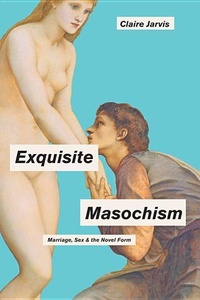
Exquisite Masochism
Marriage, Sex, and the Novel Form
Published on 10. August 2016
Book
Hardback
224 pages
978-1-4214-1993-0 (ISBN)
Description
How did realist novelists in the nineteenth and early twentieth centuries hint at sex while maintaining a safe distance from pornography? Metaphors helped: waves, oceans, blooms, and illuminations were all deployed in respectable realist novels to allude to the sexual act, allowing writers to portray companionate marriage while avoiding graphic description. But in Exquisite Masochism, Claire Jarvis argues that some Victorian novelists went even further, pushing formal boundaries by slyly developing scenes of displaced erotic desire to suggest impropriety, perversion, and danger. Through close readings of canonical works by Emily Bronte, Anthony Trollope, Thomas Hardy, and a modernist outlier, D. H. Lawrence, Jarvis reveals how writers' varied use of specific character types-the dominant woman and the submissive man-in conjunction with decadent, descriptive scenes of sexual refusal creates a strong counter-narrative hinting at relationships beyond patriarchal and companionate marriage structures.
By focusing on the exquisitely masochistic pleasure brought about by freezing, or suspending, the sexual charge, and by depicting quasi-contractual states on the periphery of marriage, including engagement, adultery, and widowhood, novelists disrupted the marriage plot's insistence that erotic drives remain unfulfilled and that sexual connection could be satisfied only by genital act. Complicating our understanding of Victorian marriage ideology's more well-trodden focus on a productive, nation-building ideal, Exquisite Masochism offers fascinating insight into our own culture's debates around illicit sexuality, marriage, reproduction, and feminism.
By focusing on the exquisitely masochistic pleasure brought about by freezing, or suspending, the sexual charge, and by depicting quasi-contractual states on the periphery of marriage, including engagement, adultery, and widowhood, novelists disrupted the marriage plot's insistence that erotic drives remain unfulfilled and that sexual connection could be satisfied only by genital act. Complicating our understanding of Victorian marriage ideology's more well-trodden focus on a productive, nation-building ideal, Exquisite Masochism offers fascinating insight into our own culture's debates around illicit sexuality, marriage, reproduction, and feminism.
Reviews / Votes
Jarvis opens new avenues of criticism to work that is often oversimplified. Highly recommended. Choice ... an engaging cultural study, with applications wider than nineteenth-century literature. Times Literary SupplementMore details
Language
English
Place of publication
Baltimore, MD
United States
Target group
College/higher education
US School Grade: College Graduate Student and over
Product notice
sewn/stitched
Cloth over boards
Illustrations
1 s/w Photographie bzw. Rasterbild
1 Halftones, black and white
Dimensions
Height: 229 mm
Width: 157 mm
Thickness: 18 mm
Weight
408 gr
ISBN-13
978-1-4214-1993-0 (9781421419930)
DOI
10.1353/book.47468
Copyright in bibliographic data and cover images is held by Nielsen Book Services Limited or by the publishers or by their respective licensors: all rights reserved.
Schweitzer Classification
Other editions
Additional editions
E-Book
08/2016
Johns Hopkins University Press
€37.99
Available for download
Person
Claire Jarvis is an assistant professor of English at Stanford University.
Content
Preface
Acknowledgments
1. Making Scenes
2. The Grasp of Wuthering Heights
3. Buoyed Up
4. Hideously Multiplied
5. Dead Gems
Conclusion
Notes
Index
Acknowledgments
1. Making Scenes
2. The Grasp of Wuthering Heights
3. Buoyed Up
4. Hideously Multiplied
5. Dead Gems
Conclusion
Notes
Index