

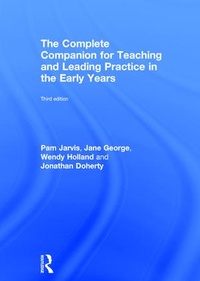
The Complete Companion for Teaching and Leading Practice in the Early Years
3rd Edition
Published on 5. April 2016
Book
Hardback
276 pages
978-1-138-82392-1 (ISBN)
Description
Previously published as The Early Years Professional's Complete Companion, this new edition has been thoroughly updated and is the essential resource for aspiring and existing leaders of early years practice.
Covering a wide range of theoretical and practical concepts, this book helps the reader consider how they can develop excellent practice within their unique setting. Divided into three distinct sections, the book begins by exploring the origins of early years practice, before discussing principles in development, social policy and child protection. The second section considers what constitutes high quality practice, and reflects on the role of emotional security, environment, and adults in shaping children's learning and development. The third and final section examines how activities associated with continued professional development impact on teaching standards, before finishing with a discussion on international perspectives on early years practice.
Key features include:
New chapters on safeguarding, children's rights, continuous professional development and international perspectives of early years practice.
Chapter objectives, tasks and links to the Early Years Foundation Stage.
Case studies with questions for reflection to promote critical thinking.
New developments in the early years practice arena are outlined, including the emergence of Early Years Teacher Status (EYTS).
This book is an essential text for those working towards qualifications in early years teaching and leading practice, and provides a flexible basis for tutors, trainers, assessors and mentors to further develop programmes of education and training. It will also appeal to teachers and practitioners interested in considering potential routes for continuing their professional development.
Covering a wide range of theoretical and practical concepts, this book helps the reader consider how they can develop excellent practice within their unique setting. Divided into three distinct sections, the book begins by exploring the origins of early years practice, before discussing principles in development, social policy and child protection. The second section considers what constitutes high quality practice, and reflects on the role of emotional security, environment, and adults in shaping children's learning and development. The third and final section examines how activities associated with continued professional development impact on teaching standards, before finishing with a discussion on international perspectives on early years practice.
Key features include:
New chapters on safeguarding, children's rights, continuous professional development and international perspectives of early years practice.
Chapter objectives, tasks and links to the Early Years Foundation Stage.
Case studies with questions for reflection to promote critical thinking.
New developments in the early years practice arena are outlined, including the emergence of Early Years Teacher Status (EYTS).
This book is an essential text for those working towards qualifications in early years teaching and leading practice, and provides a flexible basis for tutors, trainers, assessors and mentors to further develop programmes of education and training. It will also appeal to teachers and practitioners interested in considering potential routes for continuing their professional development.
More details
Edition
3rd edition
Language
English
Place of publication
London
United Kingdom
Publishing group
Taylor & Francis Ltd
Target group
College/higher education
Professional and scholarly
Illustrations
14 s/w Photographien bzw. Rasterbilder, 10 s/w Zeichnungen, 4 s/w Tabellen
4 Tables, black and white; 10 Line drawings, black and white; 14 Halftones, black and white
Dimensions
Height: 246 mm
Width: 174 mm
Weight
700 gr
ISBN-13
978-1-138-82392-1 (9781138823921)
Copyright in bibliographic data and cover images is held by Nielsen Book Services Limited or by the publishers or by their respective licensors: all rights reserved.
Schweitzer Classification
Other editions
Additional editions
Pam Jarvis | Jane George | Wendy Holland
The Complete Companion for Teaching and Leading Practice in the Early Years
E-Book
04/2016
3rd Edition
Routledge
€51.49
Available for download
Pam Jarvis | Jane George | Wendy Holland
The Complete Companion for Teaching and Leading Practice in the Early Years
Book
03/2016
3rd Edition
Routledge
€58.60
Shipment within 10-20 days
Persons
Pam Jarvis is both a chartered psychologist and a historian, and her key research focus is the development of social policy for children, young people and their families. She has 20 years of experience of creating and teaching developmental, social science and social policy modules for Education/Child Development programmes in higher education.
Jane George has extensive experience in the voluntary sector and working in socially deprived areas with ethnically diverse groups. She is Head of Faculty, Social Care and Community Practice at Bradford College.
Wendy Holland has experience of teaching in mainstream nurseries, primary and special schools for over 30 years. From the 1970s onwards, her focus has been around inclusive provision and practice for children from birth to eight years.
Jonathan Doherty has worked in a number of roles in early years and education in school and higher education. Prior to his appointment as Head of Primary Education at Leeds Trinity University, he was Head of Early Childhood Education at Leeds Metropolitan University and then Head of Early Years and Childhood Studies at Manchester Metropolitan University.
Jane George has extensive experience in the voluntary sector and working in socially deprived areas with ethnically diverse groups. She is Head of Faculty, Social Care and Community Practice at Bradford College.
Wendy Holland has experience of teaching in mainstream nurseries, primary and special schools for over 30 years. From the 1970s onwards, her focus has been around inclusive provision and practice for children from birth to eight years.
Jonathan Doherty has worked in a number of roles in early years and education in school and higher education. Prior to his appointment as Head of Primary Education at Leeds Trinity University, he was Head of Early Childhood Education at Leeds Metropolitan University and then Head of Early Years and Childhood Studies at Manchester Metropolitan University.
Content
Introduction: Introducing Early Years Practice
1. The History of 'Early Years Practice'
Section 1 -The Children's Agenda: Principles in Development, Social Policy, Child Protection and Inclusion
2. Principles in Child Care and Education
3. Safeguarding and Child Protection
4. Children as citizens: rights and responsibilities in the 21st Century'
Section 2 - Leading Practice in the Early Years Setting:
5. Leading in Children's Learning and Development
6. Promoting Emotional Security and Positive Behaviour
7. Transforming the Environment for Play and Learning
8. Management and Partnership in Early Years
Section 3 - Wider Perspectives in Early Years
9. Continuing Professional Development for the Leader in Early Years
10. The Child, the Family and the State: Different Models of Early Years Practice
Conclusion
1. The History of 'Early Years Practice'
Section 1 -The Children's Agenda: Principles in Development, Social Policy, Child Protection and Inclusion
2. Principles in Child Care and Education
3. Safeguarding and Child Protection
4. Children as citizens: rights and responsibilities in the 21st Century'
Section 2 - Leading Practice in the Early Years Setting:
5. Leading in Children's Learning and Development
6. Promoting Emotional Security and Positive Behaviour
7. Transforming the Environment for Play and Learning
8. Management and Partnership in Early Years
Section 3 - Wider Perspectives in Early Years
9. Continuing Professional Development for the Leader in Early Years
10. The Child, the Family and the State: Different Models of Early Years Practice
Conclusion