

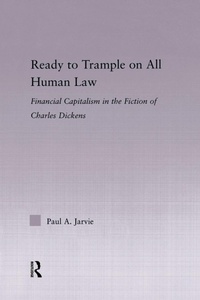
Ready to Trample on All Human Law
Finance Capitalism in the Fiction of Charles Dickens
1st Edition
Published on 23. April 2015
Book
Paperback/Softback
216 pages
978-0-415-86946-1 (ISBN)
Description
This book explores the relationship between Dickens's novels and the financial system. Elements of Dickens's work form a critique of financial capitalism. This critique is rooted in the difference between use-value and exchange-value, and in the difference between productive circulations and mere accumulation. In a money-based society, exchange-value and accumulation dominate to the point where they infect even the most important and sacred relationships between parts of society and individuals.
This study explores Dickens's critique from two very different points of view. The first is philosophical, from Aristotle's distinction between "chrematistic" accumulation and "economic" use on money through Marx's focus on the teleology of capitalism as death. The second view is that of nineteenth-century financial journalism, of "City" writers like David Morier Evans and M. L. Meason,, who, while functioning as "cheerleaders" for financial capitalism, also reflected some of the very real "dis-ease" associated with capital formation and accumulation.
The core concepts of this critique are constant in the novels, but the critique broadens and becomes more pessimistic over time. The ill effects of living in a money-based society are presented more as the consequences of individual evil in earlier novels, while in the later books they are depicted as systemic and pervasive. Texts discussed include Nicholas Nickleby, A Christmas Carol, Little Dorrit and Our Mutual Friend.
This study explores Dickens's critique from two very different points of view. The first is philosophical, from Aristotle's distinction between "chrematistic" accumulation and "economic" use on money through Marx's focus on the teleology of capitalism as death. The second view is that of nineteenth-century financial journalism, of "City" writers like David Morier Evans and M. L. Meason,, who, while functioning as "cheerleaders" for financial capitalism, also reflected some of the very real "dis-ease" associated with capital formation and accumulation.
The core concepts of this critique are constant in the novels, but the critique broadens and becomes more pessimistic over time. The ill effects of living in a money-based society are presented more as the consequences of individual evil in earlier novels, while in the later books they are depicted as systemic and pervasive. Texts discussed include Nicholas Nickleby, A Christmas Carol, Little Dorrit and Our Mutual Friend.
More details
Series
Language
English
Place of publication
London
United Kingdom
Publishing group
Taylor & Francis Ltd
Target group
College/higher education
Illustrations
75 s/w Abbildungen
75 Illustrations, black and white
Dimensions
Height: 229 mm
Width: 152 mm
Thickness: 12 mm
Weight
321 gr
ISBN-13
978-0-415-86946-1 (9780415869461)
Copyright in bibliographic data and cover images is held by Nielsen Book Services Limited or by the publishers or by their respective licensors: all rights reserved.
Schweitzer Classification
Other editions
Additional editions
Paul A. Jarvie
Ready to Trample on All Human Law
Finance Capitalism in the Fiction of Charles Dickens
E-Book
02/2014
1st Edition
Routledge
€69.99
Available for download
Paul A. Jarvie
Ready to Trample on All Human Law
Finance Capitalism in the Fiction of Charles Dickens
E-Book
02/2014
1st Edition
Routledge
€69.99
Available for download
Paul A. Jarvie
Ready to Trample on All Human Law
Finance Capitalism in the Fiction of Charles Dickens
Book
06/2005
1st Edition
Routledge
€205.40
Shipment within 15-20 days
Person
Jarvie, Paul A.
Content
Introduction: Dickens's Evolving Critique of Financial Capitalism 1. "I hold myself released from such hard bargains as these": Nicholas Nickleby and "Brotherly" Capitalism 2. "With what a strange mastery it seized him for itself": The Conversion of the Financier in A Christmas Carol 3. "Terribly wild rang the panic cry": Finance, Panic and the Struggle for Life in Little Dorrit 4."Among the dying and the dead": Metonymy and Finance Capitalism in Our Mutual Friend