

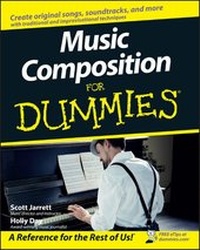
Music Composition For Dummies
Published on 1. February 2008
Book
Paperback/Softback
360 pages
978-0-470-22421-2 (ISBN)
Description
Creative exercises build your composing skills
The fun and easy way to turn the tune in your head into a full-fledged composition!
Wish you could write music? You can! This friendly guide gives you everything you need to start composing, from choosing the right rhythm and tempo to writing with chords and melody to expressing your musical ideas through instruments and voices. You'll see how to create popular songs, classically structured pieces, and even film, TV, or video game soundtracks!
Discover how to:
*
Master chord progressions
*
Harmonize with melody
*
Select the right instruments
*
Write for multiple voices
*
Compose electronic music
*
Make a demo recording
The fun and easy way to turn the tune in your head into a full-fledged composition!
Wish you could write music? You can! This friendly guide gives you everything you need to start composing, from choosing the right rhythm and tempo to writing with chords and melody to expressing your musical ideas through instruments and voices. You'll see how to create popular songs, classically structured pieces, and even film, TV, or video game soundtracks!
Discover how to:
*
Master chord progressions
*
Harmonize with melody
*
Select the right instruments
*
Write for multiple voices
*
Compose electronic music
*
Make a demo recording
More details
Other editions
New editions
Scott Jarrett | Holly Day
Music Composition For Dummies
Book
01/2021
Wiley
€21.90
Article exhausted; check for reprint
Persons
Scott Jarrett is a musician and producer who has worked with numerous artists, including Willie Nelson, Fiona Flanagan, Mary Klueh, and Keith Jarrett. He has served as music director for many live theatrical productions including the Broadway production of The Best Little Whorehouse in Texas. He currently runs Monkey House recording studio in Hudson, Wisconsin. He has released two original albums, Without Rhyme or Reason and The Gift of Thirst. He has taught music theory, composition, production, and/or recording at the Full Sail Center for the Recording Arts in Orlando, The Acting Conservatory in Nashville, and McNally-Smith School of Music in St. Paul, Minnesota.
Holly Day is a music journalist whose articles have appeared in publications all over the world, including Computer Music Journal, ROCKRGRL, Music Alive!, Guitar One, and Mixdown magazines. Her writing has received an Isaac Asimov Award, a National Magazine Award, and two Midwest Writer's Grants. She is co-author of Music Theory For Dummies (Wiley).
Holly Day is a music journalist whose articles have appeared in publications all over the world, including Computer Music Journal, ROCKRGRL, Music Alive!, Guitar One, and Mixdown magazines. Her writing has received an Isaac Asimov Award, a National Magazine Award, and two Midwest Writer's Grants. She is co-author of Music Theory For Dummies (Wiley).
Content
Introduction.
Part I: Basics and Rhythm.
Chapter 1: Thinking Like a Composer.
Chapter 2: Tools of the Trade.
Chapter 3: Musical Scrapbooks: Writing on Paper and Screen.
Chapter 4: Rhythm and Mood.
Part II: Melody and Development.
Chapter 5: Finding Melodies Where You Least Expect Them.
Chapter 6: Scales and Modes, Moods and Melodies.
Chapter 7: Building Melodies Using Motifs and Phrases.
Chapter 8: Developing Your Melodies.
Part III: Harmony and Structure.
Chapter 9: Harmonizing with Melodies.
Chapter 10: Composing with Chords.
Chapter 11: Composing from the Void.
Chapter 12: Beginnings, Middles, and Endings.
Chapter 13: Musical Forms.
Part IV: Orchestration and Arrangement.
Chapter 14: Composing for the Standard Orchestra.
Chapter 15: Composing for the Nonstandard Orchestra.
Chapter 16: Composing for Multiple Voices.
Chapter 17: Composing Commercial Music and Songs.
Chapter 18: Composing Electronic Music.
Chapter 19: Composing for Other Musicians.
Part V: The Part of Tens.
Chapter 20: Ten Composers You Should Know About.
Chapter 21: Nine Career Opportunities for Composers.
Chapter 22: Ten Recommended Books for Composers.
Chapter 23: Ten Periods of Music History to Explore.
Appendix A: Modes and Chords Reference.
Appendix B: Glossary.
Index.
Part I: Basics and Rhythm.
Chapter 1: Thinking Like a Composer.
Chapter 2: Tools of the Trade.
Chapter 3: Musical Scrapbooks: Writing on Paper and Screen.
Chapter 4: Rhythm and Mood.
Part II: Melody and Development.
Chapter 5: Finding Melodies Where You Least Expect Them.
Chapter 6: Scales and Modes, Moods and Melodies.
Chapter 7: Building Melodies Using Motifs and Phrases.
Chapter 8: Developing Your Melodies.
Part III: Harmony and Structure.
Chapter 9: Harmonizing with Melodies.
Chapter 10: Composing with Chords.
Chapter 11: Composing from the Void.
Chapter 12: Beginnings, Middles, and Endings.
Chapter 13: Musical Forms.
Part IV: Orchestration and Arrangement.
Chapter 14: Composing for the Standard Orchestra.
Chapter 15: Composing for the Nonstandard Orchestra.
Chapter 16: Composing for Multiple Voices.
Chapter 17: Composing Commercial Music and Songs.
Chapter 18: Composing Electronic Music.
Chapter 19: Composing for Other Musicians.
Part V: The Part of Tens.
Chapter 20: Ten Composers You Should Know About.
Chapter 21: Nine Career Opportunities for Composers.
Chapter 22: Ten Recommended Books for Composers.
Chapter 23: Ten Periods of Music History to Explore.
Appendix A: Modes and Chords Reference.
Appendix B: Glossary.
Index.