

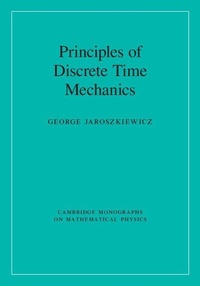
Principles of Discrete Time Mechanics
Published on 17. April 2014
Book
Hardback
360 pages
978-1-107-03429-7 (ISBN)
Description
Could time be discrete on some unimaginably small scale? Exploring the idea in depth, this unique introduction to discrete time mechanics systematically builds the theory up from scratch, beginning with the historical, physical and mathematical background to the chronon hypothesis. Covering classical and quantum discrete time mechanics, this book presents all the tools needed to formulate and develop applications of discrete time mechanics in a number of areas, including spreadsheet mechanics, classical and quantum register mechanics, and classical and quantum mechanics and field theories. A consistent emphasis on contextuality and the observer-system relationship is maintained throughout.
More details
Series
Language
English
Place of publication
Cambridge
United Kingdom
Target group
Professional and scholarly
Illustrations
21 Line drawings, unspecified
Dimensions
Height: 250 mm
Width: 175 mm
Thickness: 25 mm
Weight
834 gr
ISBN-13
978-1-107-03429-7 (9781107034297)
Copyright in bibliographic data and cover images is held by Nielsen Book Services Limited or by the publishers or by their respective licensors: all rights reserved.
Schweitzer Classification
Other editions
Additional editions
George Jaroszkiewicz
Principles of Discrete Time Mechanics
E-Book
04/2014
Cambridge University Press
€91.49
Available for download
George Jaroszkiewicz
Principles of Discrete Time Mechanics
E-Book
03/2014
1st Edition
Cambridge University Press
€109.99
Available for download
Person
George Jaroszkiewicz is an Associate Professor at the School of Mathematical Sciences, University of Nottingham, having formerly held positions at the University of Oxford and the University of Kent.
Content
1. Introduction; 2. The physics of discreteness; 3. The road to calculus; 4. Temporal discretization; 5. Discrete time dynamics architecture; 6. Some models; 7. Classical cellular automata; 8. The action sum; 9. Worked examples; 10. Lee's approach to discrete time mechanics; 11. Elliptic billiards; 12. The construction of system functions; 13. The classical discrete time oscillator; 14. Type 2 temporal discretization; 15. Intermission; 16. Discrete time quantum mechanics; 17. The quantized discrete time oscillator; 18. Path integrals; 19. Quantum encoding; 20. Discrete time classical field equations; 21. The discrete time Schrodinger equation; 22. The discrete time Klein-Gordon equation; 23. The discrete time Dirac equation; 24. Discrete time Maxwell's equations; 25. The discrete time Skyrme model; 26. Discrete time quantum field theory; 27. Interacting discrete time scalar fields; 28. Space, time and gravitation; 29. Causality and observation; 30. Concluding remarks; Appendix A. Coherent states; Appendix B. The time-dependent oscillator; Appendix C. Quaternions; Appendix D. Quantum registers; References; Index.