

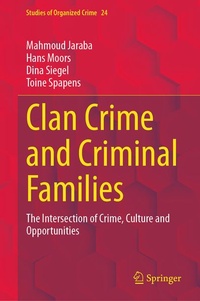
Clan Crime and Criminal Families
Description
This book provides a comprehensive analysis of clan crime and criminal families, with a particular focus on Europe. It examines the phenomenon through anthropological, criminological, and socio-political perspectives, with particular attention to kinship, migration, media framing, gender, intergenerational transmission, and institutional responses. Rather than treating 'clans' as fixed or culturally homogeneous entities, it explores the conditions under which kinship-based networks may become involved in criminal activities.
It covers a range of topics, including:
- the concepts of families, clans, and tribes;
- the emergence of 'clan crime' in European media and political discourse;
- migration, marginalisation, and criminal opportunities;
- kinship, loyalty, secrecy, and conflict regulation in criminal clans;
- women's roles and the intergenerational continuity of crime;
- interventions and policies to prevent and tackle serious and organised crime in kinship-based networks across Europe.
Ideal for academics, policymakers, law enforcement professionals, and social services practitioners, this volume provides a nuanced and empirically grounded account of clan- and family-based crime in contemporary Europe.
More details
Persons
Mahmoud Jaraba is a political scientist at the FAU Research Centre for Islam and Law in Europe (FAU EZIRE) at the Friedrich-Alexander University Erlangen-Nuremberg. Since 2015, he has conducted extensive ethnographic research on 'clan crime'. Dr. Jaraba's work provides a critical examination of the ways in which extended family networks function amidst varying socio-economic landscapes, as well as the role of cultural and religious norms in the propagation and persistence of criminal activities across generations. He has also conducted research on Islamic movements in Palestine, Egypt, Turkey, and Germany, as well as on processes of radicalisation.
Hans Moors is owner-director at EMMA, a research and consultancy firm employing 65 academics, that works on public issues for national, regional, and local administrations. He has a multidisciplinary academic background encompassing cultural history, political philosophy, and criminology. Over the past 25 years, Moors has conducted extensive ethnographic fieldwork focusing on (juvenile) delinquency, migrant communities, criminal families, (online) protest movements, and radicalisation processes in the Netherlands. With Toine Spapens he initiated and supervised three empirical studies on (extended) criminal families in the Netherlands. His academic work includes recent studies on the history of trust-based relations in social movements, (online) protest subcultures and organised crime.
Dina Siegel is a full professor of criminology at Utrecht University, the Netherlands. She has published extensively on post-Soviet organised crime, the Russian and Israeli mafia, human trafficking and prostitution, crime in the diamond sector, mobile banditry, underground banking, green criminology, music and crime and criminal clans. She was president of IASOC (International Association for the Study of Organized Crime) and co-founder and board member of CIROC (Center for Information and Research on Organized Crime).
Toine Spapens is a full professor of criminology at Tilburg University, the Netherlands. Over the past three decades, he has published extensively on serious and organised crime, including studies on illicit firearms trafficking, synthetic drugs production, illegal gambling, cannabis cultivation, mobile organised crime groups, waste trafficking and illegal trade in protected wildlife. Together with Hans Moors and colleagues, he initiated and executed three empirical studies on (extended) criminal families in the Netherlands.
Content
Chapter 1. INTRODUCTION: CRIMINAL CLANS IN EUROPE .- Chapter 2. FAMILIES, CLANS AND TRIBES.- Chapter 3. CLAN CRIME IN NEWS MEDIA.- Chapter 4. CLANS, MIGRATION AND CRIME.- Chapter 5. CRIMINAL CLANS AND ORGANISED CRIME.- Chapter 6. WOMEN IN CRIMINAL CLANS.- Chapter 7. INTERGENERATIONAL TRANSMISSION OF CRIME.- Chapter 8. PREVENTING AND TACKLING CLAN AND FAMILY-BASED CRIMES.- Chapter 9. GENERAL CONCLUSION.