

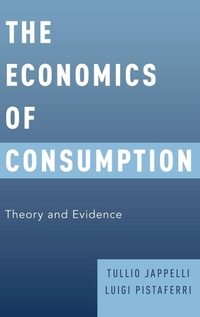
The Economics of Consumption
Theory and Evidence
Published on 23. November 2017
Book
Hardback
312 pages
978-0-19-938314-6 (ISBN)
Description
Consumption decisions are crucial determinants of business cycles and growth. Knowledge of how consumers respond to the economic environment and how they react to the risks that they encounter during the life-cycle is therefore important for evaluating stabilization policies and the effectiveness of fiscal packages implemented in response to economic downturns or financial crises.
In The Economics of Consumption, Tullio Jappelli and Luigi Pistaferri provide a comprehensive examination of the most important developments in the field of consumption decisions and evaluate economic models against empirical evidence. The first part of the book provides the basic ingredients of economic models of consumption decisions. The central part reviews the empirical literature on the effect of income and wealth changes on consumption and on the relevance of precautionary saving and credit market imperfections. The last chapters extend the basic framework to such important areas as bequests, leisure, lifetime uncertainty, and financial sophistication.
Jappelli and Pistaferri shed light on important issues, including how consumption responds to changes in economic resources, how economic circumstances and consumers' characteristics influence behavior, and whether consumption inequality depends on income shocks and their persistence.
In The Economics of Consumption, Tullio Jappelli and Luigi Pistaferri provide a comprehensive examination of the most important developments in the field of consumption decisions and evaluate economic models against empirical evidence. The first part of the book provides the basic ingredients of economic models of consumption decisions. The central part reviews the empirical literature on the effect of income and wealth changes on consumption and on the relevance of precautionary saving and credit market imperfections. The last chapters extend the basic framework to such important areas as bequests, leisure, lifetime uncertainty, and financial sophistication.
Jappelli and Pistaferri shed light on important issues, including how consumption responds to changes in economic resources, how economic circumstances and consumers' characteristics influence behavior, and whether consumption inequality depends on income shocks and their persistence.
Reviews / Votes
This book provides the synthesis of the vast research field of the economics of consumption in a coherent and accessible way. * Journal of Consumer Policy *More details
Language
English
Place of publication
New York
United States
Target group
College/higher education
Professional and scholarly
Dimensions
Height: 240 mm
Width: 161 mm
Thickness: 21 mm
Weight
637 gr
ISBN-13
978-0-19-938314-6 (9780199383146)
Copyright in bibliographic data and cover images is held by Nielsen Book Services Limited or by the publishers or by their respective licensors: all rights reserved.
Schweitzer Classification
Other editions
Additional editions
Book
01/2018
Oxford University Press Inc
€62.00
Shipment within 15-20 days
E-Book
09/2017
OUP eBook
€41.99
Available for download
E-Book
09/2017
OUP eBook
€41.99
Available for download
Persons
Tullio Jappelli is Professor of Economics and Chairman of the Department of Economics and Statistics at the University of Naples Federico II, a Research Fellow of the Center for Economics and Finance (CSEF) and of CEPR.
Luigi Pistaferri is a Professor of Economics at Stanford University, a Research Fellow of NBER, CEPR, the "Ralph Landau" Senior Fellow at the Stanford Institute of Economics and Policy Research (SIEPR), and one of the co-editors of the American Economic Review.
Luigi Pistaferri is a Professor of Economics at Stanford University, a Research Fellow of NBER, CEPR, the "Ralph Landau" Senior Fellow at the Stanford Institute of Economics and Policy Research (SIEPR), and one of the co-editors of the American Economic Review.
Author
Professor of EconomicsProfessor of Economics, University of Naples Federico II, Research Fellow, Centre for Economic Policy Research, London, and Research Fellow, Center for Financial Studies, Frankfurt
Professor of EconomicsProfessor of Economics, Stanford University, and Ralph Landau Senior Fellow, Stanford Institute for Economic Policy Research
Content
Table of Contents
CHAPTER 1 - INTERTEMPORAL CHOICE UNDER CERTAINTY
CHAPTER 2 - THE AGE PROFILE OF CONSUMPTION AND WEALTH
CHAPTER 3 - COMPLETE MARKETS
CHAPTER 4 - THE CERTAINTY EQUIVALENCE MODEL
CHAPTER 5 - LIQUIDITY CONSTRAINTS
CHAPTER 6 - THE PRECAUTIONARY SAVING MODEL
CHAPTER 7 - THE BUFFER STOCK MODEL
CHAPTER 8 - THE RESPONSE OF CONSUMPTION TO ANTICIPATED CHANGES IN INCOME
CHAPTER 9 - THE RESPONSE OF CONSUMPTION TO UNANTICIPATED CHANGES IN INCOME
CHAPTER 10 - THE RESPONSE OF CONSUMPTION TO INCOME RISK
CHAPTER 11 - LIFETIME UNCERTAINTY
CHAPTER 12 - BEQUEST MOTIVES
CHAPTER 13 - TIME, HABITS AND CONSUMER DURABLES
CHAPTER 14 - NON-STANDARD PREFERENCES
CONCLUSIONS
REFERENCES
CHAPTER 1 - INTERTEMPORAL CHOICE UNDER CERTAINTY
CHAPTER 2 - THE AGE PROFILE OF CONSUMPTION AND WEALTH
CHAPTER 3 - COMPLETE MARKETS
CHAPTER 4 - THE CERTAINTY EQUIVALENCE MODEL
CHAPTER 5 - LIQUIDITY CONSTRAINTS
CHAPTER 6 - THE PRECAUTIONARY SAVING MODEL
CHAPTER 7 - THE BUFFER STOCK MODEL
CHAPTER 8 - THE RESPONSE OF CONSUMPTION TO ANTICIPATED CHANGES IN INCOME
CHAPTER 9 - THE RESPONSE OF CONSUMPTION TO UNANTICIPATED CHANGES IN INCOME
CHAPTER 10 - THE RESPONSE OF CONSUMPTION TO INCOME RISK
CHAPTER 11 - LIFETIME UNCERTAINTY
CHAPTER 12 - BEQUEST MOTIVES
CHAPTER 13 - TIME, HABITS AND CONSUMER DURABLES
CHAPTER 14 - NON-STANDARD PREFERENCES
CONCLUSIONS
REFERENCES