

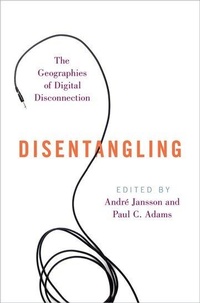
Disentangling
The Geographies of Digital Disconnection
Published on 25. October 2021
Book
Paperback/Softback
344 pages
978-0-19-757188-0 (ISBN)
Description
Digital networking platforms like Facebook and Twitter have revolutionized everyday human interaction by facilitating the search for, and access to, information, entertainment, and social connection. But with the rise of digital surveillance and data extraction for profit, more people are seeking not just to disconnect from technology but to fully disentangle themselves from the widespread social, economic, and political networks of digital communications.
Disentangling offers an interdisciplinary global analysis of this growing trend toward disconnection. Moving beyond technological disconnection, this volume proposes the term "disentangling" as a lens for re-thinking the structures of our digital world and categorizing the ways in which people reject, avoid, or rework their digital networks. Across twelve chapters, contributors explore the existential issues stemming from digitally entangled lives, including cultural capital and digital "detox" retreats, and investigate how geographies of disconnection relate to wider societal challenges. Additional chapters explore connections between digital disconnection and other forms of disconnection, including death, sleep, and the abandonment of human settlements. The volume closes with a reflection on connectivity in the post-pandemic society and how we might rework our connections to fit a "socially distanced" world.
Blending philosophy and sociology with media geography, Disentangling offers a crucial reflection on how we might unravel our digital dependence by reasserting resilient boundaries between ourselves and the surrounding political, economic, cultural, and technological systems.
Disentangling offers an interdisciplinary global analysis of this growing trend toward disconnection. Moving beyond technological disconnection, this volume proposes the term "disentangling" as a lens for re-thinking the structures of our digital world and categorizing the ways in which people reject, avoid, or rework their digital networks. Across twelve chapters, contributors explore the existential issues stemming from digitally entangled lives, including cultural capital and digital "detox" retreats, and investigate how geographies of disconnection relate to wider societal challenges. Additional chapters explore connections between digital disconnection and other forms of disconnection, including death, sleep, and the abandonment of human settlements. The volume closes with a reflection on connectivity in the post-pandemic society and how we might rework our connections to fit a "socially distanced" world.
Blending philosophy and sociology with media geography, Disentangling offers a crucial reflection on how we might unravel our digital dependence by reasserting resilient boundaries between ourselves and the surrounding political, economic, cultural, and technological systems.
Reviews / Votes
This collection offers a brilliant series of reflections on our increasingly ambivalent response to the digital tendrils that captivate and capture us. The result is a profound and riveting meditation on the fate of sociality in our increasingly networked world. * Mark Andrejevic, Monash University * In today's hyperconnected world, it is imperative to understand the geographies, experiences, and impacts of digital disconnection. Disentangling offers an important intervention for anyone seeking to understand what it means for people and places to switch off. * Mark Graham, Oxford Internet Institute *More details
Language
English
Place of publication
New York
United States
Target group
Professional and scholarly
Product notice
Paperback (trade)
Unsewn / adhesive bound
Illustrations
22 figures
Dimensions
Height: 206 mm
Width: 143 mm
Thickness: 22 mm
Weight
413 gr
ISBN-13
978-0-19-757188-0 (9780197571880)
Copyright in bibliographic data and cover images is held by Nielsen Book Services Limited or by the publishers or by their respective licensors: all rights reserved.
Schweitzer Classification
Other editions
Additional editions
Book
11/2021
Oxford University Press Inc
€129.99
Shipment within 15-20 days
E-Book
06/2021
OUP eBook
€18.99
Available for download
E-Book
06/2021
OUP eBook
€18.99
Available for download
Persons
Andre Jansson is Professor of Media and Communication Studies at Karlstad University, where he is also director of the Geomedia Research Group.
Paul C. Adams is Professor of Geography and Director of Urban Studies at the University of Texas at Austin. He is the founder of the Media Geography Specialty Group of the American Association of Geographers. His research bridges between media studies, communication theory and human geography.
Paul C. Adams is Professor of Geography and Director of Urban Studies at the University of Texas at Austin. He is the founder of the Media Geography Specialty Group of the American Association of Geographers. His research bridges between media studies, communication theory and human geography.
Editor
Professor of Media and Communication Studies, Department of Geography, Media, and Communication StudiesProfessor of Media and Communication Studies, Department of Geography, Media, and Communication Studies, Karlstad University
Professor of Geography and Director of Urban Studies, Department of Geography and the EnvironmentProfessor of Geography and Director of Urban Studies, Department of Geography and the Environment, University of Texas at Austin
Content
Acknowledgments
Contributor List
Introduction: Rethinking the Disentangling Force of Connective Media
Paul C. Adams and Andre Jansson
Part I: Power Geometries of Connectivity
Chapter 1: Disconnection and Reconnection as Resistance to Geosurveillance
David Swanlund
Chapter 2: Locational Technologies in Post-disaster Infrastructure Space: Uneven Access to OpenStreetMap in Post-earthquake Haiti
Mimi Sheller
Chapter 3: Disconnection as Distinction: A Bourdieusian Study of Where People Withdraw from Digital Media
Karin Fast, Johan Lindell, and Andre Jansson
Chapter 4: Digital Disconnection as Othering: Immersion, 'Authenticity,' and the Politics of Experience
Neriko Musha Doerr
Part II: (Dis)connected Lives
Chapter 5: Automating Digital Afterlives
Robbie Fordyce, Bjorn Nansen, Michael Arnold, Tamara Kohn, and Martin Gibbs
Chapter 6: Senses and Sensors of Sleep: Mediation and Disconnection in Sleep Architectures
Bjorn Nansen, Kate Mannell, and Christopher O'Neill
Chapter 7: Digital Ruins: Virtual Worlds as Landscapes of Disconnection
Gonzalo C. Garcia and Vincent Miller
Chapter 8: 'Think on Paper, Share Online': Interrogating the Sense of Slowness and Disconnection in the Rise of Shouzhang in China
Yan Yuan
Part III: Rethinking Disconnection in a Disrupted World
Chapter 9: Disconnect to Reconnect! Self-help to Regain an Authentic Sense of Space through Digital Detoxing
Gunn Enli and Trine Syvertsen
Chapter 10: Retreat Culture and Therapeutic Disconnection
Pepita Hesselberth
Chapter 11: Networked Intimacies: Pandemic Dis/Connections between Anxiety, Joy, and Pleasure
Jenny Sunden
Chapter 12: Paradoxes of Disconnected Connection
Paul C. Adams, Vivie Behrens, Steven Hoelscher, Olga Lavrenova, Heath Robinson, and Yan Yuan
Index
Contributor List
Introduction: Rethinking the Disentangling Force of Connective Media
Paul C. Adams and Andre Jansson
Part I: Power Geometries of Connectivity
Chapter 1: Disconnection and Reconnection as Resistance to Geosurveillance
David Swanlund
Chapter 2: Locational Technologies in Post-disaster Infrastructure Space: Uneven Access to OpenStreetMap in Post-earthquake Haiti
Mimi Sheller
Chapter 3: Disconnection as Distinction: A Bourdieusian Study of Where People Withdraw from Digital Media
Karin Fast, Johan Lindell, and Andre Jansson
Chapter 4: Digital Disconnection as Othering: Immersion, 'Authenticity,' and the Politics of Experience
Neriko Musha Doerr
Part II: (Dis)connected Lives
Chapter 5: Automating Digital Afterlives
Robbie Fordyce, Bjorn Nansen, Michael Arnold, Tamara Kohn, and Martin Gibbs
Chapter 6: Senses and Sensors of Sleep: Mediation and Disconnection in Sleep Architectures
Bjorn Nansen, Kate Mannell, and Christopher O'Neill
Chapter 7: Digital Ruins: Virtual Worlds as Landscapes of Disconnection
Gonzalo C. Garcia and Vincent Miller
Chapter 8: 'Think on Paper, Share Online': Interrogating the Sense of Slowness and Disconnection in the Rise of Shouzhang in China
Yan Yuan
Part III: Rethinking Disconnection in a Disrupted World
Chapter 9: Disconnect to Reconnect! Self-help to Regain an Authentic Sense of Space through Digital Detoxing
Gunn Enli and Trine Syvertsen
Chapter 10: Retreat Culture and Therapeutic Disconnection
Pepita Hesselberth
Chapter 11: Networked Intimacies: Pandemic Dis/Connections between Anxiety, Joy, and Pleasure
Jenny Sunden
Chapter 12: Paradoxes of Disconnected Connection
Paul C. Adams, Vivie Behrens, Steven Hoelscher, Olga Lavrenova, Heath Robinson, and Yan Yuan
Index