

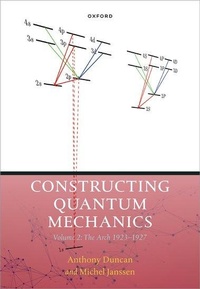
Constructing Quantum Mechanics Volume Two
The Arch, 1923-1927
Published on 17. August 2023
Book
Hardback
816 pages
978-0-19-888390-6 (ISBN)
Description
This is the second of two volumes on the genesis of quantum mechanics in the first quarter of the 20th century. It covers the period 1923-1927. After covering some of the difficulties the old quantum theory had run into by the early 1920s as well as the discovery of the exclusion principle and electron spin, it traces the emergence of two forms of the new quantum mechanics, matrix mechanics and wave mechanics, in the years 1923-27. It then shows how the new theory took care of some of the failures of the old theory and put its successes on a more solid basis. Finally, it shows how in 1927 the two forms of the new theory were unified, first through statistical transformation theory, then through the Hilbert space formalism.
This volume provides a detailed analysis of the classic papers by Heisenberg, Born, Jordan, Dirac, De Broglie, Einstein, Schroedinger, von Neumann and other authors. Drawing on the correspondence of these and other physicists, their later reminiscences and the extensive secondary literature on the "quantum revolution", this volume places these papers in the context of the discussions out of which modern quantum mechanics emerged. It argues that the genesis of modern quantum mechanics can be seen as the construction of an arch on a scaffold provided by the old quantum theory, discarded once the arch could support itself.
This volume provides a detailed analysis of the classic papers by Heisenberg, Born, Jordan, Dirac, De Broglie, Einstein, Schroedinger, von Neumann and other authors. Drawing on the correspondence of these and other physicists, their later reminiscences and the extensive secondary literature on the "quantum revolution", this volume places these papers in the context of the discussions out of which modern quantum mechanics emerged. It argues that the genesis of modern quantum mechanics can be seen as the construction of an arch on a scaffold provided by the old quantum theory, discarded once the arch could support itself.
Reviews / Votes
At the top of the scaffold, the arch! In Volume 1, Duncan and Janssen told the intricate story of the long struggles in the first twenty years of the emergence of quantum mechanics. Now, in The Arch, they give a definitive analysis of the climactic and brilliant mid-1920s, with the formulation of matrix and wave mechanics. It is an extraordinary achievement: all future work on this topic starts here. * Jeremy Butterfield, University of Cambridge * Duncan and Janssen have done something courageous and even audacious. They have surveyed the sprawling, multi-stranded, twenty-seven year saga of the birth and consolidation of modern quantum mechanics and produced a systematic description of the main conceptual advances, in historical context. I expect it will become a unique reference for interested scientists and historians. * A. Douglas Stone, Yale University * The book is rendered suitable for classroom use, albeit at the higher undergraduate or graduate levels. * Steven French, The British Journal for the History of Science *More details
Language
English
Place of publication
Oxford
United Kingdom
Target group
College/higher education
Illustrations
83 illustrations
Dimensions
Height: 253 mm
Width: 180 mm
Thickness: 50 mm
Weight
1735 gr
ISBN-13
978-0-19-888390-6 (9780198883906)
Copyright in bibliographic data and cover images is held by Nielsen Book Services Limited or by the publishers or by their respective licensors: all rights reserved.
Schweitzer Classification
Other editions
Additional editions
E-Book
08/2023
1st Edition
OUP eBook
€73.99
Available for download
Persons
Michel Janssen studied physics and philosophy at the University of Amsterdam and history and philosophy of science at the University of Pittsburgh, where he earned his PhD in 1995. He was an editor at the Einstein Papers Project before joining the School of Physics and Astronomy at the University of Minnesota as a historian of science in 2000. He has also been a regular visitor at the Max Planck Institute for History of Science in Berlin. His research focuses on the genesis of relativity and quantum theory.
Anthony Duncan received his PhD in theoretical elementary particle physics in 1975 from the Massachusetts Institute of Technology, under the supervision of Steven Weinberg. Following postdoctoral and junior faculty positions at the Institute for Advanced Study in Princeton and Columbia University in New York, he joined the faculty of the Department of Physics and Astronomy at the University of Pittsburgh in 1981 as Associate Professor of Physics. He has taught a wide range of courses, both at the undergraduate and graduate level, including courses on the history of modern physics. He is now (since 2015) Professor Emeritus of Physics at the University of Pittsburgh.
Anthony Duncan received his PhD in theoretical elementary particle physics in 1975 from the Massachusetts Institute of Technology, under the supervision of Steven Weinberg. Following postdoctoral and junior faculty positions at the Institute for Advanced Study in Princeton and Columbia University in New York, he joined the faculty of the Department of Physics and Astronomy at the University of Pittsburgh in 1981 as Associate Professor of Physics. He has taught a wide range of courses, both at the undergraduate and graduate level, including courses on the history of modern physics. He is now (since 2015) Professor Emeritus of Physics at the University of Pittsburgh.
Content
8: Introduction to Volume 2 III. Transition to the New Quantum Theory 9: The Exclusion Principle and Electron Spin 10: Theory in the Old Quantum Theory 11: Umdeutung paper 12: Consolidation of Matrix Mechanics 13: Broglie's Matter Waves and Einstein's Quantum Theory of the Ideal Gas 14: and Wave Mechanics 15: and Failures of the Old Quantum Theory Revisited IV. The Formalism of Quantum Mechanics and Its Statistical Interpretation 16: Interpretation of Matrix and Wave Mechanics 17: Neumann's Hilbert Space Formalism 18: Arch and Scaffold Appendices C. The Mathematics of Quantum Mechanics