

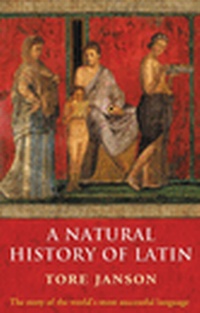
A Natural History of Latin
The story of the world's most successful language
Published on 1. November 2004
Book
Hardback
316 pages
978-0-19-926309-7 (ISBN)
Description
Latin is alive and well. Beginning in Rome around 600 BC Latin became the language of the civilized world and remained so for over two millennia. French, Spanish, Italian, and Romanian are among its progeny and it still provides the international vocabulary of law and life science. No known language, including English itself enriched by Latin words and phrases, has achieved such success and longevity. Tore Janson tells its history from origins to the present. Brilliantly conceived and written with the same light touch as Speak, his bestselling history of languages, "A Natural History of Latin" is a masterpiece of adroit synthesis. The author charts the expansion in the classical world, its renewed importance in the middle ages, and its survival into modern times. He shows its central role in European history and culture and, by judicious quotation of phrases and texts, describes how spoken and written Latin changed and evolved differently in different places. He ends with a summary of Latin grammar and lists of Latin words and of phrases still in common use.
Considered elitist and irrelevant in the second half of the twentieth century and often banned from schools, Latin is now enjoying a huge revival of interest and a renaissance in schools across Europe, the UK, and the USA. Tore Janson offers persuasive arguments for its value and direct access to its fascinating worlds, past and present.
Considered elitist and irrelevant in the second half of the twentieth century and often banned from schools, Latin is now enjoying a huge revival of interest and a renaissance in schools across Europe, the UK, and the USA. Tore Janson offers persuasive arguments for its value and direct access to its fascinating worlds, past and present.
Reviews / Votes
Natural History of Latin is an authoritative introduction to arguably the most influential language of all time. Chicago Tribune This always readable book is full of interest. The Scotsman It is hard to imagine how this book could be improved. Linguist From now on, if anyone who has never studied Latin askes me to recommend a short, readable book in which they can find out about the history of Latin and get a feel for the grammar, I will be able to answer unhesitatingly. LinguistMore details
Language
English
Place of publication
Oxford
United Kingdom
Target group
Students of classics. All who have an interest in the classical world. All who love the story of language - readers of, for example, Melvyn Bragg, Bill Bryson, Lynne Truss. Parents whose children are learning Latin at school.
Dimensions
Height: 216 mm
Width: 138 mm
ISBN-13
978-0-19-926309-7 (9780199263097)
Copyright in bibliographic data and cover images is held by Nielsen Book Services Limited or by the publishers or by their respective licensors: all rights reserved.
Schweitzer Classification
Other editions
Additional editions
Tore Janson
A Natural History of Latin
E-Book
01/2007
1st Edition
OUP eBook
€9.99
Available for download
Persons
Content
PART 1: LATIN AND THE ROMANS; 1. Lingua latina: a first acquaintance; 2. Foundations and origins; 3. How Latin became Latin; 4. From small town to great power; 5. How bad were the Romans?; 6. A voice from early Rome; 7. Meeting with Greece; 8. Theatre for the people; 9. Age of revolutions; 10. Writing, reading, listening and speaking; 11. Speeches, politics and lawsuits; 12. Cicero and rhetoric; 13. Language of history; 14. Imperium Romanum: Augustus and Empire; 15. Name and family; 16. Years and months; 17. Language of Europe; 18. Poets and poetry; 19. Philosophy: Lucretius, Cicero, Seneca; 20. Quintilian and the schools; 21. Science; 22. Everyday language; 23. Laws and legal language; 24. Tacitus, empire and beyond; 25. Dangerous Christians; PART 2: LATIN AND EUROPE; 26. Europe after Rome; 27. From Latin to Romance; 28. Missionaries and Latin; 29. Latin in Britain; 30. Latin in school; 31. Speaking and spelling; 32. Books and scribes; 33. Saints and heretics; 34. Guardians of heritage; 35. Poetry after antiquity; 36. Abelard and Heloise; 37. Thinkers; 38. The renaissance; 39. Doctors and medicine; 40. Linnaeus and plants; 41. Physics and chemistry; 42. Loanwords and neologisms; 43. Latin and French; 44. Latin and English; 45. Latin and us; PART 3: A LITTLE GRAMMAR; 46. Introduction; 47. Pronunciation and stress; 48. Sentences, verbs and nouns; 49. Words and word classes; 50. Nouns; 51. Adjectives; 52. Pronouns; 53. Verbs; 54. Amanda and amandi; 55. How words are built; Glossary of words and expressions