

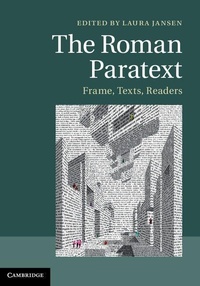
The Roman Paratext
Frame, Texts, Readers
Published on 20. March 2014
Book
Hardback
334 pages
978-1-107-02436-6 (ISBN)
Description
What is a paratext, and where can we find it in a Roman text? What kind of space does a paratext occupy, and how does this space relate to the text and its contexts? How do we interpret Roman texts 'paratextually'? And what does this approach suggest about a work's original modes of plotting meaning, or the assumptions that underpin our own interpretation? These questions are central to the conceptual and practical concerns of the volume, which offers a synoptic study of Roman paratextuality and its exegesis within the broad sphere of Roman studies. Its contributions, which span literary, epigraphic and visual culture, focus on a wide variety of paratextual features - e.g. titles and inter-titles, prefaces, indices, inscriptions, closing statements, decorative and formalistic details - and other paratextual phenomena, such as the frames that can be plotted at various intersections of a text's formal organization.
More details
Language
English
Place of publication
Cambridge
United Kingdom
Target group
Professional and scholarly
Product notice
sewn/stitched
Cloth over boards
Illustrations
4 Tables, black and white; 19 Halftones, unspecified; 19 Halftones, black and white; 1 Line drawings, black and white
Dimensions
Height: 254 mm
Width: 179 mm
Thickness: 25 mm
Weight
827 gr
ISBN-13
978-1-107-02436-6 (9781107024366)
Copyright in bibliographic data and cover images is held by Nielsen Book Services Limited or by the publishers or by their respective licensors: all rights reserved.
Schweitzer Classification
Other editions
Additional editions
Book
03/2017
Cambridge University Press
€49.50
Shipment within 15-20 days
E-Book
03/2014
Cambridge University Press
€21.99
Available for download
E-Book
03/2014
1st Edition
Cambridge University Press
€24.99
Available for download
Person
Laura Jansen is Lecturer in Latin Language and Literature at the University of Bristol. Her work addresses the topic of liminality in various forms, especially those relating to issues of authoriality, editoriality and reception. On this theme, she has published articles on Ovidian paratextuality and its exegesis, and is currently completing a book on the question of the authorial frame in Latin literature.
Content
Introduction: approaches to Roman paratextuality Laura Jansen; 1. Crossing the threshold: Genette, Catullus, and the psychodynamics of paratextuality Duncan F. Kennedy; 2. Starting with the index in Pliny Roy Gibson; 3. The topography of the law book: common structure and modes of reading Matthijs Wibier; 4. Cicero's capita Shane Butler; 5. Tarda solacia: liminal temporalities of Statius' prose prefaces Grant Parker; 6. Inter-titles as deliberate misinformation in Ammianus Marcellinus Roger Rees; 7. Paratextual perspectives upon the SC de Pisone Patre Alison Cooley; 8. Paratext and intertext in the Propertian poetry book Donncha O'Rourke; 9. Pictorial paratexts: floating figures in Roman wall painting Herica Valladares; 10. The paratext of Amores 1: gaming the system Ellen Oliensis; 11. 'Sealing' the book: the sphragis as paratext Irene Peirano; 12. Paraintertextuality: Spenser's classical paratexts in The Shepheardes Calender Bruce Gibson; 13. Modern covers and paratextual strategy in Ovidian elegy Laura Jansen.