

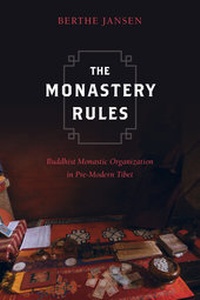
The Monastery Rules
Buddhist Monastic Organization in Pre-Modern Tibet
1st Edition
Published on 23. October 2018
Book
Paperback/Softback
298 pages
978-0-520-29700-5 (ISBN)
Description
A free ebook version of this title is available through Luminos, University of California Press's Open Access publishing program. Visit www.luminosoa.org to learn more.
The Monastery Rules discusses the position of the monasteries in pre-1950s Tibetan Buddhist societies and how that position was informed by the far-reaching relationship of monastic Buddhism with Tibetan society, economy, law, and culture. Jansen focuses her study on monastic guidelines, or bca' yig. The first study of its kind to examine the genre in detail, the book contains an exploration of its parallels in other Buddhist cultures, its connection to the Vinaya, and its value as socio-historical source-material. The guidelines are witness to certain socio-economic changes, while also containing rules that aim to change the monastery in order to preserve it. Jansen argues that the monastic institutions' influence on society was maintained not merely due to prevailing power-relations, but also because of certain deep-rooted Buddhist beliefs.
The Monastery Rules discusses the position of the monasteries in pre-1950s Tibetan Buddhist societies and how that position was informed by the far-reaching relationship of monastic Buddhism with Tibetan society, economy, law, and culture. Jansen focuses her study on monastic guidelines, or bca' yig. The first study of its kind to examine the genre in detail, the book contains an exploration of its parallels in other Buddhist cultures, its connection to the Vinaya, and its value as socio-historical source-material. The guidelines are witness to certain socio-economic changes, while also containing rules that aim to change the monastery in order to preserve it. Jansen argues that the monastic institutions' influence on society was maintained not merely due to prevailing power-relations, but also because of certain deep-rooted Buddhist beliefs.
Reviews / Votes
"The Monastery Rules is one of the most important contributions to Tibetan studies to emerge in recent years because of the author's ability to situate the story of Tibetan monasticism within mainstream Buddhist Studies as well as to address important questions in Buddhist ethics." * Journal of Buddhist Ethics * "In its geographical, temporal and topical focus, the range of the book is exceptional. . . . a great reference for anyone studying Buddhist economies, Buddhist institutions, the Vinaya and the history of Tibetan and Mongolian societies, and of monastic institutions more generally. By surveying and compiling vast stores of knowledge on monastic guidelines, Jansen is able to illustrate compellingly the socio-economic relationships between pre-1950s monastic institutions and the laity." * Inner Asia (INAS) * "In this excellent study, the author undoes the myth that Tibetan monks and monasteries were ever completely separated from lay society, highlighting the complex social role that monasteries negotiated in premodern Tibet." * Reading Religion * "The Monastery Rules offers an excellent specialist study of Tibetan Buddhist monasticism, which emphasizes indigenous voices and. . . . constitutes a monumental achievement that breaks new ground on an understudied but vitally important topic." * Eastern Buddhist * "The Monastery Rules is an eminent and indispensable contribution to the study of Tibetan society, presenting the daily reality of monastic life in its hitherto undocumented diversity." * European Bulletin of Himalayan Research *More details
Series
Edition
First Edition
Language
English
Place of publication
Berkerley
United States
Target group
Professional and scholarly
Product notice
Paperback (trade)
Dimensions
Height: 229 mm
Width: 152 mm
Thickness: 18 mm
Weight
454 gr
ISBN-13
978-0-520-29700-5 (9780520297005)
Copyright in bibliographic data and cover images is held by Nielsen Book Services Limited or by the publishers or by their respective licensors: all rights reserved.
Schweitzer Classification
Other editions
Additional editions
E-Book
10/2018
1st Edition
Naval Institute Press
€12.49
Available for download
Person
Berthe Jansen is Professor of Tibetan Studies at the Institut fuer Indologie und Zentralasienwissenschaften, Leipzig University.
Content
Acknowledgments
A Note on Transliteration
Introduction
1. Documents That Establish the Rules: The Genre of Chayik
2. Historical and Doctrinal Frameworks of Monastic
Organization in Tibet
3. Entrance to the Monastery
4. Monastic Organization
5. Monastic Economy and Policy
6. Relations with the Laity: The Roles of the Monastery in Society
7. Justice and the Judicial Role of the Monastery
8. Maintaining (the) Order: Conclusions
Appendix
Notes
Sources
Index
A Note on Transliteration
Introduction
1. Documents That Establish the Rules: The Genre of Chayik
2. Historical and Doctrinal Frameworks of Monastic
Organization in Tibet
3. Entrance to the Monastery
4. Monastic Organization
5. Monastic Economy and Policy
6. Relations with the Laity: The Roles of the Monastery in Society
7. Justice and the Judicial Role of the Monastery
8. Maintaining (the) Order: Conclusions
Appendix
Notes
Sources
Index