

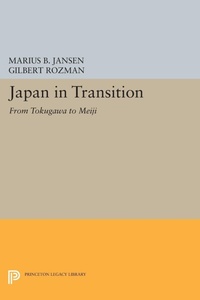
Japan in Transition
From Tokugawa to Meiji
Will be published approx. on 14. July 2014
Book
Paperback/Softback
500 pages
978-0-691-60484-8 (ISBN)
Description
In this book social scientists scrutinize the middle decades of the nineteenth century in Japan. That scrutiny is important and overdue, for the period from the 1850s to the 1880s has usually been treated in terms of politics and foreign relations. Yet those decades were also of pivotal importance in Japan's institutional modernization. As the Japanese entered the world order, they experienced a massive introduction of Western-style organizations. Sweeping reforms, without the class violence or the Utopian appeal of revolution, created the foundation for a modern society. The Meiji Restoration introduced a political transformation, but these chapters address the more gradual social transition. Originally published in 1986. The Princeton Legacy Library uses the latest print-on-demand technology to again make available previously out-of-print books from the distinguished backlist of Princeton University Press. These editions preserve the original texts of these important books while presenting them in durable paperback and hardcover editions.
The goal of the Princeton Legacy Library is to vastly increase access to the rich scholarly heritage found in the thousands of books published by Princeton University Press since its founding in 1905.
The goal of the Princeton Legacy Library is to vastly increase access to the rich scholarly heritage found in the thousands of books published by Princeton University Press since its founding in 1905.
Reviews / Votes
"In this collection of seventeen essays, leading scholars address the question of what kind and what degree of change accompanied the political events known as the Meiji Restoration. The authors make use of quantitative data and recent Japanese scholarship to add substantially to the understanding of this major historical transition. This volume, with its essays of uniformly high quality, is essential reading for anyone with a scholarly interest in the Meiji Period."--ChoiceMore details
Series
Language
English
Place of publication
New Jersey
United States
Target group
College/higher education
Professional and scholarly
Product notice
Paperback (trade)
Dimensions
Height: 234 mm
Width: 156 mm
Thickness: 27 mm
Weight
752 gr
ISBN-13
978-0-691-60484-8 (9780691604848)
Copyright in bibliographic data and cover images is held by Nielsen Book Services Limited or by the publishers or by their respective licensors: all rights reserved.
Schweitzer Classification
Other editions
Additional editions
E-Book
07/2014
1st Edition
Princeton University Press
€88.49
Available for download
Persons
Edited by Marius B. Jansen & Gilbert Rozman
Content
*FrontMatter, pg. i*CONTENTS, pg. v*FIGURES AND MAPS, pg. vii*TABLES, pg. viii*ACKNOWLEDGMENTS, pg. xi*1. Overview, pg. 1*1. Introduction o Part One, pg. 29*2. The Central Government, pg. 36*3. The Ruling Class, pg. 68*4. From Domain to Prefecture, pg. 91*5. Local Administration: The Example of Awa-Tokushima, pg. 111*Introduction to Part Two, pg. 133*6. Buddhism: The Threat of Eradication, pg. 143*7. The Military, pg. 168*8. Education: From One Room to One System, pg. 195*9. The Press, pg. 231*10. Shipping: From Sail to Steam, pg. 248*Introduction to Part Three, pg. 273*11. Population Changes, pg. 280*12. Castle Towns in Transition, pg. 318*13. The Edo-Tokyo Transition: In Search of Common Ground, pg. 347*Introduction to Part Four, pg. 377*14. The Meiji Land Tax Reform and its Effects, pg. 382*15. The Rural Economy: Commercial Agriculture, Byemployment, and Wage Work, pg. 400*16. Grain Consumption: The Case of Choshu, pg. 421*17. The Material Culture: Stability in Transition, pg. 447*About the Contributors, pg. 471*Index, pg. 475