

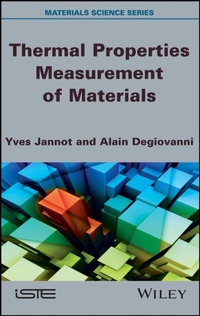
Thermal Properties Measurement of Materials
1st Edition
Published on 9. January 2018
Book
Hardback
352 pages
978-1-78630-255-7 (ISBN)
Description
This book presents the main methods used for thermal properties measurement. It aims to be accessible to all those, specialists in heat transfer or not, who need to measure the thermal properties of a material. The objective is to allow them to choose the measurement method the best adapted to the material to be characterized, and to pass on them all the theoretical and practical information allowing implementation with the maximum of precision.
More details
Language
English
Place of publication
London
United Kingdom
Target group
Professional and scholarly
Product notice
sewn/stitched
Cloth over boards
Dimensions
Height: 239 mm
Width: 163 mm
Thickness: 25 mm
Weight
272 gr
ISBN-13
978-1-78630-255-7 (9781786302557)
Copyright in bibliographic data and cover images is held by Nielsen Book Services Limited or by the publishers or by their respective licensors: all rights reserved.
Schweitzer Classification
Other editions
New editions

Yves Jannot | Alain Degiovanni
Thermal Properties Measurement of Materials
Book
01/2025
2nd Edition
Wiley-ISTE
€153.50
Shipment within 3-4 weeks
Additional editions
Yves Jannot | Alain Degiovanni
Thermal Properties Measurement of Materials
E-Book
01/2018
1st Edition
Wiley
€139.99
Available for download
Yves Jannot | Alain Degiovanni
Thermal Properties Measurement of Materials
E-Book
01/2018
1st Edition
Wiley
€139.99
Available for download
Persons
Yves Jannot, LETMA-CNRS, France.
Alain Degiovanni, University of Lorraine, France.
Alain Degiovanni, University of Lorraine, France.
Content
1. Heat transfer modelling.
2. Tools and methods for thermal characterization.
3. Steady-state methods.
4. Flux/temperature transient methods.
5. Temperature/temperature transient methods.
6. Choice of a method.
7. Analogy between different transfers.
2. Tools and methods for thermal characterization.
3. Steady-state methods.
4. Flux/temperature transient methods.
5. Temperature/temperature transient methods.
6. Choice of a method.
7. Analogy between different transfers.