

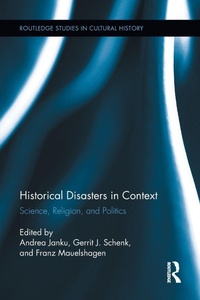
Historical Disasters in Context
Science, Religion, and Politics
1st Edition
Published on 14. October 2024
Book
Paperback/Softback
308 pages
978-1-032-92253-9 (ISBN)
Description
Growing concerns about climate change and the increasing occurrence of ever more devastating natural disasters in some parts of the world and their consequences for human life, not only in the immediately affected regions, but for all of us, have increased our desire to learn more about disaster experiences in the past. How did disaster experiences impact on the development of modern sciences in the early modern era? Why did religion continue to play such an important role in the encounter with disasters, despite the strong trend towards secularization in the modern world? What was the political role of disasters?
Historical Disasters in Context illustrates how past societies coped with a threatening environment, how societies changed in response to disaster experiences, and how disaster experiences were processed and communicated, both locally and globally. Particular emphasis is put on the realms of science, religion, and politics. International case studies demonstrate that while there are huge differences across cultures in the way people and societies responded to disasters, there are also many commonalities and interactions between different cultures that have the potential to alter the ways people prepare for and react to disasters in future. To explain these relationships and highlight their significance is the purpose of this volume.
Historical Disasters in Context illustrates how past societies coped with a threatening environment, how societies changed in response to disaster experiences, and how disaster experiences were processed and communicated, both locally and globally. Particular emphasis is put on the realms of science, religion, and politics. International case studies demonstrate that while there are huge differences across cultures in the way people and societies responded to disasters, there are also many commonalities and interactions between different cultures that have the potential to alter the ways people prepare for and react to disasters in future. To explain these relationships and highlight their significance is the purpose of this volume.
More details
Series
Language
English
Place of publication
London
United Kingdom
Publishing group
Taylor & Francis Ltd
Target group
College/higher education
Professional and scholarly
Academic and Postgraduate
Product notice
Paperback (trade)
Illustrations
43 s/w Abbildungen
43 Illustrations, black and white
Dimensions
Height: 229 mm
Width: 152 mm
Thickness: 17 mm
Weight
415 gr
ISBN-13
978-1-032-92253-9 (9781032922539)
Copyright in bibliographic data and cover images is held by Nielsen Book Services Limited or by the publishers or by their respective licensors: all rights reserved.
Schweitzer Classification
Other editions
Additional editions
Andrea Janku | Gerrit Schenk | Franz Mauelshagen
Historical Disasters in Context
Science, Religion, and Politics
Book
12/2011
1st Edition
Routledge
€232.20
Shipment within 15-20 days
Andrea Janku | Gerrit Schenk | Franz Mauelshagen
Historical Disasters in Context
Science, Religion, and Politics
E-Book
12/2011
1st Edition
Routledge
€53.99
Available for download
Andrea Janku | Gerrit Schenk | Franz Mauelshagen
Historical Disasters in Context
Science, Religion, and Politics
E-Book
12/2011
1st Edition
Routledge
€53.99
Available for download
Persons
Andrea Janku teaches Chinese History at SOAS, University of London. Her research interests include famine in Chinese history, environmental history, and processes of communication and globalization in the early modern world. She is currently working on a book manuscript entitled 'Integrating the Body Politic: Famine, the Press, and the Chinese Nation.'
Gerrit J. Schenk is Professor for the History of the Middle Ages at Darmstadt University, Germany, and Research Group Leader "Cultures of Disaster" at the Karl Jaspers Centre, University of Heidelberg, Germany. He is the co-founder of a scholarly network on historical disaster research.
Franz Mauelshagen is a Research Fellow at the Kulturwissenschaftliches Institut in Essen, Germany. His publications include authored books, edited volumes and many articles on climate history, environmental history, in particular the history of natural disasters, and media on the early modern period.
Gerrit J. Schenk is Professor for the History of the Middle Ages at Darmstadt University, Germany, and Research Group Leader "Cultures of Disaster" at the Karl Jaspers Centre, University of Heidelberg, Germany. He is the co-founder of a scholarly network on historical disaster research.
Franz Mauelshagen is a Research Fellow at the Kulturwissenschaftliches Institut in Essen, Germany. His publications include authored books, edited volumes and many articles on climate history, environmental history, in particular the history of natural disasters, and media on the early modern period.
Content
1. Introduction. Andrea Janku, Gerrit J. Schenk, Franz Mauelshagen 2. Roman Emperors and 'Natural Disasters' in the First Century AD. Mischa Meier 3. Managing Natural Hazards: Environment, Society, and Politics in the Upper Rhine Valley and Tuscany in the Renaissance (ca. 1270-1570). Gerrit J. Schenk 4. Acts of God: The Confessionalization of Disaster in Reformation Europe. Elaine Fulton 5. The Struggle Against the Sea: An Early Modern Coastal Society Between Metaphysical and Physical Attempts to Control Nature. Marie Luisa Allemeyer 6. Earthquakes in Early Modern France: From the Old Regime to the Birth of a New Risk. Gregory Quenet 7. The Doomsday Discourse in the Earth and Planetary Sciences, 1700-Present. Nicolaas A. Rupke 8. Forgotten Risks: Mass Movements in the Mountains. Andreas Dix 9. Shaping the City: Aleppo's Foreigner Community and the Earthquake of 1822. Stefan Knost 10. Earthquake versus Fire: The Struggle over Insurance in the Aftermath of the 1906 San Francisco Disaster. Eleonora Rohland 11. Mediating Foreign Disasters: The Los Angeles Times and International Relief, 1891-1914. Gordon M. Winder 12. From Natural to National Disaster: The Chinese Famine of 1928-1930. Andrea Janku 13. Climate Catastrophism: The History of the Future of Climate Change. Franz Mauelshagen Notes on Contributors Notes Index