

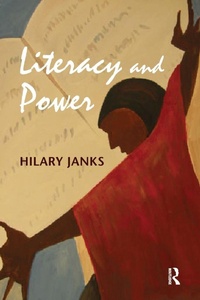
Literacy and Power
1st Edition
Published on 2. October 2009
Book
Paperback/Softback
268 pages
978-0-415-99963-2 (ISBN)
Description
Hilary Janks addresses key questions about literacy and power in this landmark text that is both engaging and accessible.
Her central argument is that competing orientations to critical literacy education ? domination (power), access, diversity, design ? foreground one over the other, but are crucially interdependent and need to work together to create possibilities for redesign and social action that serve a social justice agenda. She examines the theory underpinning each orientation, and develops new theory in the argument for interdependence and integration.
Sitting at the interface between theory and practice, constantly moving from one to the other, the text is rich with examples of how to use these orientations in real teaching contexts, and how to use them to counterbalance one another.
In the groundbreaking final chapter Janks considers how the rationalist underpinning of critical literacy tends to exclude the non-rational shows ways of working 'beyond reason' ? pleasure and play, desire and the unconscious ? and makes the case that these need to be taken seriously given their power to cut across the work of critical literacy educators working from any orientation.
Her central argument is that competing orientations to critical literacy education ? domination (power), access, diversity, design ? foreground one over the other, but are crucially interdependent and need to work together to create possibilities for redesign and social action that serve a social justice agenda. She examines the theory underpinning each orientation, and develops new theory in the argument for interdependence and integration.
Sitting at the interface between theory and practice, constantly moving from one to the other, the text is rich with examples of how to use these orientations in real teaching contexts, and how to use them to counterbalance one another.
In the groundbreaking final chapter Janks considers how the rationalist underpinning of critical literacy tends to exclude the non-rational shows ways of working 'beyond reason' ? pleasure and play, desire and the unconscious ? and makes the case that these need to be taken seriously given their power to cut across the work of critical literacy educators working from any orientation.
Reviews / Votes
"This book has integrity - in more than one meaning of the word. Hilary Janks sets out to describe and exemplify an integrated model of critical literacy which includes both cognitive skills and social practices but she is herself a writer of proven professional integrity. One of the attractive features of this book - and there are many - is that the author includes the important historical dimension as she outlines the development of critical literacy theory and practice.... Janks' view of diversity as a productive resource for social and cultural transformation speaks to any of us, wherever we live and work."--Literacy, the journal of the UK Literacy Association"The book offers a mapping of a sphere for action that is thoughtful, hopeful and profoundly practical."--Reading & Writing
"Janks accomplishes what she intended: step by step, one chapter at a time, she refines her interdependent model of critical literacy and clearly explains it to the readers. Her work in strongly grounded in theories and practice. All readers, from administrators to classroom teachers, from teacher educators to graduate students, will benefit from reading this book."--Education Review
More details
Series
Language
English
Place of publication
London
United Kingdom
Publishing group
Taylor & Francis Ltd
Target group
College/higher education
Product notice
Paperback (UK-B)
Illustrations
20 s/w Tabellen
20 Tables, black and white
Dimensions
Height: 229 mm
Width: 152 mm
Thickness: 15 mm
Weight
393 gr
ISBN-13
978-0-415-99963-2 (9780415999632)
Copyright in bibliographic data and cover images is held by Nielsen Book Services Limited or by the publishers or by their respective licensors: all rights reserved.
Schweitzer Classification
Other editions
Additional editions
Person
Hilary Janks is a professor in Applied English Language Studies in the School of Education at the University of the Witwatersrand, Johannesburg, South Africa.
Content
Foreword, Sonia Nieto
Preface
Acknowledgments
1. Turning to Literacy
2. Orientations to Literacy
3. Language and Power
4. Reading Texts Critically
5. Diversity, Difference and Disparity
6. Access, Gate-Keeping and Desire
7. Critical Text Production: Writing and Design
8. Redesign, Social Action and Possibilities for Transformation
9. The Future of Critical Literacy
References
Index
Preface
Acknowledgments
1. Turning to Literacy
2. Orientations to Literacy
3. Language and Power
4. Reading Texts Critically
5. Diversity, Difference and Disparity
6. Access, Gate-Keeping and Desire
7. Critical Text Production: Writing and Design
8. Redesign, Social Action and Possibilities for Transformation
9. The Future of Critical Literacy
References
Index