

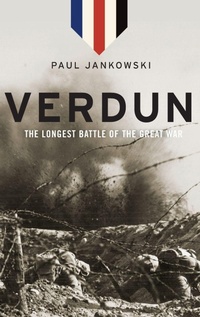
Verdun
The Longest Battle of the Great War
Published on 24. April 2014
Book
Hardback
338 pages
978-0-19-931689-2 (ISBN)
Description
At seven o'clock in the morning on February 21, 1916, the ground in northern France began to shake. For the next ten hours, twelve hundred German guns showered shells on a salient in French lines. The massive weight of explosives collapsed dugouts, obliterated trenches, severed communication wires, and drove men mad. As the barrage lifted, German troops moved forward, darting from shell crater to shell crater. The battle of Verdun had begun.
In Verdun, historian Paul Jankowski provides the definitive account of the iconic battle of World War I. A leading expert on the French past, Jankowski combines the best of traditional military history-its emphasis on leaders, plans, technology, and the contingency of combat-with the newer social and cultural approach, stressing the soldier's experience, the institutional structures of the military, and the impact of war on national memory. Unusually, this book draws on deep research in French and German archives; this mastery of sources in both languages gives Verdun unprecedented authority and scope. In many ways, Jankowski writes, the battle represents a conundrum. It has an almost unique status among the battles of the Great War; and yet, he argues, it was not decisive, sparked no political changes, and was not even the bloodiest episode of the conflict. It is said that Verdun made France, he writes; but the question should be, What did France make of Verdun? Over time, it proved to be the last great victory of French arms, standing on their own. And, for France and Germany, the battle would symbolize the terror of industrialized warfare, "a technocratic Moloch devouring its children," where no advance or retreat was possible, yet national resources poured in ceaselessly, perpetuating slaughter indefinitely.
In Verdun, historian Paul Jankowski provides the definitive account of the iconic battle of World War I. A leading expert on the French past, Jankowski combines the best of traditional military history-its emphasis on leaders, plans, technology, and the contingency of combat-with the newer social and cultural approach, stressing the soldier's experience, the institutional structures of the military, and the impact of war on national memory. Unusually, this book draws on deep research in French and German archives; this mastery of sources in both languages gives Verdun unprecedented authority and scope. In many ways, Jankowski writes, the battle represents a conundrum. It has an almost unique status among the battles of the Great War; and yet, he argues, it was not decisive, sparked no political changes, and was not even the bloodiest episode of the conflict. It is said that Verdun made France, he writes; but the question should be, What did France make of Verdun? Over time, it proved to be the last great victory of French arms, standing on their own. And, for France and Germany, the battle would symbolize the terror of industrialized warfare, "a technocratic Moloch devouring its children," where no advance or retreat was possible, yet national resources poured in ceaselessly, perpetuating slaughter indefinitely.
Reviews / Votes
A scholarly but readable account of something quite extraordinary. A valuable and valued addition to the growing library of WW1 literature. * Books Monthly * Impressive. * Max Hastings, The Sunday Times * Jankowski is abundantly qualified to present a new standard work on the subject. A well-respected scholar of French politics and culture, he has delved deeply into the contemporary sources from that nation, but he is no less at home in the copious German archives. The writing throughout is of the highest order, to a degree that may startle any reader with a dated stereotype of military history as a mechanical recounting of military formations. * Books & Culture * The first major study of the battle to appear in English for many years, and the first to draw fully on archival research on both sides... A thoughtful, original, and moving account, full of insights into the course of the fighting and its subsequent commemoration and impact. * David Stevenson, author of Cataclysm: The First World War as Political Tragedy * Jankowski has written a superb, definitive popular account of Verdun through the eyes of soldiers, military leaders, and citizens of the two nations. * Publishers Weekly *More details
Language
English
Place of publication
New York
United States
Target group
College/higher education
Illustrations
20 b/w
Dimensions
Height: 240 mm
Width: 161 mm
Thickness: 23 mm
Weight
684 gr
ISBN-13
978-0-19-931689-2 (9780199316892)
Copyright in bibliographic data and cover images is held by Nielsen Book Services Limited or by the publishers or by their respective licensors: all rights reserved.
Schweitzer Classification
Other editions
Additional editions
Book
12/2016
Oxford University Press Inc
€26.70
Shipment within 15-20 days
E-Book
01/2014
1st Edition
Oxford University Press
€11.89
Available for download
E-Book
01/2014
1st Edition
Oxford University Press
€11.89
Available for download
Person
Paul Jankowski is Raymond Ginger Professor of History at Brandeis University. His many books include Stavinksy: A Confidence Man in the Republic of Virtue and Shades of Indignation: Political Scandals in France, Past and Present.
Content
Introduction ; I. The Three Hundred Days of Verdun ; II. Verdun under German Eyes ; III. Verdun under French Eyes ; IV. The Offensive Trap ; V. The Prestige Trap ; VI. The Attritional Trap ; VII. The Nightmare ; VIII. Rancor ; IX. Warning Signals ; X. Enemies ; XI. Circles of Loyalty ; Epilogue ; Appendix ; Acknowledgments ; Bibliography