

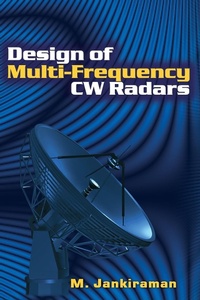
Design of Multi-Frequency CW Radars
Published on 30. June 2007
Book
Hardback
350 pages
978-1-891121-56-2 (ISBN)
Description
This book deals with the basic theory for design and analysis of Low Probability of Intercept (LPI) radar systems. The design of one such multi-frequency high resolution LPI radar, PANDORA, is covered. This work represents the first time that the topic of multi-frequency radars is discussed in such detail and it is based on research conducted by the author in The Netherlands. The book provides the design tools needed for development, design, and analysis of high resolution radar systems for commercial as well as military applications. Software written in MATLAB and C++ is provided to guide the reader in calculating radar parameters and in ambiguity function analysis. Some radar simulation software is also included.
More details
Series
Language
English
Place of publication
New York
United States
Target group
College/higher education
Professional and scholarly
Dimensions
Height: 260 mm
Width: 183 mm
Thickness: 24 mm
Weight
899 gr
ISBN-13
978-1-891121-56-2 (9781891121562)
Copyright in bibliographic data and cover images is held by Nielsen Book Services Limited or by the publishers or by their respective licensors: all rights reserved.
Schweitzer Classification
Other editions
Additional editions
M. Jankiraman
Design of Multi-Frequency CW Radars
E-Book
05/2014
1st Edition
SciTech Publishing Inc
€182.19
Available for download
Person
Dr. Mohinder Jankiraman received his B. Tech. degree in electronics and telecommunications from the Naval Electrical School in Jamnagar, India, in 1971. Subsequently, he served as an electrical officer in the Indian Navy for many years. In 1982 he was seconded to research work in military electronics. He took part in a number of military research projects and won a number of awards for technology development in India. His research has spanned several disciplines, emphasizing signal processing, development of naval mines, torpedoes, sonars, radar, and communication systems. He retired from the Indian Navy in 1995 with the rank of a Commodore and joined the International Research Centre for Telecommunications and Radar (IRCTR) in the Delft University of Technology, Netherlands, in 1997. During this period, he took part in the research and development program for high-resolution radars at IRCTR.
Dr. Jankiraman completed his Master of Technology in Design (MTD) degree in 1999, from Delft University of Technology, The Netherlands, graduating cum laude, and went on to complete his Ph.D. from Aalborg University, Denmark, in September 2000. He is currently living in the United States, based in Dallas, Texas. He is a senior member of IEEE.
Dr. Jankiraman completed his Master of Technology in Design (MTD) degree in 1999, from Delft University of Technology, The Netherlands, graduating cum laude, and went on to complete his Ph.D. from Aalborg University, Denmark, in September 2000. He is currently living in the United States, based in Dallas, Texas. He is a senior member of IEEE.
Content
Part I: Fundamentals of CW Radar
Chapter 1: Frequency Modulated Continuous Wave Radar
Chapter 2: Radar Waveforms and Processing
Chapter 3: The Radar Ambiguity Function
Chapter 4: FMCW Waveform
Chapter 5: Phase-Coded Waveform
Chapter 6: Frequency Hopped Waveform
Part II: Theory and Design of Calypso FMCW Radar
Chapter 7: Design Approach
Part III: Theory and Design of Pandora Multifrequency Radar
Chapter 8: Design Approach
Chapter 9: Implementation of the Single-Channel Pandora and Other Issues
Chapter 10: Pandora Radar Multi-Channel Radar
Appendices
Appendix A: CW Radar Range Equations
Appendix B: The Design Process
Appendix C: A Hardware Solution to the Range Resolution Problem
Appendix D: Nonlinearity in FM Waveforms
Appendix E: Transmitter Noise Leakage
Appendix F: Pandora Receiver Channel - Basic Design
Appendix G: Direct Digital Synthesis
Appendix H: Implementation of the Single - Channel Radar
Appendix I: Pandora Radar Performance Verification Measurements
Appendix J: 8 - Way Combiner Analysis Results
Appendix K: Matlab Simulation Program
Appendix L: Level Diagram Calculations - SFCW Radar
Chapter 1: Frequency Modulated Continuous Wave Radar
Chapter 2: Radar Waveforms and Processing
Chapter 3: The Radar Ambiguity Function
Chapter 4: FMCW Waveform
Chapter 5: Phase-Coded Waveform
Chapter 6: Frequency Hopped Waveform
Part II: Theory and Design of Calypso FMCW Radar
Chapter 7: Design Approach
Part III: Theory and Design of Pandora Multifrequency Radar
Chapter 8: Design Approach
Chapter 9: Implementation of the Single-Channel Pandora and Other Issues
Chapter 10: Pandora Radar Multi-Channel Radar
Appendices
Appendix A: CW Radar Range Equations
Appendix B: The Design Process
Appendix C: A Hardware Solution to the Range Resolution Problem
Appendix D: Nonlinearity in FM Waveforms
Appendix E: Transmitter Noise Leakage
Appendix F: Pandora Receiver Channel - Basic Design
Appendix G: Direct Digital Synthesis
Appendix H: Implementation of the Single - Channel Radar
Appendix I: Pandora Radar Performance Verification Measurements
Appendix J: 8 - Way Combiner Analysis Results
Appendix K: Matlab Simulation Program
Appendix L: Level Diagram Calculations - SFCW Radar