

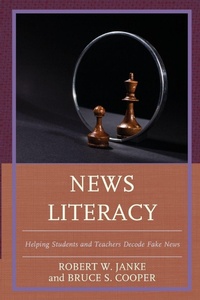
News Literacy
Helping Students and Teachers Decode Fake News
Published on 11. October 2017
Book
Paperback/Softback
170 pages
978-1-4758-3930-2 (ISBN)
Description
Our society faces international challenges from cyber attacks and dissemination of fake news with a goal to destabilize our society. Fake news can be used as a weapon with destructive effects as powerful as any military attack. Fake news can spread as fast as a wildfire carried on the winds of social media. Students and all citizens need to be prepared and informed of ways to quickly understand and distinguish real and fake news. Preventing the potential destructive effects of fake news is the purpose of this book. The focus is upon providing a resource for educators to develop "news literacy" skills of students in objectively evaluating the news.
Reviews / Votes
Is there a subject that we need to study as urgently as the matter of what is, and is not, fake news? Social media have provided a platform for the dissemination and absorption of untruths in a way our ancestors could not have dreamed of-with what now looks like grotesques implications for societal progress, citizenship, and the social contract. Janke and Cooper could not be writing at a better time and their excellent and very readable exploration of this topic should be on every teacher's (and teacher trainer's) reading list. -- Tom Bennett, Director of researchED and author of multiple teacher training books Our democracy depends on a citizenry that can evaluate 'facts' and distinguish between accurate and fake news. This book serves as vital resource for educators and students in a period of cyber warfare-and political attacks on the news media. -- James G. Cibulka, PhD, Past President, Council for the Accreditation of Educator Preparation (CAEP) With the explosion of various forms of social media and their use in the widespread distribution of fake news, there has never been a previous time in our nation's history when it has been more important to inform our students with the knowledge to separate the true from the false. This timely book provides teachers with valuable information to impart in an effort to combat a serious threat to our democracy. -- Richard A. Boyd, State Superintendent of Education, emeritus for MississippiMore details
Language
English
Place of publication
United States
Publishing group
Bloomsbury Publishing Plc
Target group
Professional and scholarly
Dimensions
Height: 229 mm
Width: 152 mm
Thickness: 9 mm
Weight
256 gr
ISBN-13
978-1-4758-3930-2 (9781475839302)
Copyright in bibliographic data and cover images is held by Nielsen Book Services Limited or by the publishers or by their respective licensors: all rights reserved.
Schweitzer Classification
Persons
Robert W. Janke is professor of education at Baldwin Wallace University with almost 50 years of experience as a teacher, psychologist, and professor. He received a PhD from the University of Michigan.
Bruce S. Cooper is professor emeritus in education leadership, administration, and policy at Fordham University. He receive a PhD from the University of Chicago and has published over forty books on policy, finance, leadership, and school improvement.
Bruce S. Cooper is professor emeritus in education leadership, administration, and policy at Fordham University. He receive a PhD from the University of Chicago and has published over forty books on policy, finance, leadership, and school improvement.
Content
Preface
Acknowledgments
PART I: Background and Hurdles for Evaluating the News
1. Background
2. Hurdles
PART II: Sources and Terms of Accurate and Fake News
3. Sources
4. Terms and Vocabulary
PART III: Collecting Information in Real and Fake News
5. Obtaining a Sample of Persons or Documents
6. Instruments Used to Collect Information
7. Types of Information
8. Analyzing Information
9. Interpreting Information
10. Promises or Recommendations
PART IV: How Fake News Persuades
11. Techniques of Fake News Communication
12. Fake News about Education
PART V: Preventing Fake News from Spreading
13. Protecting Against Fake News
14. Instructional Activities
15. Recommendations
References
Index
Acknowledgments
PART I: Background and Hurdles for Evaluating the News
1. Background
2. Hurdles
PART II: Sources and Terms of Accurate and Fake News
3. Sources
4. Terms and Vocabulary
PART III: Collecting Information in Real and Fake News
5. Obtaining a Sample of Persons or Documents
6. Instruments Used to Collect Information
7. Types of Information
8. Analyzing Information
9. Interpreting Information
10. Promises or Recommendations
PART IV: How Fake News Persuades
11. Techniques of Fake News Communication
12. Fake News about Education
PART V: Preventing Fake News from Spreading
13. Protecting Against Fake News
14. Instructional Activities
15. Recommendations
References
Index