

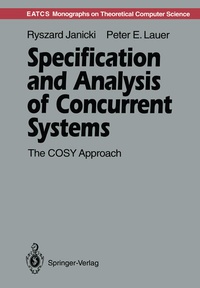
Specification and Analysis of Concurrent Systems
The COSY Approach
Published on 29. December 2011
Book
Paperback/Softback
XII, 480 pages
978-3-642-77339-6 (ISBN)
Description
Concurrent systems abound in human experience but their
fully adequate conceptualization as yet eludes our most able
thinkers. The COSY (ConcurrentSystem) notation and theory
was developed in the last decade as one of a number of
mathematical approaches for conceptualizing and analyzing
concurrent and reactive systems.
The COSY approach extends theconventional notions of
grammar and automaton from formal language and automata
theory to collections of "synchronized" grammars and
automata, permitting system specification and analysis of
"true" concurrency without reduction to non-determinism.
COSY theory is developed to a great level of detail and
constitutes the first uniform and self-contained
presentationof all results about COSY published in the
past, as well as including many new results.
COSY theory is used to analyze a sufficient number of
typical problems involving concurrency, synchronization and
scheduling, to allow the reader to apply the techniques
presented tosimilar problems.
The COSY model is also related to many alternative models of
concurrency, particularly Petri Nets, Communicating
Sequential Processes and the Calculus of Communicating
Systems.
More details
Series
Edition
Softcover reprint of the original 1st ed. 1992
Language
English
Place of publication
Berlin
Germany
Publishing group
Springer Berlin
Target group
Professional and scholarly
Research
Illustrations
XII, 480 p.
Dimensions
Height: 242 mm
Width: 170 mm
Thickness: 27 mm
Weight
847 gr
ISBN-13
978-3-642-77339-6 (9783642773396)
DOI
10.1007/978-3-642-77337-2
Schweitzer Classification
Other editions
Additional editions
Book
09/1992
Springer
€139.09
Article exhausted; check different version
Content
1 What COSY Is and What It Is For.- 1.1 Introduction.- 1.2 Concepts, Objectives and Design Decisions.- 1.3 Structure of Bookevevr.- 1.4 Acknowledgements.- 2 Formal Theory of Basic COSY.- 2.1 Basic COSY Syntax and Semantics.- 2.2 VFS Semantics of COSY.- 2.3. Petri Net Semantics of COSY.- 2.4 Adequacy Properties of Path Programs.- 2.5 Execution Semantics for COSY.- 2.6 Semantics of COSY with Priorities.- 2.7 Bibliographic Notes.- 3 High-level COSY Programs and System Design.- 3.1 High-level COSY Syntax and Semantics.- 3.2 The Process Notation.- 3.3 Macro Generators for COSY Notation.- 3.4 The Semantics of Macro COSY Programs.- 3.5 The COSY Environment.- 3.6 The COSY System Dossier.- 3.7 Bibliographical Notes.- 4 COSY Applications.- 4.1 Two-Way Channel with Disconnect.- 4.2 The Hyperfast Banker.- 4.3 Cigarette Smokers.- 4.4 Merlin-Randell Problem of Train Journeys.- 4.5 Transforming Sequential Systems into Concurrent Systems.- 4.6 Modelling N-Modular Redundancy.- 5 Comparison of COSY with Other Models.- 5.1 COSY and CCS.- 5.2 COSY and CSP.- Full COSY and Petri Nets.- 5.4 Vector Sequences and Mazurkiewicz Traces.- 5.5 COSY and Synchronized Behaviours.- 6 Historical Perspective.- 6.1 Introduction.- 6.2 Conceptual and Methodological Framework of COSY Approach.- Appendices.- A Algebra of Relations.- B Automata and Formal Language Theory.- B.1 Strings.- B.2 Languages.- B.3 Regular Expressions and Languages.- B.4 Finite State Automata and Grammars.- C Elements of Graph Theory.- D Proofs of Theorems 2.25, 2.26 and 2.28.- E Proofs of Theorems 2.37 and 2.38.- F Proof of Theorem 2.29.- G Proof of Theorem 4.3.- H Basic COSY Notations and Macro COSY Notation.- List of Figures.- List of Algorithms.- List of Definitions.- List of Theorems.- List of Corollaries.- List of Lemmas.