

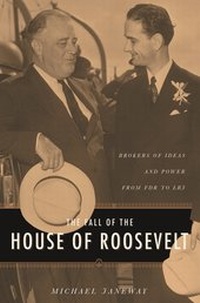
The Fall of the House of Roosevelt
Brokers of Ideas and Power from FDR to LBJ
Will be published approx. on 6. June 2006
Book
Paperback/Softback
352 pages
978-0-231-13109-4 (ISBN)
Description
In the 1930s a band of smart and able young men, some still in their twenties, helped Franklin D. Roosevelt transform an American nation in crisis. They were the junior officers of the New Deal. Thomas G. Corcoran, Benjamin V. Cohen, William O. Douglas, Abe Fortas, and James Rowe helped FDR build the modern Democratic Party into a progressive coalition whose command over power and ideas during the next three decades seemed politically invincible. This is the first book about this group of Rooseveltians and their linkage to Lyndon Johnson's Great Society and the Vietnam War debacle. Michael Janeway grew up inside this world. His father, Eliot Janeway, business editor of Time and a star writer for Fortune and Life magazines, was part of this circle, strategizing and practicing politics as well as reporting on these men. Drawing on his intimate knowledge of events and previously unavailable private letters and other documents, Janeway crafts a riveting account of the exercise of power during the New Deal and its aftermath.
He shows how these men were at the nexus of reform impulses at the electoral level with reform thinking in the social sciences and the law and explains how this potent fusion helped build the contemporary American state. Since that time efforts to reinvent government by "brains trust" have largely failed in the U.S. In the last quarter of the twentieth century American politics ceased to function as a blend of broad coalition building and reform agenda setting, rooted in a consensus of belief in the efficacy of modern government. Can a progressive coalition of ideas and power come together again? The Fall of the House of Roosevelt makes such a prospect both alluring and daunting.
He shows how these men were at the nexus of reform impulses at the electoral level with reform thinking in the social sciences and the law and explains how this potent fusion helped build the contemporary American state. Since that time efforts to reinvent government by "brains trust" have largely failed in the U.S. In the last quarter of the twentieth century American politics ceased to function as a blend of broad coalition building and reform agenda setting, rooted in a consensus of belief in the efficacy of modern government. Can a progressive coalition of ideas and power come together again? The Fall of the House of Roosevelt makes such a prospect both alluring and daunting.
Reviews / Votes
Janeway dutifully navigates the ideological differences that developed among the New Dealers and the ways in which the Democratic Party later moved away from their crowd. But this book is far more interesting and original as a biographical study of what human beings will do to acquire great power and try to hold onto it-especially after their time has passed... Janeway's volume is almost a kind of "New Deal Confidential."... Janeway's book is a reminder that even monument makers can have feet of clay. -- Michael Beschloss New York Times Book Review The Fall of the House of Roosevelt is a fascinating personal perspective on the New Deal and its aftermath. Michael Janeway's book is an elegant contribution to political as well as to personal history. -- Arthur Schlesinger Jr. A smart mix of family and social history by the son of a New Deal brains-truster... A fine effort to restore [New Dealers] to the textbooks, and a lively, highly readable work of history. Kirkus Reviews With both eloquence and a sense of regret, Janeway describes an era in which both the populace and the elites generally assumed that government and governmental activism were positive forces of good... this well-written and valuable examination of the evolution of our body politic is very worthwhile. Booklist Son of Eliot Janeway-financial adviser to FDR and other prominent Democrats through the end of the 20th century-Janeway recalls those days in a personal and insightful narrative. He deftly weaves tales of his father's deal making from the New Deal to the Great Society, with personal reflections about his father's private life during those years... this book is recommended for history and political science collections in academic and public libraries. Library Journal [The Fall of the House of Roosevelt's] elegiac tone, its penetrating insights and its evocation of a world when politics truly mattered should find a warm welcome among readers eager to define a new American Century. -- Ted Widmer Chicago Tribune [A] bittersweet family memoir and a fresh interpretation of the New Deal. -- Christopher Caldwell New York Times [A]n engaging book. -- William Lasser The New Leader Janeway has given us a wide-ranging, well-considered, deeply researched and engaging study of Democratic Party developments in the FDR years and succeeding regencies. His thoughtful and penetrating review of the operations of party stalwarts furnishes potent cause for concern to anyone interested in the future of the Democratic Party and of the country. -- John S. Monagan Washington Times Containing new material and written from a particularly privileged vantage point,The Fall of the House of Roosevelt is a valuable contribution to New Deal history. -- Merle Rubin Los Angeles Times At the heart ofFall of the House of Roosevelt is a thoughtful man's attempt to understand his enigmatic father, and the portions of the book focusing on this pursuit are the author's best work. -- Kimberly Marlowe Hartnett Seattle Times/Post Intelligencer earlier American liberalism springs back to life in a remarkable new book,The Fall of the House of Roosevelt -- Robert Fulford National Post Toronto Janeway's personal memories of these men and his unique access...allow him to make an important contribution to the study of the exercise of power during the New Deal...Highly recommended. All levels and libraries. Choice With fresh detail and affecting vignettes, rendered in beautiful, evocative prose, Janeway captures the New Dealer's keenness for action. -- David Greenberg American Prospect For its insights, balanced tone, and thorough research, this accessible volume will provide stimulating analysis for those readers in the twenty-first century. -- Lewis L. Gould The Register of the Kentucky Historical Society Gracefully written narrative... it makes many wise observations about American politics during and after the age of Roosevelt. -- Alonzo L. Hamby H-New Deal This book offers a useful portrait of an era that may seem less complex but really wasn't. -- Bruce M. Stave American Historical ReviewMore details
Series
Language
English
Place of publication
New York
United States
Target group
Professional and scholarly
Product notice
Paperback (trade)
Illustrations
16 photos
Dimensions
Height: 235 mm
Width: 156 mm
Weight
425 gr
ISBN-13
978-0-231-13109-4 (9780231131094)
Copyright in bibliographic data and cover images is held by Nielsen Book Services Limited or by the publishers or by their respective licensors: all rights reserved.
Schweitzer Classification
Other editions
Additional editions
E-Book
09/2015
1st Edition
De Gruyter
from
€29.95
Available for download
Book
01/2004
Columbia University Press
€113.89
Article not available at the moment
Person
Michael Janeway is professor of journalism and arts at Columbia University and is the author of Republic of Denial: Press, Politics, and Public Life. He has been special assistant to Secretary of State Cyrus Vance, editor of The Boston Globe, and dean of the Medill School of Journalism at Northwestern University.
Content
Preface: Public and Private The Partners 1. Government by Brains Trust: "God Bless You; Keep Scheming" 2. Tommy Corcoran and the New Dealers Gospel: "You're Beginning to Be an Operator-How Do You Like the Water?" 3. Making the New Deal Revolution: "The Sense of Being Special" 4. The Fight for the Rooseveltian Succession: "Douglas's Army" 5. 1945-the New Dealers Government-in-Exile: "I Got the Circuit Moving" In My Father's House 6. Rise of an Insider: "We're Going to Get Hubert Some Dough" 7. Ends and Means: "Baby, You're Superb!" 8. Forbidden Version: "Continue Janeway Inquiry" Receivership 9. Enter LBJ, Stage Center: "Average in Honesty, Above Average in Ability" 10. 1960-Checkmate: "Looking Back, the Result Was Inevitable" 11. President of All the People: "You Can't Deal with Him Any Longer" 12. Last Act: "We Got Your Man" Epilogue Notes Acknowledgments Index