

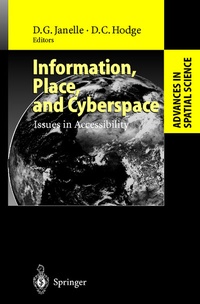
Information, Place, and Cyberspace
Issues in Accessibility
Published on 26. July 2000
Book
Hardback
XI, 386 pages
978-3-540-67492-4 (ISBN)
Description
This book explores how new communication and information technologies combine with transportation to modify human spatial and temporal relationships in everyday life. It targets the need to differentiate accessibility levels among a broad range of social groupings, the need to study disparities in electronic accessibility, and the need to investigate new measures and means of representing the geography of opportunity in the information age. It explores how models based on physical notions of distance and connectivity are insufficient for understanding the new structures and behaviors that characterize current regional realities, with examples drawn from Europe, New Zealand, and North America. While traditional notions of accessibility and spatial interaction remain important, information technologies are dramatically modifying and expanding the scope of these core geographical concepts.
More details
Series
Edition
2000 ed.
Language
English
Place of publication
Berlin
Germany
Publishing group
Springer Berlin
Target group
College/higher education
Professional and scholarly
Research
Illustrations
XI, 386 p.
Dimensions
Height: 241 mm
Width: 160 mm
Thickness: 27 mm
Weight
770 gr
ISBN-13
978-3-540-67492-4 (9783540674924)
DOI
10.1007/978-3-662-04027-0
Schweitzer Classification
Other editions
Additional editions
Book
12/2010
Springer
€160.49
Shipment within 7-9 days
Content
1. Information, Place, Cyberspace, and Accessibility.- I: Conceptualization and Measurement.- 2. Conceptualizing and Measuring Accessibility within Physical and Virtual Spaces.- 3. Evaluating Intra-metropolitan Accessibility in the Information Age: Operational Issues, Objectives, and Implementation.- 4. Transportation, Telecommunications, and the Changing Geography of Opportunity.- 5. Space, Time and Sequencing: Substitution at the Physical / Virtual Interface.- 6. The Fuzzy Logic of Accessibility.- 7. The E-merging Geography of the Information Society: From Accessibility to Adaptability.- II: Visualization and Representation.- 8. Representing and Visualizing Physical, Virtual and Hybrid Information Spaces.- 9. Who's Up? Global Interpersonal Temporal Accessibility.- 10. The Role of the Real City in Cyberspace: Understanding Regional Variations in Internet Accessibility.- 11. Accessibility to Information within the Internet: How can it Be Measured and Mapped?.- 12. Towards Spatial Interaction Models of Information Flows.- 13. Application of a CAD-based Accessibility Model.- 14. Human Extensibility and Individual Hybrid-accessibility in Space-time: A Multi-scale Representation Using GIS.- III: Societal Issues.- 15. Accessibility and Societal Issues in the Information Age.- 16. Reconceptualizing Accessibility.- 17. Revisiting the Concept of Accessibility: Some Comments and Research Questions.- 18. Legal Access to Geographic Information: Measuring Losses or Developing Responses?.- 19. Qualitative GIS: To Mediate, Not Dominate.- IV: Conclusion.- 20. From Sustainable Transportation to Sustainable Accessibility: Can We Avoid a New Tragedy of the Commons?.- Figures.- Tables.- Author Index.- Contributors.