

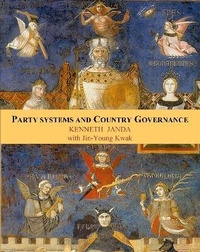
Party Systems and Country Governance
1st Edition
Published on 30. April 2011
Book
Hardback
256 pages
978-1-59451-932-1 (ISBN)
Description
Party Systems and Country Governance focuses on the variety of party systems across the world and their effects on country governance and the conceptualisation and measurement of country governance. International aid agencies have spent millions of dollars believing that the presence of stable party systems contributes to better country governance. This study largely supports the assumptions of the aid agencies. To measure governance, the authors used the existing World Bank Governance Indicators for 2007 on 212 countries. They collected parliamentary party data for 189 countries. The authors identified fifteen additional countries that did not hold elections for parliamentary parties and eight countries that held non-partisan elections, seating no deputies by party. Together these 212 countries account for virtually all the variations in party systems across the world.
Reviews / Votes
"Party Systems and Country Governance provides a sophisticated development of the concept ofcountry governance, a long-needed clarification of the meaning of the party system, and a systematic
investigation of the relationship between the two. Thanks to the incorporation, en passant, of a
friendly and entirely accessible introduction to the uses of theory and statistical analysis in political
science, the book is a delight to read. I enthusiastically recommend it to students and party scholars
at all levels. A masterful accomplishment."
-Kay Lawson, San Francisco State University
"An empirically nuanced and tightly reasoned analysis of the complicated relationship between
the vitality and contributions of political party systems to the quality, competence, and democratic
relevance of a country's governance. . . .All in all, quite an impressive intellectual achievement and,
given the nature of the problem addressed, a landmark study in the field."
-William Crotty, Northeastern University
"A rare book in that it provides both cutting-edge original research and an excellent primer in
quantitative analysis. It has great potential for teaching undergraduates about hypothesis formation
and testing, measurement issues, and statistics. And it delivers all this while shedding light on a
fundamentally important question about the about the quality of governance."
-Paul Webb, University of Sussex, UK
"Governance is discussed frequently, but it is analyzed in a rigorous and robust manner all too infrequently.
Kenneth Janda and Jin-Young Kwak have provided one of the more comprehensive and enlightening attempts to measure governance and to relate its success and failure to political factors. This short book is crucial reading for academics and for practitioners of the arts of governance."
-B. Guy Peters, University of Pittsburgh
"This in-depth study of the role played by party systems across the world in the quality of governmental
performance by nation-states fills a gap in existing knowledge of this important concern and makes significant contributions to the conceptualization and measurement of country governance. The book will no doubt become an important source and an essential reference point for
future studies."
-Anatoly Kulik, Russian Academy of Sciences
"Authors Janda and Kwak provide an examination of the inner workings of political party systems and country governance. The authors begin by defining the concept of country governance and how it is measured, and follow with discussions of environmental and party system effects on governance. The book contains numerous tables and graphs and extensive end-of-chapter notes." --Eithne O'Leyne, August 2011 Reference and Research Book News
More details
Language
English
Place of publication
New York
United States
Publishing group
Taylor & Francis Inc
Target group
College/higher education
Illustrations
Illustrations
Dimensions
Height: 229 mm
Width: 152 mm
Weight
453 gr
ISBN-13
978-1-59451-932-1 (9781594519321)
Copyright in bibliographic data and cover images is held by Nielsen Book Services Limited or by the publishers or by their respective licensors: all rights reserved.
Schweitzer Classification
Other editions
Additional editions
Kenneth Janda | Jin-Young Kwak
Party Systems and Country Governance
E-Book
11/2015
Routledge
€64.49
Available for download
Kenneth Janda | Jin-Young Kwak
Party Systems and Country Governance
E-Book
11/2015
Routledge
€64.49
Available for download
Kenneth Janda | Jin-Young Kwak
Party Systems and Country Governance
Book
08/2011
1st Edition
Routledge
€76.93
Shipment within 3-4 weeks
Persons
Kenneth Janda works in American government, political parties, elementary statistics, and computer methods. His books include Political Parties: A Cross-National Survey, Parties and Their Environments: Limits to Reform?, and the American government textbook, The Challenge of Democracy. He cofounded and coedits the international journal, Party Politics. In 2000, he won a "Lifetime Achievement" award from the American Political Science Association for his research on political parties. In 2005, he was a co-winner of the APSA Award for Best Instructional Software, and in 2009 he received the APSA's Frank J. Goodnow Award for service to the profession. Jin-Young Kwak is former chair and current professor in the Department of Political Science at Konkuk University in Seoul, South Korea. Her co-authored Korean books include Governance: Diffusion and Internalization, American Governance in the 21st Century, Understanding Contemporary Party Politics, and The Politics of Governance. She also publishes widely on electoral behavior, women's rights, and regional issues in Asia. She currently serves as Secretary General of the Korean Association of Party Studies.
Content
Part I The Nature of Country Governance; Chapter 1 Governance: From Quaint Term to Hot Topic; Chapter 2 Science and Art in Measuring Country Governance; Part II Environmental Effects on Country Governance; Chapter 3 Country Governance: Chicken or Egg?; Chapter 4 The Effects of Country Size; Chapter 5 The Effects of Country Wealth; Part III Party System Effects on Country Governance; Chapter 6 Party Systems Effects: The Theory, Jin-Young Kwak; Chapter 7 Party Systems: Data and Measures, Jin-Young Kwak; Chapter 8 Governance Without Party Systems; Chapter 9 The Effects of Competition; Chapter 10 The Effects of Aggregation; Chapter 11 The Effects of Aggregation; Chapter 12 Reviewing the Theory and Research;