

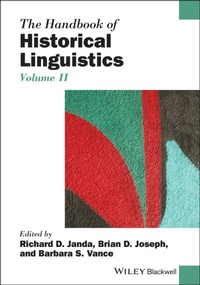
The Handbook of Historical Linguistics, Volume II
1st Edition
Published on 13. February 2025
Book
Paperback/Softback
704 pages
978-1-119-09654-2 (ISBN)
Description
"The first volume of the Handbook of Historical Linguistics is the best-worn handbook among many in my office and even though it's almost 20 years old, I still consult it often. Still, historical linguistics is a very different field today than it was in 2003 and this new volume fully reflects and engages with the state of the art. It's a completely new book, a worthy successor, and I look forward to wearing out this second volume."
Joseph Salmons, University of Wisconsin-Madison, USA
"This is an important resource for right now and far into the future. In its breadth and depth it has everything we could ask for and more, a comprehensive survey in 24 chapters written by the world's foremost scholars. It unites time-honored fundamentals of historical linguistics and progressive lines of ongoing research."
Lyle Campbell, University of Hawai'i at Manoa, USA
This brand-new, second volume of The Handbook of Historical Linguistics is a complement to the well-established first volume, initially published in 2003. It includes extended content allowing uniquely comprehensive coverage of the study of language(s) over time. Though it adds fresh perspectives on several topics previously treated in the first volume, this Handbook focuses on extensions of diachronic linguistics beyond those key issues.
This Handbook provides readers with studies of language change whose perspectives range from comparisons of large open vs. small closed corpora, via creolistics and linguistic contact in general, to obsolescence and endangerment of languages. Written by leading scholars in their respective fields, the chapters of this Handbook cover new topics such as the origin of language, the evidence from language for reconstructing human prehistory, the relevance of the study of present-day language for studying language in the past, and the benefits of linguistic fieldwork for historical investigation. Unique to this volume is a chapter that discusses in detail a large number of highly specific predictions as to the future of a widely spoken language-variety, thereby focusing long-term attention on thirty changes in the lexicon, phonology, morphology, and morphosyntax of North American English.
The Handbook of Historical Linguistics, Volume II, is an ideal book for undergraduate and graduate students in linguistics, researchers, and professional linguists, as well as all those interested in the history of particular languages and the history of language more generally.
Joseph Salmons, University of Wisconsin-Madison, USA
"This is an important resource for right now and far into the future. In its breadth and depth it has everything we could ask for and more, a comprehensive survey in 24 chapters written by the world's foremost scholars. It unites time-honored fundamentals of historical linguistics and progressive lines of ongoing research."
Lyle Campbell, University of Hawai'i at Manoa, USA
This brand-new, second volume of The Handbook of Historical Linguistics is a complement to the well-established first volume, initially published in 2003. It includes extended content allowing uniquely comprehensive coverage of the study of language(s) over time. Though it adds fresh perspectives on several topics previously treated in the first volume, this Handbook focuses on extensions of diachronic linguistics beyond those key issues.
This Handbook provides readers with studies of language change whose perspectives range from comparisons of large open vs. small closed corpora, via creolistics and linguistic contact in general, to obsolescence and endangerment of languages. Written by leading scholars in their respective fields, the chapters of this Handbook cover new topics such as the origin of language, the evidence from language for reconstructing human prehistory, the relevance of the study of present-day language for studying language in the past, and the benefits of linguistic fieldwork for historical investigation. Unique to this volume is a chapter that discusses in detail a large number of highly specific predictions as to the future of a widely spoken language-variety, thereby focusing long-term attention on thirty changes in the lexicon, phonology, morphology, and morphosyntax of North American English.
The Handbook of Historical Linguistics, Volume II, is an ideal book for undergraduate and graduate students in linguistics, researchers, and professional linguists, as well as all those interested in the history of particular languages and the history of language more generally.
More details
Series
Language
English
Place of publication
Hoboken
United Kingdom
Publishing group
John Wiley and Sons Ltd
Target group
Professional and scholarly
Product notice
Paperback (trade)
Unsewn / adhesive bound
Dimensions
Height: 254 mm
Width: 180 mm
Thickness: 43 mm
Weight
1021 gr
ISBN-13
978-1-119-09654-2 (9781119096542)
Copyright in bibliographic data and cover images is held by Nielsen Book Services Limited or by the publishers or by their respective licensors: all rights reserved.
Schweitzer Classification
Other editions
Additional editions
Richard D. Janda | Brian D. Joseph | Barbara S. Vance
The Handbook of Historical Linguistics, Volume II
Book
09/2020
1st Edition
Wiley
€188.50
Article not available at the moment
Richard D. Janda | Brian D. Joseph | Barbara S. Vance
The Handbook of Historical Linguistics, Volume II
E-Book
09/2020
1st Edition
Wiley
€44.99
Available for download
Richard D. Janda | Brian D. Joseph | Barbara S. Vance
The Handbook of Historical Linguistics, Volume II
E-Book
09/2020
1st Edition
Wiley
€44.99
Available for download
Persons
Richard D. Janda is currently Visiting Scholar in French and Italian at Indiana University Bloomington, USA, but his teaching spans eleven universities in nine US states. He is author or editor of over 75 publications, including The Handbook of Historical Linguistics (Wiley Blackwell, 2003).
Brian D. Joseph is Distinguished University Professor of Linguistics and The Kenneth E. Naylor Professor of South Slavic Linguistics at The Ohio State University, USA. He has written and edited numerous books and published some 300 articles. He served as editor of the journal Language from 2002 - 2009, and is currently co-editor of the Journal of Greek Linguistics.
Barbara S. Vance is Associate Professor of Linguistics and Associate Professor of French Linguistics at Indiana University Bloomington, USA. She is the author of Syntactic Change in Medieval French (1997) and is a specialist in the historical syntax of French and Occitan.
Brian D. Joseph is Distinguished University Professor of Linguistics and The Kenneth E. Naylor Professor of South Slavic Linguistics at The Ohio State University, USA. He has written and edited numerous books and published some 300 articles. He served as editor of the journal Language from 2002 - 2009, and is currently co-editor of the Journal of Greek Linguistics.
Barbara S. Vance is Associate Professor of Linguistics and Associate Professor of French Linguistics at Indiana University Bloomington, USA. She is the author of Syntactic Change in Medieval French (1997) and is a specialist in the historical syntax of French and Occitan.