

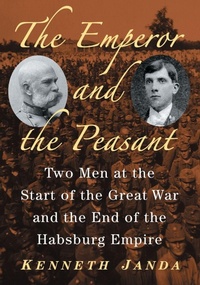
The Emperor and the Peasant
Two Men at the Start of the Great War and the End of the Habsburg Empire
Published on 11. January 2018
Book
Paperback/Softback
287 pages
978-1-4766-6957-1 (ISBN)
Description
There was more to World War I than the Western Front. This history juxtaposes the experiences of a monarch and a peasant on the Eastern Front. Franz Josef I, emperor of Austria-Hungary, was the first European leader to declare war in 1914 and was the first to commence firing. Samuel Mozolak was a Slovak laborer who sailed to New York--and fathered twins, taken as babies (and U.S. citizens) to his home village--before being drafted into the Austro-Hungarian army and killed in combat.
The author interprets the views of the war of Franz Josef and his contemporaries Kaiser Wilhelm II and Tsar Nicholas II. Mozolak's story depicts the life of a peasant in an army staffed by aristocrats, and also illustrates the pattern of East European immigration to America.
The author interprets the views of the war of Franz Josef and his contemporaries Kaiser Wilhelm II and Tsar Nicholas II. Mozolak's story depicts the life of a peasant in an army staffed by aristocrats, and also illustrates the pattern of East European immigration to America.
Reviews / Votes
"A compelling, highly readable World War I research narrative...thoughtful, well-researched...fascinating"-Polish American Journal; "An engaging book...well-written...makes for good reading and the general public will undoubtedly learn a lot from it about Slovak immigration to America, and the Habsburg Empire's decline and fall during the Great War. Janda is to be congratulated for this tribute to the Mozolak family"-Slovakia; "A unique, eye-opening approach...the author performs an outstanding round-up of the existing literature on the Habsburg Monarchy, from the old classics like Wickham Steed to the latest."-Geoffrey Wawro, A Mad Catastrophe: The Outbreak of World War I and the Collapse of the Habsburg Empire; "This wonderful book explores oft-neglected history and is enlivened by a family story that exemplifies the lives of many immigrants from Central Europe. Read it for vivid insight into a complex time still relevant today."-John Palka, author of My Slovakia, My Family; "A unique, engaging account of World War I as seen through the eyes of both the Austro-Hungarian emperor and one of his Slovakian peasants-a fascinating read combining geopolitics, class, ethnicity, and personal history."-Bernard Tamas, Valdosta State University.More details
Language
English
Place of publication
Jefferson, NC
United States
Target group
Professional and scholarly
Interest Age: From 18 years
Product notice
Paperback (trade)
Illustrations
66 photos, 14 maps, notes, bibliography, index
Dimensions
Height: 254 mm
Width: 178 mm
Thickness: 16 mm
Weight
547 gr
ISBN-13
978-1-4766-6957-1 (9781476669571)
Copyright in bibliographic data and cover images is held by Nielsen Book Services Limited or by the publishers or by their respective licensors: all rights reserved.
Schweitzer Classification
Person
Kenneth Janda, Payson S. Wild Professor Emeritus at Northwestern University, received the Frank J. Goodnow Award from the American Political Science Association in 2009. He has authored or edited several books on computer methods of data analysis, the cross-national study of political parties, and American government. He lives in Roseville, Minnesota.
Content
Table of Contents
Acknowledgments
Preface
Prologue: The Habsburg Empire and the Great War
?1.?The Emperor in Vienna
?2.?The Peasant in Krajne
?3.?The Emperor's Subjects
?4.?The Peasant's Voyage
?5.?Imperial Ignorance
?6.?Peasants in Passage
?7.?Imperial Deciders
?8.?Peasants Under Arms
?9.?Imperial Armies
10.?Peasants in Peril
11.?Imperial Irrelevance
12.?Peasants in War
13.?Imperial Losses
14.?Peasant Gains
Epilogue: Immigration and -Self-Determination
Chapter Notes
Bibliography
Index
Acknowledgments
Preface
Prologue: The Habsburg Empire and the Great War
?1.?The Emperor in Vienna
?2.?The Peasant in Krajne
?3.?The Emperor's Subjects
?4.?The Peasant's Voyage
?5.?Imperial Ignorance
?6.?Peasants in Passage
?7.?Imperial Deciders
?8.?Peasants Under Arms
?9.?Imperial Armies
10.?Peasants in Peril
11.?Imperial Irrelevance
12.?Peasants in War
13.?Imperial Losses
14.?Peasant Gains
Epilogue: Immigration and -Self-Determination
Chapter Notes
Bibliography
Index